Internet connectivity on the Annapurna Base Camp Trek has improved significantly. In June 2024, Nepal Telecom expanded its 4G LTE network to Machhapuchhre Base Camp (MBC) and Annapurna Base Camp (ABC), while also upgrading Deurali from 2G to 4G. Trekkers can now access mobile data at higher elevations than ever before, although network speed and reliability still depend on weather, terrain, and the number of users connected.
This guide covers everything you need to know before your ABC trek: which network to use, where coverage stops, whether an eSIM makes sense, what teahouse Wi-Fi is really like, how much charging costs, and what to do once you’re fully offline.
Table of Contents
Is there Internet on the Annapurna Base Camp Trek?
Yes, there is internet on the Annapurna Base Camp trek through a combination of mobile data (NTC and Ncell) and paid teahouse Wi-Fi. The lower half of the route, from Pokhara to roughly Chhomrong (2,170 m), offers fairly reliable connectivity. Above Chhomrong, signal weakens sharply. At Machhapuchhre Base Camp (MBC) and Annapurna Base Camp (ABC) itself, connectivity is sparse, unreliable, and expensive where it exists at all.
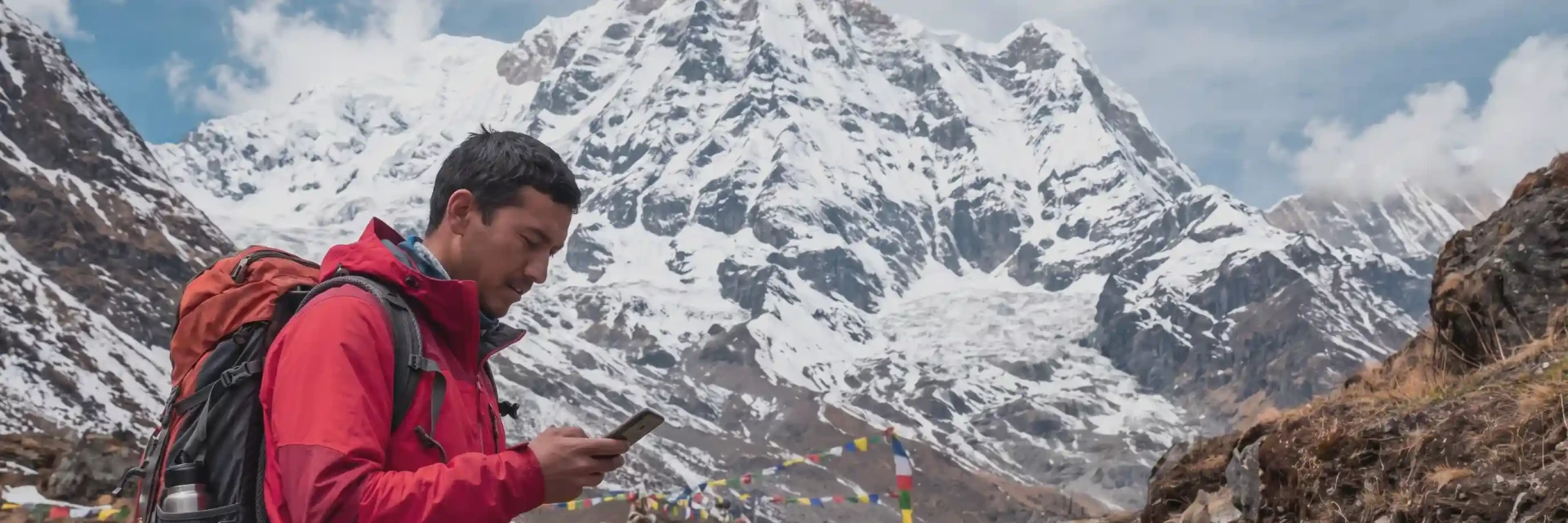
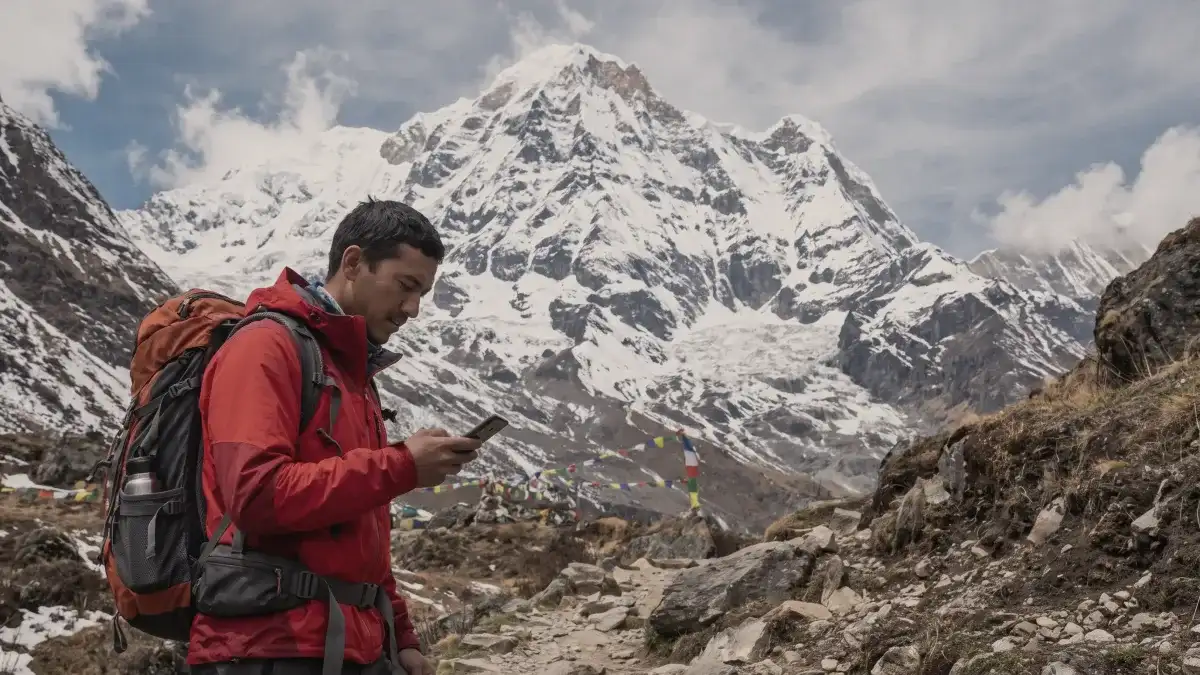
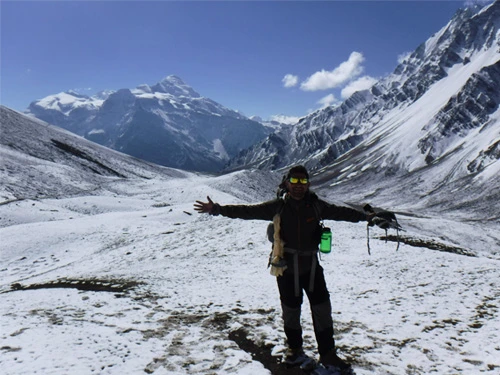
Trekker using mobile phone near Annapurna Base Camp
Quick facts at a glance:
Quick facts about internet on Annapurna Base Camp
Factor
What to expect
Best network for ABC trek
NTC (Nepal Telecom) is more reliable at altitude
SIM vs eSIM
Both work; eSIM is more convenient pre-arrival
Typical teahouse Wi-Fi cost
NPR 200-600+ per session (rises with altitude)
Device charging cost
NPR 100-300 lower down; NPR 200-500 higher up
Internet at ABC (4,130 m)
NTC 4G signal possible but weather might affect the signal
Starlink at teahouses
Not legally approved in Nepal as of 2026
Connectivity at a Glance: Coverage by Stop
The table below gives you an honest stop-by-stop picture. Altitudes are approximate. Coverage reflects typical conditions: bad weather, terrain, and congestion can affect real-world experience, especially outside the main trekking seasons.
Connectivity coverage at different stop in ABC trek
Stop
Altitude
NTC
Ncell
Teahouse
Wi-Fi
Pokhara
822 m
Strong 4G
Strong 4G
Free at most hotels
Nayapul/Birethanti
1,070 m
Good
Good
Available
Ghorepani/Tadapani
2,860 m
Good
Good
Available
Chhomrong
2,170 m
Good
Fair
Available (paid)
Sinuwa/Bamboo/Dovan
2,310-2,600 m
Moderate
Weak
Limited, expensive
Deurali
3,230 m
4G Availabe (upgraded in 2024)
Weak
Limited, expensive
Machhapuchhre Base Camp (MBC)
3,700 m
4G Available
LImited
Available
Annapurna Base Camp (ABC)
4,130 m
4G Available
LImited
Available
Note: coverage here depends on line-of-sight to a tower, not raw altitude. Open ridge stops like Ghorepani (2,860 m) hold a signal despite being high, while the steep-walled gorge from Chhomrong up to ABC loses it, which is why signal "drops" past Chhomrong even though some stops beyond it sit at similar elevation.
Mobile Network Coverage on the ABC Trek
Nepal Telecom (NTC) Coverage on the ABC Trek
NTC is the state-owned provider and the stronger choice for the Annapurna Base Camp route. Its infrastructure extends deeper into remote areas than Ncell’s, and it consistently holds a signal higher up the trail. In villages like Sinuwa, and Bamboo (where Ncell has largely dropped out), NTC still provides intermittent coverage.
Since June 2024, Nepal Telecom has expanded its 4G LTE network to Machhapuchhre Base Camp (3,700 m), Annapurna Base Camp (4,130 m) and upgraded the 2G network to 4G network in Deurali.
This means trekkers can now use mobile data even at Annapurna Base Camp. However, signal strength can still fluctuate due to mountain terrain, snowfall, heavy rain, power outages, and network congestion during trekking seasons
Ncell Network on the ABC Trek
Ncell is Nepal’s largest private telecom operator and offers faster 4G speeds in cities and lower-altitude areas. In Pokhara, Nayapul, and Ghorepani it performs well, sometimes better than NTC for data speed. However, Ncell’s coverage fades noticeably above Chhomrong and is largely absent in the upper sections of the trail. Ncell generally does not work at ABC.
If you are spending time in Pokhara before or after the trek, Ncell’s speed makes it useful there. Many trekkers carry both SIMs for this reason.
Can I Get a Signal at Annapurna Base Camp?
Sometimes, yes, but you cannot count on it. A faint NTC signal is possible at ABC (4,130 m) depending on atmospheric conditions and which part of the camp you are standing in. On clear days, some trekkers report being able to send a WhatsApp message or a low-resolution photo. On cloudy or stormy days, there is nothing. Ncell does not work at ABC. Do not plan any important communications (family check-ins, work messages) for ABC. Handle all of that from Chhomrong or below.
Signal at Deurali and Machhapuchhre Base Camp
Deurali (3,230 m) sits in a valley and has intermittent NTC coverage. Ncell is largely absent here. You may be able to send a text or a WhatsApp message, but do not expect to load a webpage or make a video call. MBC (3,700 m) is even more marginal, NTC signal is very weak, and most trekkers report no usable data. Some teahouses at MBC have satellite-based landline phones for emergency use.
Best SIM Card for the Annapurna Base Camp Trek
NTC vs Ncell: Which to Buy for ABC?
For the ABC trek specifically, NTC is the better primary SIM because of its superior high-altitude coverage. Ncell is faster and more convenient in cities and on the lower trail. Many experienced trekkers carry both: NTC as the primary trekking SIM and Ncell as a backup for speed in Pokhara and Nayapul.
If you want to buy only one SIM, then NTC is recommended by experienced guides and trekkers.
Where and How to Buy a SIM
You can buy both NTC and Ncell SIMs at the following locations:
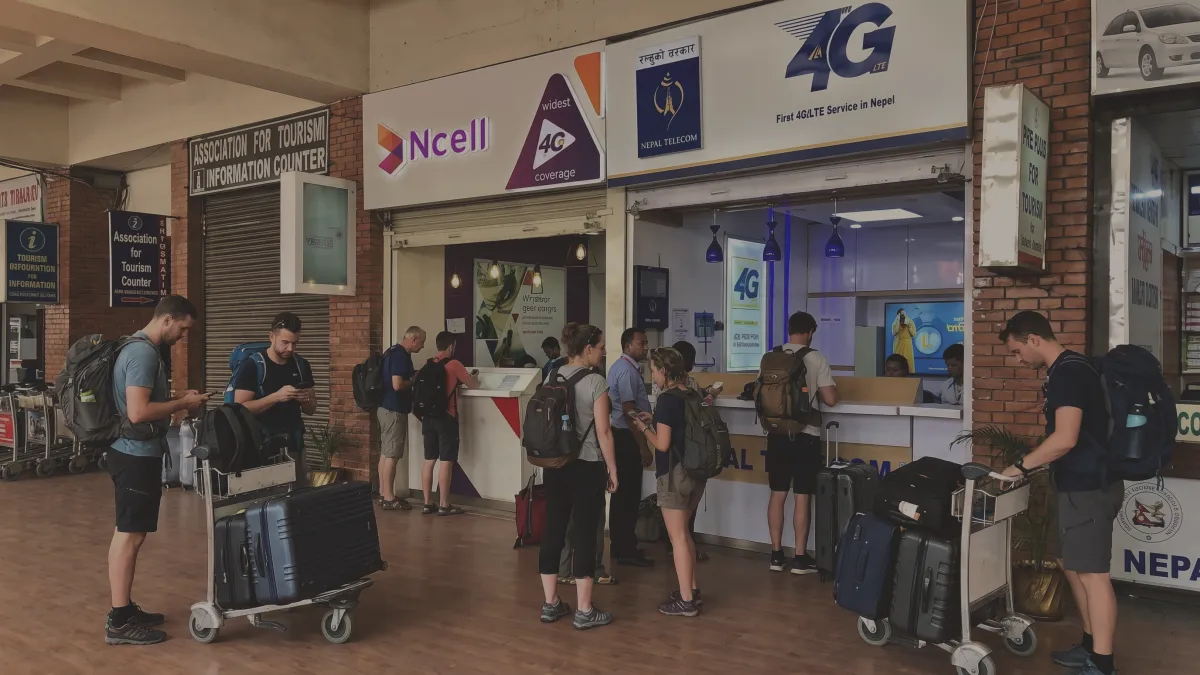
Tribhuvan International Airport (TIA), Kathmandu: Both providers have dedicated counters in the arrivals hall, staffed by English-speaking agents. This is the most convenient option and gets you online within 15-20 minutes of landing. Airport packages may be slightly pricier than in-city stores, but the convenience is worth it for most trekkers.
NTC and Ncell counter at Tribhuvan International Airport (TIA)
Pokhara city (Lakeside area): Multiple authorized retailers in the Lakeside area sell both NTC and Ncell SIMs. This is a good option if you are heading directly to Pokhara after landing, which many trekkers do.
Thamel, Kathmandu: Packed with mobile shops; staff are used to registering tourist SIMs.
Documents required for SIM registration:
Original passport (photocopies are usually not accepted)
One passport-sized photograph
Nepal visa or entry stamp
Registration is mandatory under Nepal’s telecom laws and typically takes 10-20 minutes. Activate your SIM before leaving for the mountains.
Data Packs and How Much Data You Need
For a 7-12 day ABC trek, most trekkers need somewhere between 5 GB and 15 GB of mobile data, depending on usage. You will consume data primarily on the lower sections; above Chhomrong your phone will barely connect.
NTC data pack pricing (as of April 2026, verify before travel):
1 GB – NPR 29 (1-day validity)
5 GB – NPR 109 (7-day validity)
20 GB – NPR 399 (30-day validity)
100 GB – NPR 999 (30-day Validity)
Ncell tourist pack pricing:
7 GB + local minutes – NPR 599 (7-day validity)
Unlimited data – NPR 1,299 (30-day validity)
For most ABC trekkers, NTC’s 20 GB / NPR 399 pack (~USD $2.66) covers 30 days and is excellent value. Buy a data pack immediately after activating your SIM.
Should You Carry Both SIMs?
For the ABC route, it is worth carrying both if your phone has a dual SIM slot. Use Ncell for faster data in Pokhara and on the lower trail, then switch to NTC above Chhomrong. If your phone is single SIM and you have an eSIM slot, the ideal combination is an NTC physical SIM plus an Ncell eSIM (or vice versa).
eSIM for Nepal Trekking
eSIMs are increasingly relevant for 2026 trekkers, yet most guides don't cover them.
Can Trekkers Use eSIMs in Nepal?
Yes. Both NTC and Ncell now offer eSIM services to international trekkers. NTC launched its eSIM platform in September 2022 and introduced online activation via its app and website in 2025. Ncell offers trekkers eSIMs both at the airport counter and through its online tourist eSIM platform. Foreign visitors can purchase eSIMs from both providers at the TIA arrivals hall in Kathmandu.
Additionally, a wide range of international travel eSIM providers, including Airalo, Holafly, Nomad, and Saily, sell Nepal eSIM plans that roam on local NTC or Ncell towers.
Local eSIM vs International Travel eSIM
This is the most important thing to understand about eSIMs for Nepal trekking: a travel eSIM from an international provider still uses NTC or Ncell towers. The physical coverage is identical to buying a local SIM. The difference is purely in convenience and setup. You activate the eSIM from your phone before you land, skip the airport queue, and have data the moment you step off the plane.
International travel eSIMs tend to cost more per GB than local SIMs, and they may not always include a local Nepal phone number. For most trekkers, the extra cost is worth the convenience of not fumbling with a physical SIM at the airport after a long flight.
If you want the best of both worlds (local pricing and eSIM convenience), buy an NTC or Ncell eSIM at the airport counter.
Does Your Phone Support eSIM? How to Check Before You Arrive
Check your phone's settings (Settings → General → About → look for an IMEI2 or eSIM entry on iPhone; Settings → Connections → SIM Card Manager on Samsung). Most phones released after 2020 support eSIM, but some budget Android models and phones bought in China do not.
If buying an international travel eSIM, install it before you travel because most require a data connection to activate, which can be tricky mid-journey. If buying a local NTC or Ncell eSIM, the airport counter staff will handle the setup.
eSIM vs Physical SIM on the Trail: Which Actually Makes More Sense?
Here is the honest answer: on the trail itself, there is no difference. An eSIM riding NTC towers and a physical NTC SIM card give you identical coverage, identical speeds, and identical frustration when the signal disappears above Deurali. The towers do not care whether your profile is embedded in your phone or sitting in a tiny plastic card.
Where the two options diverge is everything around the trek - the logistics, the cost, and what happens if things go wrong.
The case for eSIM is mostly about convenience before you arrive. You can activate an international travel eSIM from your sofa, land in Kathmandu with data already working, skip the airport SIM queue entirely, and be navigating to your hotel before most other passengers have cleared the counter. If your phone has a dual SIM slot, you can also keep your home SIM active for calls and run the Nepal eSIM for data simultaneously, which is useful if your bank or family needs to reach you on your regular number.
The case for a physical SIM is mostly about cost and flexibility on the ground. A local NTC SIM with a 20 GB data pack costs roughly NPR 500 in total which is around USD $3.33. Most international travel eSIMs charge USD $9-$27 for the same or less data. The physical SIM also gives you a local Nepal number, which matters for WhatsApp verification, calling local guesthouses, and reaching your guide agency. And if you are in Pokhara for a few days before the trek, you can easily top up a physical SIM at any corner shop; topping up an international eSIM often requires a credit card and an app.
The one scenario where a physical SIM has a real disadvantage is if you lose your phone or it gets damaged mid-trek. An eSIM profile can be re-downloaded on a replacement device; a physical SIM card left inside a lost or soaked handset is gone with it.
For most first-time ABC trekkers, the practical sweet spot is a local NTC physical SIM as your primary trekking connection, with an international travel eSIM as either a convenient pre-arrival option or a secondary data layer if your phone supports dual connectivity. Carrying both a local NTC SIM and an Ncell eSIM (one for altitude coverage, one for city speed) is the setup several long-term Nepal trekkers swear by, and it costs very little extra.
Wi-Fi in ABC Teahouses
How Teahouse Wi-Fi Works
Wi-Fi in teahouses is typically delivered through a combination of cellular backhaul, microwave links, or satellite connections depending on location. When the sun has been shining and the teahouse is not overloaded with guests, it works. When it is cloudy, there is a power outage (which happens regularly in bad weather), or twenty trekkers are all trying to video-call home simultaneously at 7 PM, it does not.
Wi-Fi is most reliable at lower-altitude teahouses (Birethanti, Ghorepani, Chhomrong) and least reliable at Deurali, MBC, and ABC. The higher you go, the more expensive the signal gets and the less reliable it becomes. Plan your important online tasks for the evening stops below Chhomrong.
Wi-Fi Cost on the ABC Trek
Wi-Fi is not typically included in room rates. Most teahouses sell a code or session pass separately.
Section of trail
Typical Wi-Fi cost
Lower trail (Birethanti to Ghorepani)
NPR 200-300 per session
Mid-trail (Chhomrong to Sinuwa)
NPR 300-500 per session
Upper trail (Deurali to ABC)
NPR 400-600+ per session; unreliable
Wi-Fi Speed and What You Can Actually Do
Teahouse Wi-Fi is shared between all guests and runs over a slow satellite or radio link. In most cases, you can:
Send and receive WhatsApp or Viber messages
Make short voice calls on WhatsApp (lower stops, off-peak hours)
Upload a compressed photo (may take a few minutes)
But you cannot:
Make a video call (too slow and shared)
Stream music or video
Upload a large file
Evening hours (roughly 7-9 PM) are peak usage time when everyone tries to connect at once. If you need to do anything more than messaging, try connecting earlier in the afternoon when you arrive.
Charging and Electricity on the ABC Trek
This is the practical detail most guides skip and on a long trek, it matters as much as the signal.
Where to Charge and What it Costs
Teahouses along the ABC route provide charging in the common dining area, not in the rooms. Power comes from a combination of the national grid (lower sections), micro-hydro, and solar panels (mid-to-upper sections). Because solar generation is weather-dependent, electricity is often available only in the evenings, typically between roughly 6 PM and 10 PM.
Charging Costs by section:
Section
Typical cost per device
Lower trail (Birethanti to Chhomrong)
NPR 100-200 per phone
Mid-trail (Sinuwa to Deurali)
NPR 200-300 per phone
Upper trail (MBC to ABC)
NPR 300-500 per device; not always available
Some teahouses include one charging slot for free if you eat all meals with them. At higher altitudes, charging is per device and often per hour. Bring your own cables because adapters and charging cables are not always provided.
Power Banks, Solar Chargers, and Battery Management
Carry a power bank. This is not optional on a trek where electricity windows are narrow and shared among many guests. A 10,000-20,000 mAh power bank will last you through the upper sections of the trail without needing a teahouse charge. Charge the power bank at every opportunity lower on the trail.
Solar chargers are useful in principle but unreliable in the Annapurna Sanctuary, which sits in a steep-sided amphitheater where direct sunlight is limited. They work better on open ridgeline sections like Ghorepani and Tadapani. If you bring one, treat it as a supplement, not a replacement for a power bank.
Battery management tips:
Put your phone in airplane mode when not in use on the upper trail. Searching for signal drains the battery fast
Reduce screen brightness and turn off background app refresh
Carry spare batteries for cameras: camera batteries drain faster in the cold
SIM, Data, Wi-Fi, and Charging Costs on the ABC Trek (2026)
Here is a consolidated cost table for planning purposes. All prices are approximate as of mid-2026.
SIM, Data, Wi-Fi, and Charging Costs on the ABC Trek
Item
Cost in NPR
Cost in USD (approx.)
NTC SIM card
NPR 100
~$0.67
Ncell SIM card
NPR 110
~$0.73
NTC 20 GB data pack (30 days)
NPR 399
~$2.66
Ncell 7 GB tourist pack (7 days)
NPR 599
~$3.99
International Travel eSIM (1-10 GB)
NPR 1350-4050
~$9-$27
Teahouse Wi-Fi, lower trail
NPR 200-300
~$1.33-$2
Teahouse Wi-Fi, upper trail
NPR 400-600+
~$2.67-$4
Device charging, lower trail
NPR 100-200
~$0.67-$1.33
Device charging, upper trail
NPR 200-500
~$1.33-$3.33
Based on an exchange rate around NPR 150 per USD at the time of writing. Prices may vary by teahouse and season.
For a 10-day trek with moderate connectivity use, budget roughly NPR 3,000–5,000 (USD 22–38) for data, Wi-Fi, and charging combined, not counting the SIM purchase. Because it is one of several hidden costs on the ABC trek worth planning for.
Staying Connected on the ABC Trek: A Practical Strategy
The Hybrid Approach
The most effective strategy for the ABC trek combines mobile data and teahouse Wi-Fi. Use your NTC SIM for maps, quick messages, and weather checks while on the trail during the day. In the evening, buy a Wi-Fi session at the teahouse for slightly more bandwidth-intensive tasks like photo uploads or a voice call home.
Above Deurali, skip teahouse Wi-Fi entirely because it is expensive and rarely delivers. Rely solely on your NTC SIM for quick messages, and accept that you will largely be offline.
Low-Bandwidth Tools
The ABC trek is a WhatsApp and Viber trek, not a social media or streaming trek. Set these up before you leave:
WhatsApp / Viber: The most data-efficient way to send messages, voice notes, and compressed photos.
Maps.me or Gaia GPS: Download offline trail maps for the entire Annapurna region before you leave Pokhara; these work without any data.
Weather apps: Download offline forecasts; Mountain Forecast covers ABC well
Entertainment: Download podcasts, audiobooks, Netflix content, and Spotify playlists before leaving; there is no streaming above Chhomrong.
Enable data saver mode on your phone to compress images and reduce background data use.
Pre-Trek Phone Checklist
Work through this in Pokhara the evening before you start the trek:
Phone fully charged
Power bank fully charged
NTC SIM activated and data pack loaded
Offline maps downloaded for the full ABC route
WhatsApp/Viber working
Weather app offline forecast downloaded
Entertainment downloaded (podcasts, music, shows)
Family/emergency contacts informed of your itinerary and expected dead zones above Chhomrong
Phone in a waterproof bag or case (sudden rain and river crossings happen)
Communication Options When There is No Signal
Satellite Phones and Starlink at ABC Teahouses
Some teahouses on the upper trail have satellite landline phones available for emergency calls. These are expensive on a per-minute basis but exist as a last resort.
On the question of Starlink: as of 2026, Starlink has not received regulatory approval for use in Nepal. Nepal Telecommunications Authority (NTA) has stated that unauthorized satellite internet services violate the Telecommunications Act. Several articles speculate about Starlink coming to Himalayan teahouses, but it is not legally operating in Nepal at the time of writing. Do not factor Starlink into your connectivity planning for the ABC trek.
Emergency Communication and Your Guide
Under Nepal’s mandatory guide policy, which applies fully to the ABC trek in 2026, all foreign trekkers must be accompanied by a licensed, government-registered guide. This is not just a regulatory formality. It is a genuine safety asset for connectivity in emergencies. Licensed guides carry agency contacts, know the locations of teahouse satellite phones, and have established relationships with helicopter rescue operators. In a genuine emergency above the signal line, your guide is your most important communication resource.
ABC vs Annapurna Circuit: Connectivity Compared
The Annapurna Circuit follows a longer, higher route that loops around the Annapurna massif. The connectivity pattern is broadly similar: good coverage in lower villages, fading above 3,000 m, and generally absent near Thorong La Pass (5,416 m). NTC holds coverage further up the Circuit than Ncell. Manang (3,519 m) has reasonable NTC coverage; above Manang toward the pass, signal is minimal.
On the descent side, Muktinath and Jomsom have coverage again. The Circuit also benefits from more established teahouse infrastructure overall, so Wi-Fi options are broader at lower stops. For connectivity purposes, the ABC trek is slightly more compromised at the top end due to the deep-valley terrain of the Annapurna Sanctuary.
Frequently Asked Questions about Internet on Annapurna Base Camp Trek
Q. Is there internet on the Annapurna Base Camp Trek?
Yes. Most villages along the Annapurna Base Camp Trek offer internet through mobile data or tea house Wi-Fi. Nepal Telecom's 4G network now reaches Deurali, Machhapuchhre Base Camp, and Annapurna Base Camp, although speeds vary with weather and network congestion.
Q. Is there 4G at Annapurna Base Camp?
Yes. Nepal Telecom expanded its 4G LTE network to Annapurna Base Camp in 2024. Trekkers can use mobile data for messaging, navigation, and checking weather updates, but connection quality depends on terrain, weather conditions, and the number of users.
Q. Can I use mobile data instead of teahouse Wi-fi at Annapurna Base Camp?
Yes. A Nepal Telecom SIM with an active data plan is usually enough for messaging, browsing, maps, and social media. However, tea house Wi-Fi is still a useful backup when mobile signals weaken or become congested during peak trekking seasons.
Q. Which SIM is best for the ABC Trek, NTC or Ncell?
Nepal Telecom (NTC) is the best SIM card for the Annapurna Base Camp Trek because it offers the widest coverage, including 4G at higher elevations. Ncell works well in lower villages but provides less reliable service near the base camp.
Q. Can tourists use eSIMs in Nepal?
Yes. Both NTC and Ncell now offer eSIM services at their airport counters and city stores. International travel eSIM providers like Airalo and Holafly also sell Nepal eSIMs that roam on local NTC or Ncell towers.
Q. Which eSIM is best for Annapurna?
There is no single answer, what matters is which network the eSIM runs on. An eSIM that uses NTC towers will perform like an NTC SIM on the trail (better at altitude). An eSIM on Ncell towers will be faster lower down but fade above Chhomrong. The physical coverage is identical to a local SIM; the difference is only convenience and pricing. Check which networks your international travel eSIM provider uses in Nepal before buying.
Q. Do I need an unlocked phone for a Nepal SIM or eSIM?
Yes. Your handset must be unlocked to accept a Nepali physical SIM. For an eSIM, the device must be unlocked and eSIM-compatible. Check both conditions before you travel.
Q. Can I make WhatsApp or Messenger calls during the trek?
Yes. WhatsApp, Messenger, and other internet-based calling apps work where Nepal Telecom 4G or stable Wi-Fi is available. Call quality is usually better during quieter hours when fewer trekkers are sharing the network.
Final Thoughts
The ABC trek rewards preparation, and connectivity is one area where a little planning before you leave Pokhara saves a lot of frustration on the trail. Buy the right SIM, load a data pack, download your offline maps, and charge everything the night before you start walking.
Staying connected on the Annapurna Base Camp Trek is easier than ever. With Nepal Telecom's 4G network now reaching Deurali, Machhapuchhre Base Camp, and Annapurna Base Camp, trekkers can enjoy better mobile internet alongside teahouse Wi-Fi. While weather and terrain can still affect connectivity, a Nepal Telecom SIM and a flexible approach will help you stay in touch, navigate confidently, and share your Himalayan adventure with family and friends.
Kishwor Adhikari is a passionate writer with a deep enthusiasm for trekking and adventure. His extensive travels across Nepal, exploring its diverse landscapes and hidden corners, have shaped his unique perspective on the country's natural beauty. With a wealth of first-hand experience in adventure trekking, Kishwor has become a trusted voice for fellow enthusiasts. Through his writing, he shares invaluable insights, offering practical advice and inspiration for both seasoned trekkers and novices alike. His dedication to sharing his journey and knowledge helps others discover the wonders of Nepal's wilderness, making his work an essential resource for anyone seeking adventure in the region.