Nar Phu Valley Trek - 10 Days

Tripadvisor165 reviews
google140 reviews
youtube99 reviews
trustpilot36 reviews
Kangla Pass
At a Glance
  • Duration10 Days
  • Difficulty Level Moderate
  • Max Altitude 5320m
  • Group Size 2 - 15 person
  • Start City Kathmandu
  • End City Kathmandu
  • Trip Type Private and Group Joining
  • Activity Trekking and Hiking
  • Best Season August - November and March - July
Trip Highlights
  • Thrilling Kang La Pass - 5320 meters
  • Ethnically Tibetan villages – with Tibetan Buddhist monuments
  • The exceptional diversity of landscapes – forests, canyons, rivers, waterfalls, desolate valleys, and snowy mountain peaks
  • ‘Off-the-beaten-path’ trekking – including the opportunity to stay with local people in the village.
  • Astonishing panorama views of Himalayan peaks
  • Unique, Historical, and Cultural Nar and Phu village
  • Night stay at Nar Phedi Monastery ( Satek Gomba) with Monks.
  • Breathe taking the view of Annapurna valley from Kang La Pass

Nar Phu Valley Trek takes us to an isolated valley that connects Nar and Phu in the Manang district. This ‘off-the-beaten-path in the Annapurna region takes the classic trade route between Nepal and Tibet. The culture of Nar Phu is very unique; its heritage and architecture make an unforgettable experience in the Tibetan Plateau region.

 This restricted area of Nepal needs a special trekking permit and a licensed guide. The Nar Phu village of the Annapurna region is more suitable for peace lovers, culture lovers, and adventurous souls. The stunning surrounding landscape and warm Nar and Phu climate are also a blessing.  After leaving Kathmandu for Besisahar, we first stop in the beautiful village of Dharapani. Above Odar, the stunning views of Mt.Manaslu, the Annapurna range, Lamjung Himal, Himalchuli, and many other Himalayas' oldest peaks fascinate us.

From Koto, we follow Nar Khola to the Meta village and then to the Nar Phu valley on the Mountain’s lap. These villages from the 5th century have ancient connected houses and buckwheat flowers. The night's stay in the Buddhist Monasteries, Satek Gumba, with the monks, is a true mountain experience. At 4,250m, Phu village is very peaceful and pure. Lastly, descending from the pass, we stop at Ngwal Village and then drive to Kathmandu. Ready for adventurous trekking in Nar Phu with Breeze Adventure?

Best time for Nar Phu Valley Trek

The best times to take the Nar Phu Valley Trek are during autumn (September-November), spring (March-May), and monsoon (June-August)! The only time that we do not recommend taking the Nar Phu Valley Trek is during the winter, as the weather is extremely cold and snow can prevent you from being able to cross the Kang La Pass. 

This trail is located behind the Annapurna and Manaslu Himalayan ranges. The landscape is quite similar to Tibet’s, so there is very little rainfall, even in the monsoon season. For this reason, the Nar Phu Valley Trek is a perfect one to do during the monsoon and offers very colorful scenery with rare Himalayan flowers. Overall, May to September is the best time for flower lovers! Also, during the monsoon season, people from the villages have more spare time. They’ve finished their work for the season and have more time to relax. So, this is the period when many people celebrate their marriage ceremonies and other special social festivals.

September offers a gorgeous view of the colorful flowers and the Himalayas with few clouds in the sky. The land is still beautifully dotted with colorful alpine flowers. October and November are the best months for clear skies, providing the best mountain views. March, April, and May also present crisp views of the Himalayas and have the best temperatures for hiking. This time is the warmest period in the Himalayas, so you can enjoy your time in the Himalayas without being uncomfortably cold. 

Nar Phu Valley Trek is possible to do in the winter (December-January) if you can enjoy the cold temperatures and aren’t afraid of trudging through the snow. If you would like to trek during the winter, we will provide the proper gear necessary for that.

10-Day Nar Phu Valley Trek Cost/Price - 2026 | 2027

The Nar Phu Valley Trek costs US$ 950–1,550 per person, depending on group size:

  • Solo trekker: US$ 1,550
  • 2 trekkers: US$ 1,050 per person
  • 3–5 trekkers: US$ 999 per person
  • 6–20 trekkers: US$ 950 per person

What your package price covers

Your package is fully inclusive of the essentials: private jeep transport from Besisahar to Koto and from Ngwal back to Besisahar, tourist bus between Kathmandu and Besisahar, three nights at Hotel Surya Heritage (or similar) in Kathmandu with breakfast, 9 nights' teahouse accommodation on trek, all meals during the trek, a licensed English-speaking guide, porter support, all restricted area and conservation permits, trekking gear, an emergency oxygen cylinder carried by your team, and a celebratory dinner in Kathmandu. Full inclusion and exclusion lists are below.

Optional upgrades and personal expenses

A few items are kept out of the standard package so you only pay for what you actually use:

  • Extra days in Nar or Phu village - approximately US$ 80 per person per day, including guide, accommodation, and meals
  • Hot showers and device charging at higher-altitude teahouses - typically NPR 200–500, paid directly to the lodge
  • Bottled drinks, snacks, beer, and alcoholic beverages during the trek
  • Tips for your guide and porter
  • Travel insurance with helicopter evacuation cover - required, arranged in your home country
  • International flights and Nepal visa fees

No hidden costs. Every charge is disclosed upfront. You'll never be surprised by a fee at the end of your trek.

How difficult is the Nar Phu Valley Trek?

Short answer: Not very difficult. This trip is not difficult at all if you have basic walking habits. It is just a long hike on a mid-altitude Himalayan trail. Every day we walk about 10-15 kilometers, and some days up to 20 kilometers. The trekking trail is well-maintained by the locals so it is safe to walk on. The trip to the two villages (Nar and Phu) is so beautiful.

The journey from Koto to Meta is a long way but is doable. The path to Phu is also a long one, but by the time you reach that day, your body will be used to it. The acclimatization day in Phu, with the hike up to Phu Viewpoint, physically and mentally prepares you for the rest of the trek. The whole trek (minus a small section after the Kangla Pass) is on a well-maintained, human-made trail that is accessible to anyone with a moderate trekking experience. It is recommended to have some prior trekking experience, but otherwise, the trail is not too difficult.

Nar Phu Valley Trekking Permit cost

Nar Phu Valley is considered a restricted area. Trekkers need a TIMS (Trekkers’ Information Management Systems) card, an ACAP (Annapurna Conservation Area Permit), as well as a special trekking permit from the Nepal government. This permit can only be acquired from registered trekking companies in Nepal. Therefore, to do the Nar Phu Valley Trek, you must have both permits.

Strangely enough, the cost of the restricted area permit depends on when you would like to trek. So, from September to November, the cost is $100 per week, and from December to August, the cost is $80 per week. The Annapurna Conservation Area Permit is $30, and the TIMS card is $10. You should plan to spend around USD 280 for two people but believe us that the cost of the permits is small compared to the joy that the Nar Phu Valley Trek will bring you.

There are several tourist checkpoints on this trek. One is at the beginning of the trip to Besishar, one in Manang, and one at the ending point of the  Manaslu Circuit trail in Dharapani. Before we enter Nar Phu Valley we need to show our permit in Koto at the tourist checkpoint. There is also one permit check post in Meta, which will soon be shifting to Kyang village, as the main administrative office is in this village.

Where Are the Permit Checkpoints?

There are multiple checkpoints along the Nar Phu Valley Trek:

  • Besishar Checkpoint – Permit registration before entering ACAP
  • Koto Checkpost (Mandatory Entry Point) – Main gateway into Nar Phu Valley
  • Meta Checkpost – Soon moving to Kyang Village (local administration)
  • Manang Checkpoint – ACAP continuation
  • Dharapani Checkpost – Exit point meeting Manaslu/Annapurna trail

Our licensed guide will handle all permit presentation and coordination with police/ACAP officers.

Why Take the Nar Phu Valley Trek With Breeze Adventure?

Breeze Adventure has decades of combined experience guiding Himalayan treks and has led countless expeditions across the Nar & Phu Valley. Our team delivers high-quality trekking experiences with a focus on safety, authentic culture, and well-designed itineraries. What Makes Us Different?

  • Our guides have crossed Kang La Pass over 16 times
  • An emergency 1 tank of oxygen cylinder carried by your guide
  • We offer professional local guides with the latest trail knowledge
  • We have excellent trail reviews from clients
  • Provide a complete Nar Phu Valley trek video for preparation
  • Our itineraries balance acclimatization + comfort + adventure

Nar Phu is a rare Himalayan trek, and still, very few people know about these hidden villages. Our guides are local experts who understand the culture, weather patterns, and trail conditions around Nar, Phu, and Kang La Pass.

We trek peacefully, slowly, and responsibly, making your journey safe, successful, and truly unforgettable. If you want a remote, cultural, and authentic Himalayan experience, the Nar Phu Valley Trek with Breeze Adventure is a perfect choice.

Optional Itinerary for the Nar Phu Valley Trek

The Nar Phu Valley Trek lies in the heart of the Annapurna region, offering access to several interconnected and optional routes. With just a few additional days, you can enjoy an excellent combination of the Nar Phu Valley Trek, sections of the Annapurna Circuit, and the stunning Tilicho Lake Trek. This combined itinerary provides a rich blend of cultural immersion, remote valley exploration, and high-altitude alpine scenery.

Please review the optional outline itinerary below, and feel free to contact our trekking operator for detailed information, customized plans, and expert guidance for your Nar Phu Valley, Tilicho Lake, and Annapurna Circuit Trek.

Nar Phu Valley + Tilicho Lake Trek    ItineraryNar Phu Valley Trek + Annapurna Circuit Trek Itinerary

Day 01: Drive to Koto

Day 02: Trek to Meta Village

Day 03: Trek to Phu Village

Day 04: Exploration day at Phu Village

Day 5: Trek to Nar Phedi

Day 06: Trek to Nar Village

Day 07: Cross Kang La Pass and Trek to Ngwal Village

Day 8: Trek to Manang

Day 9: Trek to Tilicho Base Camp

Day 10: Hike to Tilicho Lake and trek back to Khangsar

Day 11: Drive to Besishar

Day 12: Drive to Kathmandu

Day 01: Drive to Koto

Day 02: Trek to Meta Village

Day 03: Trek to Phu Village

Day 04: Exploration day at Phu Village

Day 5: Trek to Nar Phedi

Day 06: Trek to Nar Village

Day 07: Cross Kang La Pass and Trek to Ngwal Village

Day 8: Trek to Manang

Day 09: Trek to Yak Kharka

Day 10: Trek to Thorang Phedi

Day 11: Cross Thorang La Pass Trek to Muktinath

Day 12: Drive to Pokhara and Fly to Kathmandu


Itinerary

Expand allCollapse all

We leave Kathmandu early and head west along the Prithvi Highway, following the Trishuli River as the road weaves through terraced hillsides and roadside villages. After about five hours, we reach Besisahar, the gateway to the Annapurna region, where we stop for lunch. From here, we transfer to a private jeep for the more rugged stretch ahead.

The road from Besisahar to Koto is bumpy but spectacular, waterfalls drop down the cliffs at Ghermu and Chamje, the Marsyangdi River roars below, and Mount Manaslu starts to appear behind the ridges. We pass Dharapani, Bagarchhap, and Timang before arriving in Koto by late afternoon. Koto is where the Nar Phu trail branches off from the classic Annapurna Circuit. The quiet village will be our base for the night.

  • Max Altitude: 2600m
  • Accommodation: Guest House
  • Time: 10 Hours
  • Meals: BLD
  • Walking Distance: 240 km | 149.129miles
  • Transport: Bus & Jeep

After breakfast, we walk over to the police checkpost to register our restricted-area permits — this is the official gateway into the Nar Phu Valley, and only a handful of trekkers pass through here each day. Once we're cleared, we cross a suspension bridge over the Marsyangdi and follow the Nar Khola upstream into the valley.

The trail today is the longest of the trek, but the scenery makes it pass quickly. We walk through pine and bamboo forests beside the river, crossing a few smaller streams and suspension bridges. The sound of running water stays with us for most of the morning. After about five hours, we reach Dharmasala, a small rest stop where we have lunch.

From Dharamsala, the trail climbs steeply for the last stretch up to Meta. The landscape begins to change here, the forests thin out, the slopes turn dry and ochre-coloured, and suddenly we're standing on what feels like a different country. Meta is our first taste of the Tibetan plateau: stone houses, prayer flags, and yaks grazing on the high pastures.

  • Max Altitude: 3550m
  • Accommodation: Guest House
  • Time: 7-8 Hours
  • Meals: BLD
  • Walking Distance: 22 km | 13.6 Miles

This is the day we built into the itinerary so you can actually breathe and look around. The walk from Meta to Kyang is shorter, around four to five hours. Which means we move slowly, take photos, and let our bodies adjust to the altitude.

The trail follows the valley with gentle ups and downs, crossing a few streams and offering wider views of Pisang Peak and the surrounding ridges. We pass the abandoned Khampa settlement of Chyaku — the ruined stone fortifications here date back to when Tibetan refugees from the 1950s and 60s lived in this valley. Your guide will share the story.

Kyang itself is a small seasonal village with a handful of teahouses. We arrive in time for a relaxed lunch, then spend the afternoon exploring the area, sitting outside with locals, or simply doing nothing — which, at 3,820m on the edge of a remote valley, is its own kind of experience. This slower pace also helps your body acclimatize properly before we go higher tomorrow.

  • Max Altitude: 3820m
  • Accommodation: Guest House
  • Time: 4 Hours
  • Meals: BLD
  • Walking Distance: 10 km | 6.2 Miles

A shorter, more enjoyable walk today, somewhere between three and four hours. Leading us into the heart of the hidden Phu Valley. The trail winds along the Phu Khola, crossing suspension bridges and passing rocky outcrops where, if we're lucky, we'll spot Blue Sheep grazing on the cliffs.

The approach to Phu is one of the most dramatic moments of the trek. The valley narrows, then opens, and suddenly Phu village appears perched on a hillside, decorated with prayer flags and chortens, with a monastery crowning the top. You climb a final steep section up to the Phu gate, an old stone entrance carved with mantras, and you've arrived.

Phu is a settlement of around 30 houses that has been here since at least the 5th century. The villagers still live by subsistence farming, yak herding, and seasonal migration — much as their ancestors did. We arrive in time for lunch, then spend the afternoon walking through the village and visiting Tashi Lakhang Monastery, said to be one of the 108 great Buddhist monasteries of the world and the last monastery built by Karmapa Rinpoche. From the monastery, there's a beautiful view of Himlung Himal (7,126m) glowing in the afternoon light.

  • Max Altitude: 4080m
  • Accommodation: Guest House
  • Time: 3-4 Hours
  • Meals: BLD
  • Walking Distance: 9 km | 5.6 Miles

A built-in acclimatization day in one of the most remarkable villages in Nepal. You'll have two options today, depending on how you're feeling.

Option 1 Phu Viewpoint: A three-hour round-trip hike to the ridge above the village. The viewpoint sits directly above Phu and gives you a sweeping perspective of the entire valley — the village rooftops below, the river winding through, and the snow peaks circling the horizon. The light up here in the late afternoon is unforgettable.

Option 2 Himlung Himal Base Camp: A longer hike, about three hours up and two hours back, leading to the base camp used by expeditions climbing Himlung Himal. The reward is a close-up view of the glacier and the south face of Himlung. If you're feeling strong and have some climbing curiosity, this is the better choice.

After the hike, we return to Phu for a late lunch, then spend the rest of the afternoon however we like — wandering the old part of the village, visiting Tashi Lakhang again, sitting with local families, or just lying in the sun. This is what the trek is really about.

  • Max Altitude: 4080m
  • Accommodation: Guset House
  • Time: 3 | 6 Hours
  • Meals: BLD
  • Walking Distance: 5 | 9 Km

We retrace part of yesterday's trail back down towards Kyang, then take a different route along the river. The walk follows the Phu Khola through narrow canyons, crossing several streams and suspension bridges. After about five hours, we reach Mahendra Pul — a high suspension bridge strung 80 metres above the Lapche River gorge. Crossing it is one of the more vertiginous moments of the trek, but the view straight down into the river canyon is worth a moment of nerves.

From Mahendra Pul, it's another 30 minutes uphill to Satek Gomba (Nar Phedi), a working Buddhist monastery tucked into the mountainside. This is where we spend the night — not in a teahouse, but in the monastery's guest quarters, with the monks. The accommodation is simple but warm, and the evening meal is shared with the monastic community. After dinner, you can listen to the monks chanting their evening prayers, or just sit outside and watch the stars come out over the gorge. It's one of the most memorable nights of the entire trek.

  • Max Altitude: 3440m
  • Accommodation: Monastery Guest House
  • Time: 6 Hours
  • Meals: BLD
  • Walking Distance: 19 km | 11.8 Miles

We wake up early to the smell of juniper smoke. The monks burn juniper branches every morning as part of their daily ritual. After visiting the main shrine and, if you'd like, joining the 20-minute morning Puja ceremony, we have breakfast with the monks and pack up.

The trail today climbs steadily uphill through a row of chortens for the first two hours. After that, it levels off and becomes one of the most beautiful stretches of the whole trek. The high traverse with the Annapurna range filling the southern horizon and the Phu Valley opening out below us. Three and a half hours of walking brings us to Nar Village, a stone-walled medieval-looking settlement perched on a sunny plateau.

Nar is bigger than Phu, with four small monasteries and a lively local life. We have lunch and then spend the rest of the day exploring. Visiting the monasteries, walking the old village paths, and getting to know the people make you forget today's tiredness. Some of our guides have friends here from previous treks, and conversations over butter tea are a regular part of the afternoon.

  • Max Altitude: 4120m
  • Accommodation: Guest House
  • Time: 3 Hours
  • Meals: BLD
  • Walking Distance: 5 km | 3.1 Miles

The hardest and most rewarding day of the trek. We start before sunrise to take advantage of cool conditions and clear morning skies. A two-hour walk on a gradual incline brings us to Kang La Phedi (the base of the pass), where we stop for tea and a short rest.

From here, the trail climbs steeply for about two and a half hours up to Kang La Pass at 5,320 metres, the highest point of the trek. The final push is hard work at this altitude, but every step is worth it. From the top, the entire Annapurna range unfolds in front of you: Annapurna II, Annapurna III, Gangapurna, Tilicho Peak, Pisang Peak, and on a clear day, the white pyramid of Annapurna IV. We take photos, hang prayer flags if you've brought them, and soak it in.

The descent to Ngawal is steep for the first half hour, then easier. About three hours from the pass, we drop into Ngawal village, a charming settlement on the upper Annapurna Circuit trail. After the basic teahouses of Nar Phu, Ngawal feels almost luxurious, nicer rooms, attached bathrooms, hot showers if you want them, and a good kitchen. You've earned it.

  • Max Altitude: 5320m
  • Accommodation: Guest House
  • Time: 8 Hours
  • Meals: BLD
  • Walking Distance: 14 km | 8.7 Miles

After breakfast and one last view of the Annapurna range, we meet our private jeep in Ngawal and begin the long drive back down the Manang valley. The road follows the Marsyangdi River, passing through Pisang, Chame, Dharapani, and back through the villages we glimpsed on the way up.

We stop for lunch at the Chamje waterfall around midday. The road from here onwards is paved in sections and rough in others, but the changing landscape. From high alpine to subtropical lowland in a few hours is fascinating to watch. We arrive in Besisahar by late afternoon and check into a comfortable hotel. After eight days at altitude, the warm, thicker air at 760m feels like a holiday in itself.

  • Max Altitude: 3660m
  • Accommodation: Guest House
  • Time: 6 Hours
  • Meals: BLD
  • Transport: Jeep

A relaxed final morning. After breakfast, we drive back to Kathmandu along the Prithvi Highway, following the Marsyangdi and then the Trishuli rivers. The drive takes around six hours with a lunch stop, and you arrive in Kathmandu by late afternoon.

The rest of the day is yours. Rest at the hotel, walk in Thamel, pick up souvenirs, or get a well-deserved massage. In the evening, we'll meet for a celebratory dinner at one of our Cultural restaurants in Kathmandu to toast the completion of one of the most memorable treks in Nepal.

Heading to Pokhara next? If you're planning to spend time in Pokhara after the trek, mention it during booking; we can route you directly from Besisahar to Pokhara on Day 10 instead, which is a shorter and more scenic drive than going back to Kathmandu and back again.

  • Max Altitude: 1400m
  • Accommodation: 2/3 Star Hotel
  • Time: 6 Hours
  • Meals: Breakfast
  • Transport: Bus

Join us for an unforgettable 10-day Narphu Valley Trek, exploring hidden Tibetan-influenced villages, dramatic gorges, and high mountain passes. This off-the-beaten-path journey offers stunning views and authentic cultural experiences. If you'd like to extend your adventure to the Annapurna Circuit or spend extra days in Kathmandu, Breeze Adventure will gladly customize your itinerary to match your preferences. Let us craft the perfect Himalayan experience tailored just for you.

Updated 20 May 2026: We now drive directly from Kathmandu to Koto on Day 1 and have added an overnight stay at Kyang between Meta and Phu. The route remains the same classic trail, now with additional time for acclimatization and a more immersive experience in the valley.

Please note that the daily section of the route map has been updated accordingly. Kindly follow the detailed itinerary for the most accurate day-to-day schedule.

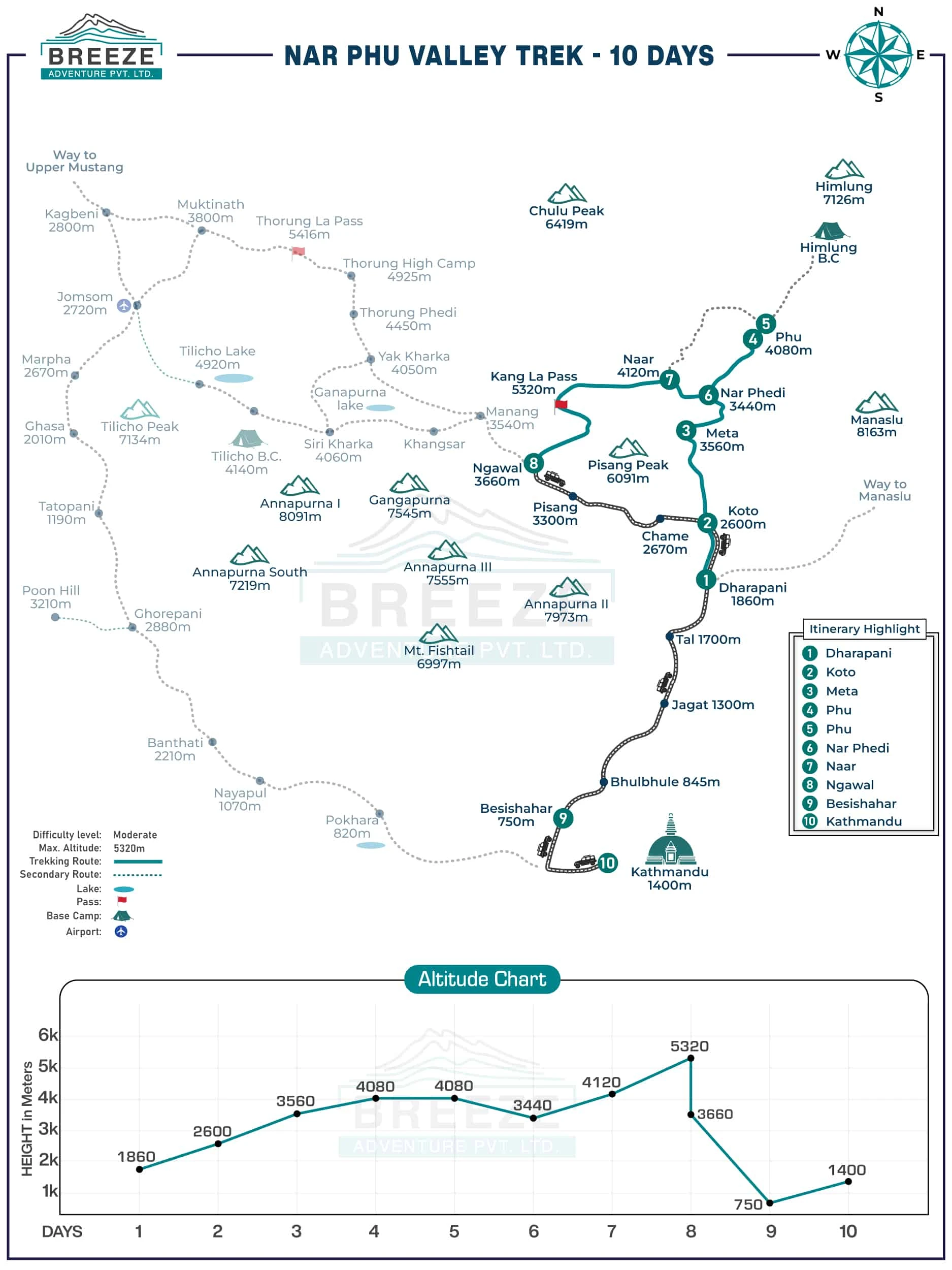
Route Map

Nar Phu Valley Trek - 10 Days map
Cost Details
What's Included
  • Airport transfers to and from Tribhuvan International Airport
  • Three nights' accommodation at hotel Surya Heritage or similar in Kathmandu with breakfast
  • Tourist bus from Kathmandu to Besisahar and return
  • Private jeep from Besisahar to Koto (start of trek)
  • Private jeep from Ngwal to Besisahar (end of trek)
  • 9 nights' teahouse accommodation in the mountains
  • Government-licensed, experienced trekking guide and porter
  • Salary, food, accommodation, and insurance for guide and porter
  • All meals during the trek (breakfast, lunch, and dinner)
  • Trekking equipment: sleeping bag, down jacket, trekking poles, and crampons
  • Duffel bag for porter to carry your gear
  • Comprehensive first-aid kit
  • Emergency oxygen cylinder carried by your guide
  • Trekking route map
  • All government taxes and service charges
  • Celebratory dinner in Kathmandu after the trek
What's Not Included
  • International flights and Nepal visa
  • Travel insurance (with helicopter evacuation cover) — required, arranged in your home country
  • unch and dinner in Kathmandu (only breakfast included at hotel)
  • Personal expenses: shopping, laundry, phone calls, Wi-Fi at teahouses
  • Hot showers and device charging at higher-altitude teahouses (paid directly to lodge)
  • Bottled drinks, alcoholic beverages, snacks, and tea/coffee outside meals
  • Tips for guide and porter (customary but not required)
  • Extra accommodation or meals outside the itinerary

Client's Experience

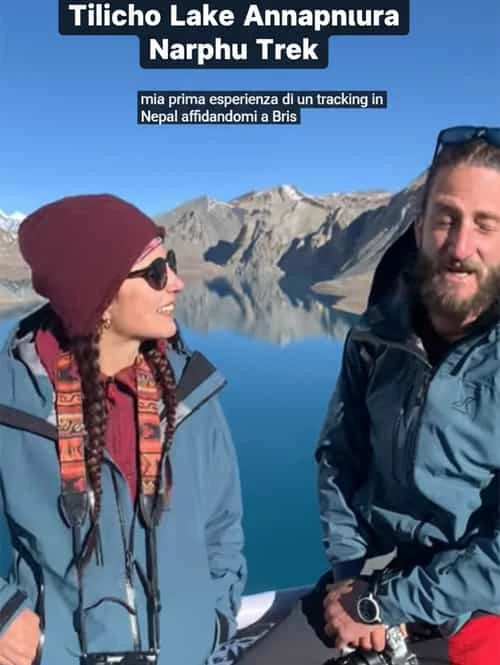
  • Narphu Valley Tilicho Trek Review
    Narphu Tilicho Annapurna Trek Review
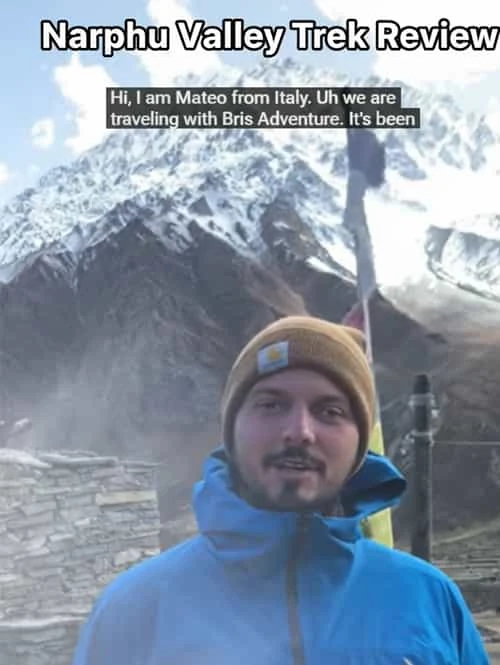
  • nar-phu-trek-review
    Nar Phu Trek Review
Dates & Price

We especially quoted and specified the below list of Nar Phu Valley Trek start dates for the group joining option. Please let us know if the below dates do not match your holiday plan. We will surely add your available days to fit your interest. However, we must have two people to organize this trek.

Essential Information

Safety Tips for the Nar Phu Valley Trek

Overall, the Nar Phu Valley trail is safe and secure. The biggest concern in terms of safety is altitude sickness, and even that risk is very low. Some parts of the trail are a bit narrow and you’ll have to pass local porters who carry heavy loads and can’t always see us, so it’s always best to stay in a safe place and let them pass ahead. Also, you will cross lots of donkeys and yaks on the trail. While you pass them, you must be on the inside, away from the corner/edge, especially if there is a steep drop-off. If you stay on the cliffside, the donkey might push you off, causing injury. When you see yaks on the trail, please don’t go too close for the picture, they have been known to attack people, so keep a safe distance

Accommodation on Nar Phu Valley Trek

Accommodation on the Nar Phu Valley Trek is improving year by year. You used to have to camp on this trail, but now there are guesthouses at each stop. Please don’t expect luxurious guesthouse accommodation, as all of them are very simple with beds and blankets in each room. In the High season, you might have to share a room with other trekkers. In Meta, there is a newly built guesthouse with basic services, and the same goes for Kyang and Phu. Most of the guesthouses have a common bathroom (on a sharing basis). The accommodation at Satek Gompa is a bit nicer, though the bathroom is still on a sharing basis. After you cross the Kangla Pass and walk down to Ngwal village, the accommodation will be a special reward. After the basic rooms in the Nar Phu Valley, Ngwal is a step up, with nicer rooms and an attached bathroom. In conclusion, if you are used to trekking or are willing to sacrifice a little bit of comfort for the beauty of the Himalayas, then you will not be disappointed. 

Food and Beverage on Nar Phu Valley Trek

The food on the Nar Phu Valley Trek is amazing! You will love the tasty vegetables, which are mostly grown locally. What you get may depend on the season. From May to October, you can enjoy local foods, such as Sherpa stew, dhindo, roti, Dal Bhat, etc. As winter approaches, the weather gets slightly colder and cloudier, so more of the vegetables are brought in from other villages (though still tasty). In each guesthouse, there are usually Western options as well, such as pizza, macaroni, fried noodles, pasta, etc. There are also candy bars, bottled soda, beer, etc. in every village. Most of the locals drink Tibetan tea, which is made of butter, salt, and wheat flour. You should try it at least once while you are there, but if that doesn’t tickle your fancy, you can also order black tea, green tea, milk tea, etc. Trying the local Himalayan dishes is always a memorable part of the trek. 

Trekking Trail on Nar Phu Valley Trek

The trekking trail is lengthy, but very safe and maintained all the way to Phu village these days. Just this year, the local community has built another trail along the way. Remember, while hiking try to remain on the inside of the trail because there are more loose stones on the edge. The path after the Kangla Pass is a bit steep down for about 30 minutes, but it is safe, especially if there is no snow. We recommend using hiking poles throughout the trek, just to help with balance and take some weight off your knees and ankles. 

Transportation on Nar Phu Valley Trek

The transportation to and from the Nar Phu Valley trailhead is by road. Normally, we take a Tourist bus ride to Besisahar and take a jeep to Chyamche or Dharapani as per your itinerary. The Nar Phu Valley cannot be accessed by road, but the Nepal government is planning to change that. They are currently building a road to Meta village. The main source of transportation from village to village for locals is by horse, donkey, or yak. After finishing the trip, we will take a jeep ride from Ngwal to Besisahar again. As previously mentioned, there is an airport in Humde village, but flights have not begun yet. 

is not connected by road. But soon it is going to be connected. People and the Nepal government are building the road to Meta village. The main transportation of the Nar Phu villagers is Horse, Donkey, and Yaks. After finishing the trip we take a jeep ride from Ngwal to Besishar again. There is an Airport at the Humde Village on the way however, there are not any flights yet. 

Acclimatization Days on Nar Phu Valley Trek

Acclimatization is the process of letting our body become friendly with the high altitude and low oxygen level. There are one and a half days of acclimatization built into our itinerary. If you have extra time and want to spend some extra time in Nar and Phu village, you can surely add another day or two to the trek. This will let you get closer to the locals and make the rest of the trail easier for your body. Although the trail leads high into the Himalayas, you will not be spending any nights over 4,000 meters, so one day in Phu village and a half-day in Nar village will be enough for you to acclimatize. 

Guides and Porters for Nar Phu Valley Trek

Our Guides and porters are very dedicated to their job and have a wonderful time in the Himalayas. For many, trekking in the Himalayas is their dream job, though they still take it seriously. The package cost includes food, beverage, and insurance for both the porter and guide. Our guides, with their years of experience trekking in the Himalayas, will make your trip successful. Also, we are very respectful of our porters. They earn a livable wage, while happily carrying your bags and enjoying the Himalayas. Our responsible and dedicated team will bring you success on your Nar Phu Valley Trek.

Note:

Please be assured that Breeze Adventure manages our treks to the highest standards. Your safety and satisfaction are our priority. We will support you to the best of our abilities with any issues that may arise. We will work with you to ensure you get the most from your Nar Phu Valley Trekking and visit Nepal. 

Nar Phu Valley Trek - 10 Days FAQs

  • Altitude sickness is very unlikely on the Nar Phu Valley Trek. You will not spend a night above 4000 meters. The highest point you reach is Kangla Pass (5320 meters/17,454 feet), but only a few moments are spent there, so you are not facing a high risk of altitude sickness. That being said, some are more sensitive to the variations in elevation than others. Our team is highly experienced in the case of high-altitude sickness and is properly trained to help you. At the onset of symptoms, our guides will take you to a lower elevation as quickly as possible. You should not worry, though, we have built-in acclimatization days to prevent altitude sickness from happening.

  • Before the road to Manang was built, there was a weekly flight from Humde to Pokhara. The flights stopped in 2011 because the total airport was not well constructed; it was just a normal gravel road. In 2011, the Nepal government started the renovation of the airport and built a nicer runway. However, now there are no flights because people opt for the cheaper option of driving to Manang village by Jeep, while the Nepal government is still pushing for airports in the more rural areas in the Himalayas.

  • Yes of course! If you have enough time and want to join the popularAnnapurna Circuit trail also known as the Apple Pie Trail in Nepal, we recommend you do so! You would have a great experience crossing two high passes: Kangla and Thorong La Pass. Also, if you have time and want to see the beautiful Tilicho Lake, we can arrange a Tilicho Lake day trip. The ultimate trek would combine both Tilicho Lake and Thorong La Pass with the underrated Nar Phu Valley Trek. After crossing the Kangla Pass, the trail joins the Annapurna Circuit. Visit Tilicho Lake and then Yak Kharka, where you prepare to traverse the Thorong La Pass (5400 meters). You’ll have a leg-up on other trekkers in terms of acclimatization, making the second high pass a walk in the park. So, why not get the best of both worlds? Combine the hidden gem of the Nar Phu Valley with the legendary Annapurna Circuit ( Apple Pie Trail in Nepal) and create the adventure of a lifetime!

  • We recommend having travel insurance before going on Nar Phu Valley trekking. We do our best to take care of you, but if something happens that is out of our control. In the case of os a medical emergency, leading to helicopter evacuation, it is best to have insurance. You are unable to obtain medical insurance in Nepal and must do so in your home country. Be sure that your insurance covers accidents aboard and high in the Mountains.

  • Yes! As of March 2026, Nepal's Department of Immigration now issues restricted-area permits for single trekkers, provided you travel with a government-licensed guide arranged through a registered agency like Breeze Adventure. The agency assumes full responsibility for emergency rescue. Until early 2026, the rule was a two-person minimum, so older articles online may still say solo trekking is not allowed, but the policy has officially changed.

  • It is located in the Annapurna Region of Nepal. Specifically, in Manang District, it lies north of the main Annapurna Range. Furthermore, it is a remote region in the Himalayas of Nepal and connected to Tibetan border.

  • Nar Phu Valley is a remote and high-altitude trek in Nepal. The villages of this place are normally at an altitude of 4150 meters. Similarly, the highest point you reach on this trek is the Kang La Pass at an altitude of 5320 meters above sea level.

  • This trek is considered moderately difficult, so anyone with some trekking experience can do it. Though it is not an easy trek, it is also not very challenging. You can make it happen with the right preparation and guidance.

  • The Nar Phu Valley trek is about 300 km from Kathmandu. You will reach there after a few days of driving. The paths are black topped roads about 70% and the rest are rugged, steep land. You will rest or acclimatize on the journey, so the exact distance between these places is uncertain.

  • Yes, you can be on this trek even as a beginner. However, the remote trails and high altitude require a good level of preparation. You have to be fit both physically and mentally, and pay attention to some warm-up exercises before starting the trip.

  • Anyone can do this trek if guided well and has good preparation. Though it is a moderately difficult journey, you can achieve this even as a beginner. However, a fit and healthy body, along with smart trekking planning, is necessary.

  • This trek is completed within 10 days, letting you enjoy it to the fullest. Within this time, you will explore Kathmandu, diverse villages, and mountain terrain. Our package has made it possible to enjoy this remote trip in a short time to fit your limited time.

  • You can reach Nar Phu Valley starting your journey from Kathmandu. First, you will take a bus or jeep and move towards Besisahar. After that, you will drive further to Koto at an altitude of 2600 meters. After that, you will start trekking to the Nar Phu Valley Circuit.

  • No, you cannot do the Nar Phu Valley trek without a guide. It is a restricted area requiring permits, and only with the help of a local or experienced guide, you will be able to do this trek. The remote location, high altitude, and challenging terrain make it difficult to do a solo trip.

  • The permit cost for the Nar Phu Valley trek is $100 for the special permit, $15 for the TIMS Card, and $28 for the ACAP permit. This is a permit charge applicable to foreign clients.

Clients Reviews

  • Our guide handled everything with great experience and confidence

    We completed the Nar Phu Valley trek with Breeze Adventure and were very impressed by their professionalism and attention to safety. This is a remote and challenging route, but our guide handled everything with great experience and confidence.

    The itinerary was well designed, with proper acclimatization and comfortable daily distances. When one of our group felt unwell, the guide took great care and adjusted the plan to make sure everyone was okay.

    Accommodation was simple but well managed, and logistics were smooth throughout the trip. We always felt in good hands and would highly recommend Breeze Adventure for this kind of remote Himalayan adventure.

    N
    Noah WilliamsGermany,February 22, 2026
    TripAdvisor
  • Nar Phu Valley trek with Breeze was one of the most unique Experience

    Our Nar Phu Valley trek with Breeze Adventure was one of the most unique trekking experiences we’ve ever had. The trail feels truly remote and untouched, with dramatic landscapes, ancient villages, and very few other trekkers.

    Our guide was incredibly knowledgeable and confident in this rugged region, and we always felt safe and well supported. The days were adventurous, sometimes challenging, but always rewarding. Visiting Nar and Phu villages felt like stepping back in time.

    The organization was excellent, the tea houses were simple but cozy, and the whole journey felt like a real Himalayan expedition. If you want something different from the busy trails, this trek is a perfect choice.

    T
    Thomas SchneiderItaly,February 16, 2026
    Google
Similar Trips
You May Also Like