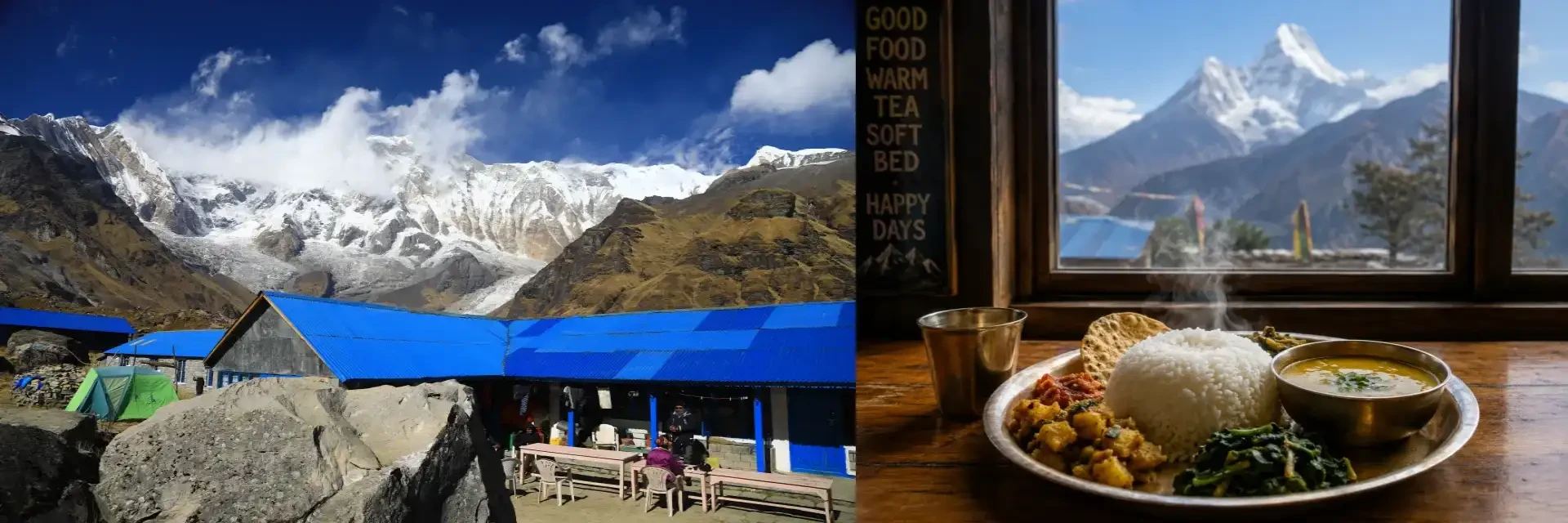
The Annapurna Base Camp trek is one of the most rewarding treks in Nepal, which offers the opportunity to stand at the foot of Annapurna I (8,091m), the world’s 10th-highest mountain. And while planning the trek, most trekkers wonder what kind of food and accommodation on the Annapurna Base Camp trek are available.
This trek doesn’t require camping gear or a packed kitchen, but it does require realistic expectations of teahouse food and accommodation, which get more basic as you go higher.
Whether you are a first-time trekker, budget traveler or trekking with family, this post gives you the picture of what you’ll eat and where you’ll sleep on the Annapurna Base Camp trek.
Table of Contents
Why Food and Accommodation Planning Confuses Most First-time Trekkers
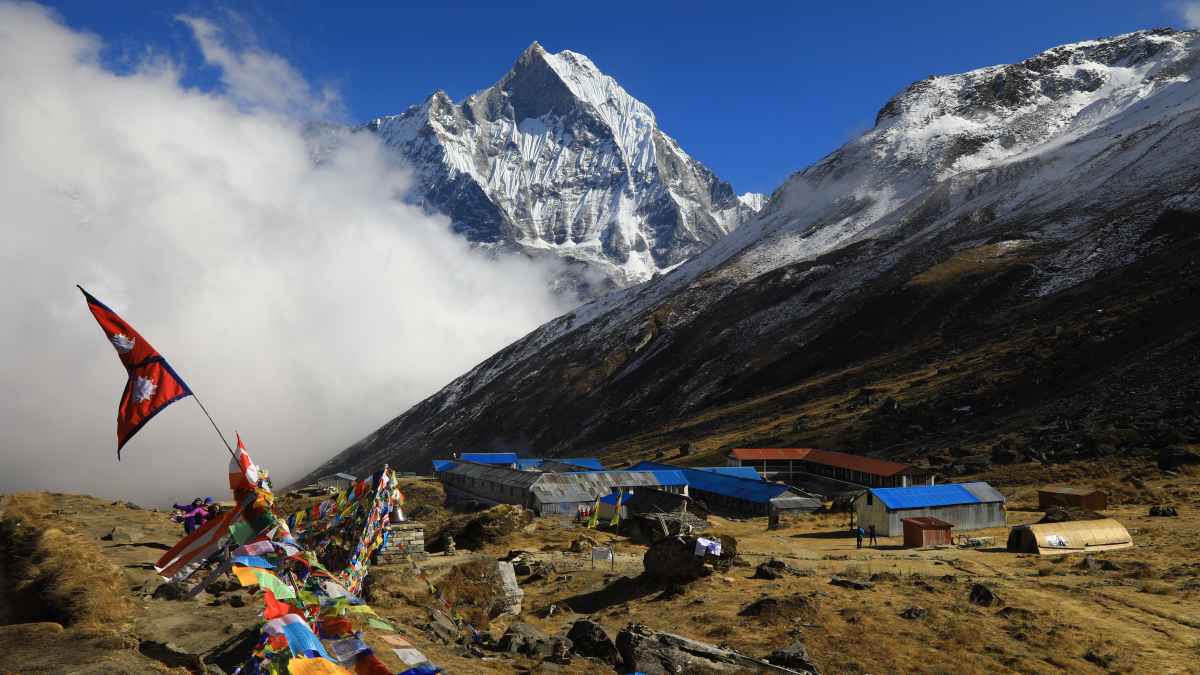
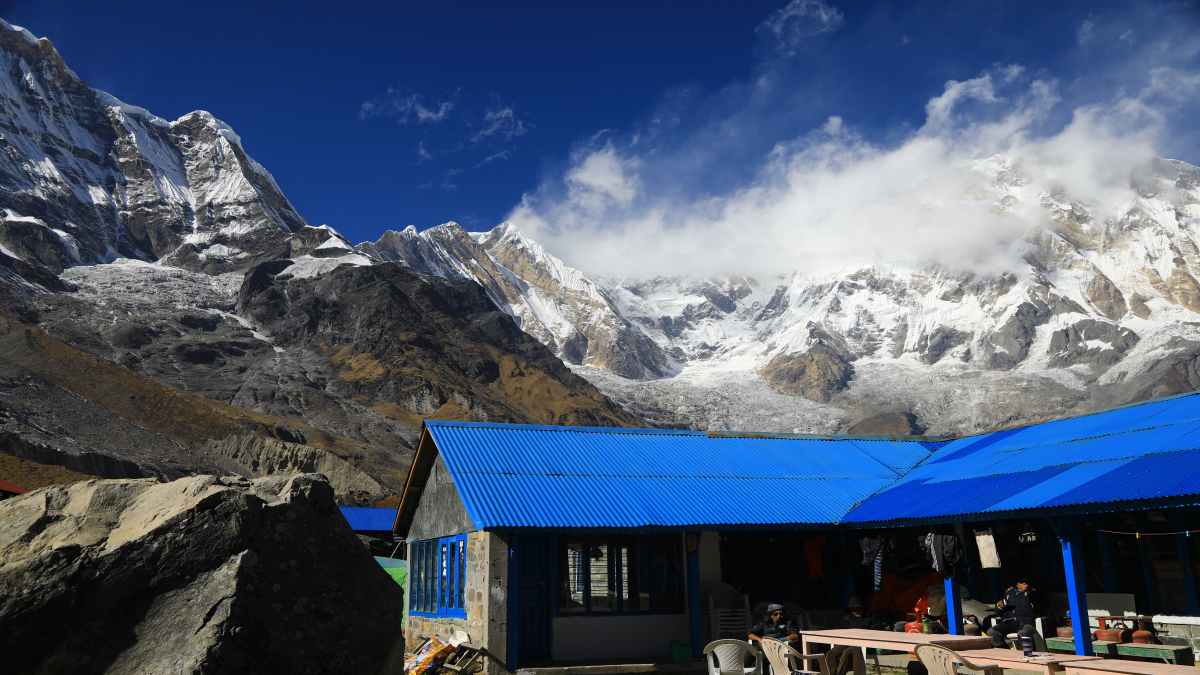
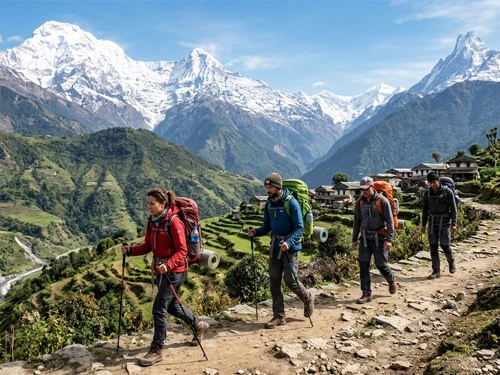
Stunning views of mountains from Annapurna Base Camp
The problem isn’t a lack of information, it’s that most of the information treats the food and accommodation on the ABC route as one experience. It doesn’t tell you that the teahouse in Jhinu Danda has a hot shower and a varied menu, while the teahouses near Machhapuchhre Base Camp have limited food items and no hot shower. That gap matters when you’re planning.
While researching Annapurna Base Camp treks, trekkers read that teahouses are available throughout the trek and assume that the facilities will be consistent. What they get instead is better facilities, fresher food, and more options at lower elevations and a progressively simpler version of everything as altitude increases. Families can't find straight answers on food safety. Budget travelers don't understand why costs climb with the altitude. Solo trekkers don't know what a shared bathroom actually means on a mountain.
And many trekkers confuses on the fact that Annapurna Base Camp and Annapurna Circuit trek are not the same trek. While both treks are in the same Annapurna Conservation Area, the trekking route and the altitude are completely different.
Food on the ABC Trek
Food on the ABC trek is simple, and the reason is straightforward: everything above the road gets carried up on foot. Menus are consistent across teahouses because local lodge committees have standardized menus and pricing across the region, which keeps costs predictable if not always low.
Teahouses stock up during the spring and autumn seasons when demand is high, and this season usually offers safe transport of goods. When traveling in the off-season and the selection narrows, you won't go hungry.
A useful principle you must follow is that the higher you go, the simpler your meals should be because altitude slows down your digestion and makes heavy or unfamiliar food harder to process. Warm, carbohydrate-rich, locally prepared dishes like dal bhat, noodle soup, rice, and lentils are what actually work up there.
You’ll eat dinner and breakfast at the same teahouse or lodge that you spent the night in and lunch at the teahouse you find on the route at midday. Most trekkers carry snacks for the afternoon gap between lunch and dinner because energy drops reliably around that window, especially higher up.
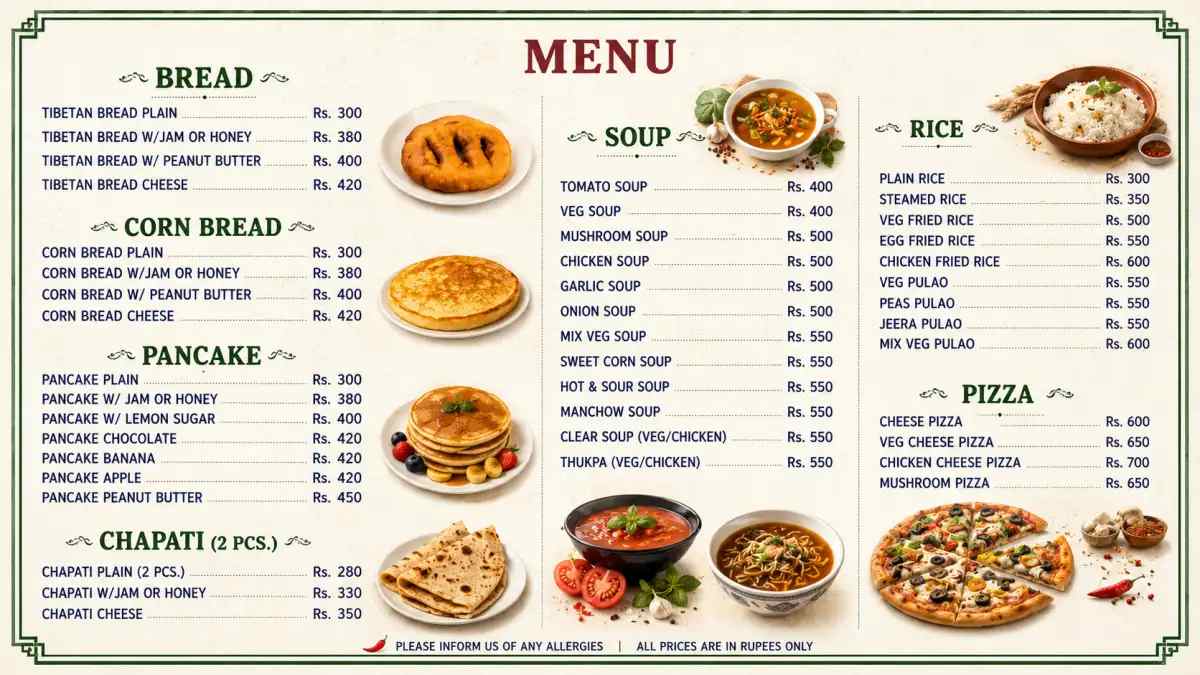
Example of a food menu on the ABC trek
Breakfast on ABC Trek
Most lodges start serving breakfast around 6 a.m. and stop by 8. Eat early. You want to be walking before the sun is overhead, partly for the heat, partly because the clouds usually roll in by late morning and steal the views. Don't skip it. A full morning of uphill trekking burns far more than a day at a desk, and starting on an empty stomach will be the main cause of fatigue and poor acclimatization.
What can you find on the breakfast menu:
Breakfast Set: Includes toast or chapati, a boiled or fried egg, hash brown potatoes, and tea or coffee. The most filling morning option on the menu and worth ordering if you have a long day ahead.
Tibetan Bread: Deep-fried flatbread with a satisfying chew, served with peanut butter, honey, or jam. At higher lodges, this is often the only breakfast available, and it holds up well.
Pancakes: More common on the lower trail. Plain, banana, or chocolate, with honey or local jam. Better for easy mornings than big climb days.
Porridge and muesli: Lighter and easier on the stomach than most breakfast options. Served warm with milk or yogurt, sometimes fruit. Worth knowing about if your appetite drops at altitude, and it will.
Paratha: Stuffed flatbread with spiced potato or vegetables. Good fuel for a long ascent.
Budget roughly $3 to $8 USD for breakfast, with the higher end applying at higher elevations.
Lunch and Dinner on the ABC Trek
Lunch happens on the trail, usually between eleven and one, at whatever teahouse on the route passes through around that time, according to your guide’s pick. While stopping for lunch, you can relax and give yourself an hour to an hour and a half here because food is cooked fresh and takes time. And it’s the best time to take a break to stretch and dry out sweaty layers.
After a day of hiking, you check in, wash up, and head down to the dining room. Most lodges serve dinner between 7 and 9. There's usually a stove in the middle of the room, and on cold nights, that's where people drift. Conversations get going. You hear about the pass someone crossed that morning, or which lodge two days up has the best dal bhat.
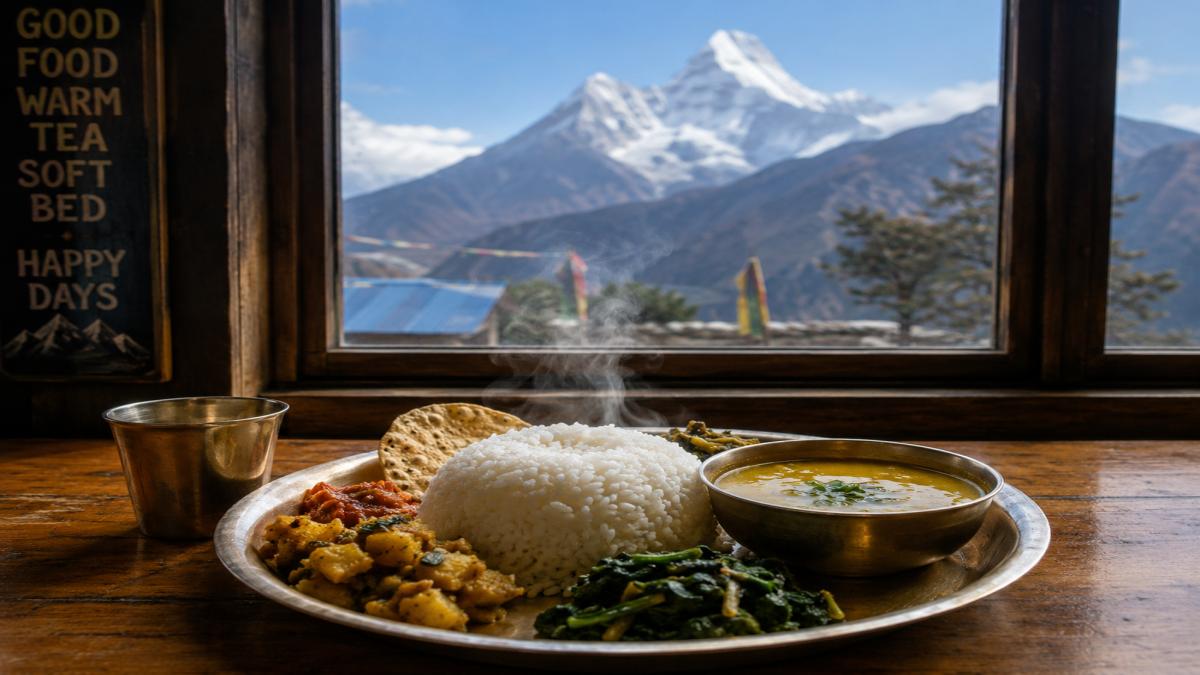
Dal bhat traditional Nepali food
The menu for Lunch and dinner meals is similar:
Dal Bhat: Nepal's national dish, and what most trekkers basically live on for two weeks straight. It's rice, lentil soup, and a vegetable curry, and at most lodges, refills are free until you tap out. It’s on every teahouse menu on the route from lower elevations to upper elevations, everywhere.
Momo: Steamed dumplings stuffed with vegetables, cheese, or minced meat, served with a spiced tomato-sesame dipping sauce. They're everywhere in Nepal, from Kathmandu Street stalls to teahouses at 4,000 meters.
Thukpa and Thentuk: Two Tibetan noodle soups you'll see on most lodge menus once you get higher up. Thukpa is the thin-noodle version in a clear broth. Thentuk uses flat, hand-pulled noodles and tends to be thicker, closer to a stew. Both come out scalding, which is the whole point at 4,000 metres in November.
Chowmein: Stir-fried noodles with vegetables and eggs or tofu if you want it. Quick to prepare and widely available.
Fried rice: Rice tossed in a wok with egg, vegetables, and a bit of seasoning. Cheap, hot, and big enough to refuel on.
Pizza and pasta: A variety of pizza and pasta is available at lower-elevation teahouses, but the variety becomes limited as you move higher up.
Snacks for the ABC Trek
The daily hikes usually wrap up around three or four, leaving a long gap before dinner. Lodges can sort you out with instant noodles or fries, but carrying snacks from Pokhara is cheaper and simpler. Energy bars, chocolate, biscuits, dried fruit, nuts, etc., pack them before you start. Buying the snacks up in high altitude is not generally a good idea, money-wise, because a Snickers bar that costs a dollar in town runs three or four times that at the higher lodges.
You should make a packing list for Annapurna Base Camp for the types of snacks and other essentials that are important while planning for the trek.
Meat options on the ABC Trek (why it's limited)
A non-vegetarian menu is available in the lower section of the trail, but you will not find it in the upper elevation of the trail. The Annapurna Sanctuary is a "No-Kill Zone" due to religious beliefs. Killing animals is forbidden within the sanctuary. While eggs are generally permitted and considered a safe protein source, many teahouses above Sinuwa offer strictly vegetarian menus out of respect for local deities.
Drinks on the Annapurna Base Camp Trek
You can find different kinds of drinks at every teahouse on the Annapurna Base Camp route, but the selection and prices of drinks change with altitude. The higher you go, the fewer the options, and the cost goes up because they have to be carried at a higher altitude by porters on their backs or by mules.
Drinking Water
Hydration is critical during the Annapurna Base Camp (ABC) trek to assist with acclimatization and prevent Acute Mountain Sickness (AMS); trekkers are advised to consume 3 to 4 liters of water daily.
The tap and stream water isn't safe to drink untreated. Teahouses provide safe water, typically sold as boiled water by the liter or glass. Purification tablets or a filter bottle are worth carrying because they're a cheaper option over a long trek and produce less plastic waste on the mountain.
Single-use plastic bottles are banned in most of the conservation areas, including the Annapurna sanctuary. So, teahouses don’t sell them. You have to bring a reusable water bottle or water bags and refill them at teahouses for a small fee.
Hot Drinks
Hot Drinks are central to trekking in the Himalayas because they warm you up, settle your stomach, and give you a reason to sit down after a long section.
Teas: Tea is the default hot drink. Masala chai is the most popular, but ginger, lemon, green, black, and mint are all standard. It’s cheap, arrives quickly, and helps you keep warm.
Garlic tea and garlic soup: You'll see both on most menus from about 3,000 meters up. Locals and guides will tell you garlic helps with circulation and altitude sickness. There's no real medical evidence for it, but it can't hurt, and a hot garlic soup at the end of a cold day is genuinely good.
Other hot drinks: Instant coffee, hot chocolate, and hot lemon with honey are widely available throughout the trail. Some lower teahouses offer espresso-style drinks. Don't count on finding those above Chhomrong.
Soft Drinks
Most teahouses sell different soft drinks like Coke, Sprite, Fanta, Pepsi, canned juice, and energy drinks. They're fine occasionally, but go easy on them because they contain high sugar and caffeine, both of which pull water out of you and cause dehydration for a lot of trekkers, which is the main cause of altitude sickness. They cost more than MRP everywhere on the trail, and the higher you go, the more they cost.
Alcoholic Drinks
While alcohol is available, its consumption is subject to specific safety guidelines and religious restrictions.
Beer: Beer is available at most teahouses below 3500m. Everest, Gorkha, and Tuborg are the most common brands you will find. Prices run NPR600-900 or more per bottle as the altitude increases.
Local drinks: Local spirits/drinks like raksi (a potent distilled spirit made from millet, rice, or wheat), Tongba (a traditional fermented millet drink served in a vessel with hot water and consumed through a straw), and Chhyang (a milky-white, sweet-and-sour rice beer) are also available.
Safety warning: It is strongly recommended to avoid alcohol while ascending, especially above 2,500 m–3,000 m, as it causes dehydration and can mask or worsen the symptoms of altitude sickness.
Accommodation in the ABC trek
Teahouse in Annapurna Base Camp
You sleep in teahouses the whole way after leaving Pokhara. They are basically family homes with a few extra rooms attached and a dining room downstairs where everyone eats together.
The teahouses in lower villages are pretty comfortable. And if you pay a bit extra, you can enjoy hot showers and Wi-fi. The facilities provided in higher-altitude teahouses are more basic than lower altitude teahouses. By the time you’re at MBC or ABC, you're in a plywood-walled room with two foam mattresses, one bare bulb, and a blanket that won't be enough on its own.
The room
Most teahouse rooms are twin-sharing with two single wooden beds, foam mattresses, a pillow, and blankets. Nights at ABC can drop to -15 °C, and the blankets provided by the teahouse won’t be enough to keep you warm. So, bringing a high-quality sleeping bag rated to -10 °C or lower is essential, and it isn’t optional gear for trekking above 3500m.
Private rooms are common in lower villages like Ghandruk and Chhomrong. But higher up, it gets harder. At MBC and ABC, the teahouses have limited rooms, and in October or April, you’ll probably end up sharing a room with 3 to 6 other trekkers. If you’re set on a private room up there, your guide can sometimes call ahead, but it is not guaranteed that you will get one.
In higher elevations, walls are typically made of thin plywood and offer very little sound or thermal insulation.
Bathrooms
Bathrooms on the Annapurna Base Camp trek change a lot depending on altitude and the village where you stay. Lower down, you’ll mostly find western-style sit-down toilets, and often inside your room. But higher up, you can only find teahouses with shared squat toilets, which are usually in a separate block outside the main building.
The teahouses in villages like Ghandruk, Jhinu Danda, and Ghorepani offer private rooms with attached western-style toilets. And Ghorepani has some of the best-equipped teahouses on the ABC trek route.
From Sinuwa through Deurali, facilities become more basic. Bathrooms are usually shared between a few rooms, and you'll often find both Western and squat toilets in the same block (sometimes in the same building, sometimes not).
At Machhapuchhre Base Camp (3,700m) and Annapurna Base Camp (4,130m), there's no such thing as a private bathroom. You must use the shared block and its squat toilets. Bring a head torch for night trips; the buildings aren't lit, and it's a short walk outside in the cold.
Heating
The dining hall is the only heated space in most teahouses with a central stove burning gas or kerosene, since wood burning is restricted in the conservation area. Trekkers gather in the common dining hall in the evenings to eat, share stories, and stay warm before heading back to bed.
Hot Showers, Charging, and Wi-Fi
Hot showers are available at most stops for a fee of $1 to $5 (NPR 150 – 700). In lower villages, solar or gas-heated showers are standard, but at higher elevations, these often transition to “Bucket showers” with water heated over a stove. Hot showers are not recommended at higher altitudes like MBC and ABC because it increases the risk of catching a cold or pneumonia and potential hypothermia upon exiting the shower.
Charging is available at almost every teahouse, but often costs extra and may only be available in the dining room. The power supply on ABC trek relies on solar or hydro-power, so teahouses charge $1 to $3 per device for a full charge. Bring a power bank if you need reliable power for a camera, medical device, or navigation.
Many teahouses offer Wi-Fi for $2-$5 per session or per hour. However, the signal becomes highly unreliable above Chhomrong. Download your offline maps and anything else before you leave Pokhara, where you can find fast and reliable Wi-Fi.
Food and accommodation costs on the ABC Trek
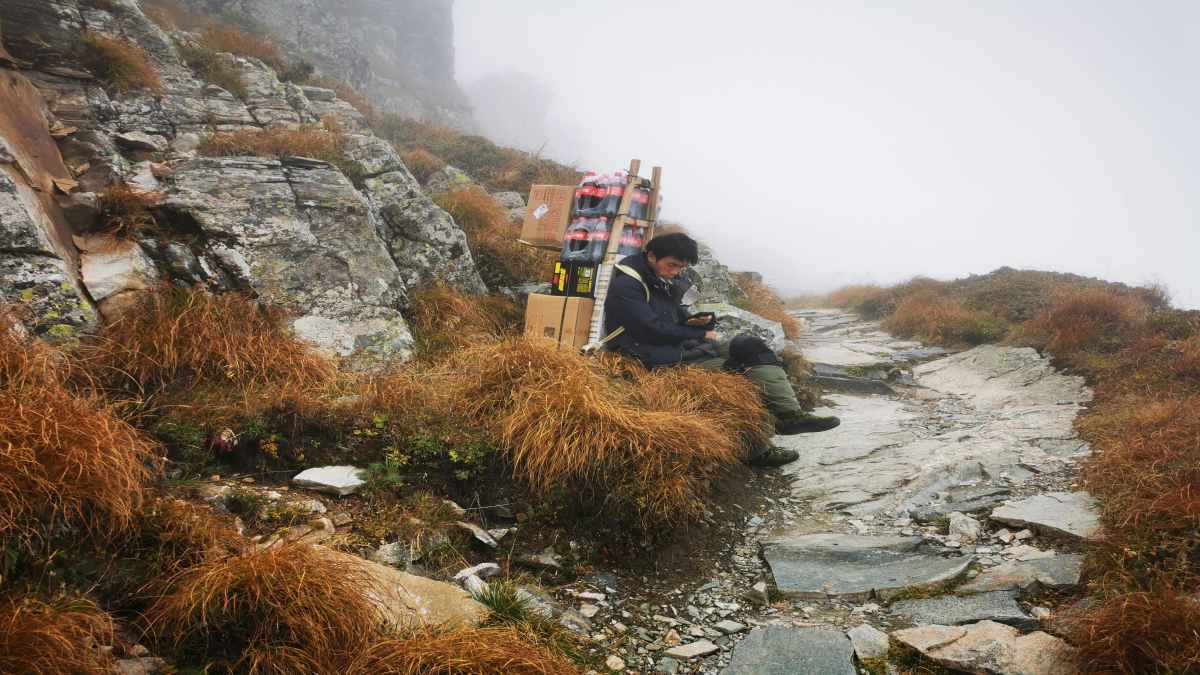
Porter carrying supplies up to the teahouses
The cost of food and accommodation on the Annapurna Base Camp trek rises with altitude as everything gets carried up on foot by porters or by mule, and that's reflected in the price.
Annapurna Base Camp Trek Accommodation Costs
Room rates are kept low with the expectation that you'll eat dinner and breakfast at the same teahouse where you sleep.
Accommodation cost in the different trail sections of ABC
Trail section
Key Villages
Shared/Dorm Room in USD (per night)
Private room in USD (per night)
Lower trail
Nayapul, Ulleri, Ghandruk
$3-$7
$5-$12
Mid trail
Chhomrong, Sinuwa, Dovan
$4-$10
$6-$15 (limited availability)
Upper trail
Deurali, MBC, ABC
$7-$15
$18-$25 (Limited availability, usually on a first-come, first-served basis and not available in peak season)
As you can see, room costs roughly double from the trailhead to ABC, with private rooms becoming increasingly scarce above Chhomrong, and during peak season, it becomes totally unavailable.
ABC Trek Food and Drinks Costs
Food and drink prices on the Annapurna Base Camp trek rise with elevation because all supplies above Chhomrong are carried up by porter or mule.
Daily food cost by altitude (USD)
Elevation Zone
Villages
Breakfast
Lunch
Dinner
Total cost
Below 2200m
Ulleri, Ghandruk, Chhomrong
$3-$5
$4-$6
$4-$7
$15-$25
2200m-3200m
Bamboo, Dovan, Deurali
$4-$7
$5-$8
$6-$9
$20-$30
Above 3200m
MBC, ABC
$6-$9
$7-$11
$8-$13
$25-$40
A full daily food budget at base camp is roughly double what you'd spend at the trailhead. Plan accordingly, and bring more cash than you think you'll need.
Annapurna Base Camp Trek Food and Drink Prices in USD by Altitude
Food and drink prices by altitude in USD
Menu item
Lower route Altitude
Mid route altitude
Upper route altitude
Dal Bhat (unlimited refills)
$3.50 – $4.50
$4.50 – $6.00
$6.00 – $14.00
Noodle Soup / Thukpa
$2.30 – $4.00
$3.00 – $6.00
$4.00 – $10.00
Pasta / Spaghetti
$3.50 – $6.00
$5.00 – $8.00
$7.00 – $11.00
Pizza (Mountain-style)
$4.50 – $7.00
$7.00 – $9.00
$8.00 – $10.00
Eggs
$1.50 – $3.00
$2.30 – $4.50
$3.00 – $8.00
Boiled Water (1 Liter)
$0.60 – $1.10
$0.90 – $2.30
$1.10 – $4.00
Tea / Coffee (1 Cup)
$0.60 – $1.50
$0.80 – $2.50
$1.10 – $4.00
Soft Drinks (Coke/Fanta)
$1.00 – $2.00
$2.00 – $4.00
$3.00 – $5.50
Beer (Bottle)
$3.00 – $4.50
$4.50 – $7.00 (not recommended above 3,000m due to health risks)
$6.00 – $9.00 (Discouraged due to health risks)
ABC Trek Food and Accommodation: Expectations vs Reality
Here's where most trekkers get caught off guard about the food and accommodation on the ABC trek.
ABC Trek Food and Accommodation: Expectations vs Reality
Topic
Expectation
Reality
Rooms
Cozy, heated bedrooms to escape the mountain cold
Rooms are unheated with thin plywood walls and no insulation. Nights at ABC drop to -10 °C to -20 °C. Teahouse blankets are usually insufficient. A sleeping bag rated to at least -10 °C is essential above 3,000 m.
Privacy
Private twin rooms every night of the trek
Private rooms are common at lower elevations (Ghandruk, Chhomrong), but increasingly scarce at MBC and ABC. In peak season, dormitory rooms of 4–6 beds are the norm, and late arrivals sometimes sleep on dining hall floors.
Bathrooms
Western sit-down toilets and hot showers throughout
Attached bathrooms and hot showers are standard only below Chhomrong (2,170 m). Above that, shared squat toilets are the norm. Hot showers above MBC are either expensive bucket showers or unavailable, and skipping them is advisable to avoid hypothermia risk.
Connectivity
Reliable Wi-Fi and free phone charging
Wi-Fi is slow and frequently fails above 2,500 m. Charging costs $1–$5 per device, is solar-dependent, and may require waiting in line at the dining hall.
Meat
Fresh chicken or meat dishes available for protein throughout
Meat is discouraged or unavailable above Chhomrong. The Annapurna Sanctuary is a religiously protected No-Kill Zone. Any meat available above this point has typically been porter-carried for days without refrigeration, which has a high food poisoning risk.
Menu variety
A diverse international menu for the whole journey
Menus are broad and varied at lower altitudes but shrink significantly above 3,500 m. Complex Western dishes largely disappear in favour of simple, energy-dense carbohydrates (dal bhat), rice, and noodle soups.
Prices
Fixed, affordable prices similar to Pokhara
Everything above Chhomrong is porter-carried uphill, and prices reflect that. A Coke that costs NPR 150 in Pokhara can reach NPR 500 at ABC. Daily on-trail spend climbs from $25–$40 near the trailhead to $50–$70 at base camp.
Pro Tips for food and accommodation
Bring Cash before you leave Pokhara, in small bills, because there are no ATMs on the trail and teahouses struggle to break large notes.
Take your proper hot showers at lower elevations and skip hot showers in higher altitudes to avoid catching a cold in the freezing air.
Carry a 10,000-20000mAh power bank to avoid paying $2-$5 for every single device charge at teahouses.
Teahouse blankets are often thin and insufficient for -15°C nights; a professional sleeping bag rated to at least -10°C is an essential cold temperature above 3000m
Buy snacks like energy bars, trail mix, etc., from Kathmandu or Pokhara because these items can cost three times as much at base camp due to the cost of porter transport.
During peak season, start your day early to arrive at your next destination by early afternoon to secure a room, as lodges at MBC and ABC fill up quickly
In peak season, eat dinner early because the teahouse kitchens get overwhelmed when everyone arrives at the same time.
Most guides and trekkers recommend eating Dal Bhat because it is nutritionally balanced for trekking and typically comes with free refills of rice, dal, and curry.
Book ahead in peak season (October–November, March–April) through your trekking operator to guarantee rooms at MBC and ABC.
Tell your guide about dietary restrictions before the trek begins so they can coordinate with teahouses in advance.
Carry electrolyte sachets to mix with boiled water. They help with hydration and make plain water more drinkable.
Frequently Asked Questions (FAQs)
1. Is the food safe on the Annapurna Base Camp trek?
Yes, food is generally safe at teahouses on the ABC trek when you stick to freshly cooked vegetarian meals like dal bhat, noodle soup, and momo. Avoid meat above Chhomrong, where the lack of refrigeration creates a food poisoning risk.
2. What is the cheapest food on the ABC trek?
Dal Bhat is the cheapest and most nutritious meal on the ABC trek, costing $3.5-$14.00 depending on altitude. It usually comes with unlimited refills of rice, lentils, and vegetables, making it the best value-per-calorie option on the trail.
3. Do teahouses have hot showers at Annapurna Base Camp?
Hot showers are available at most teahouses below Chhomrong (2170m) for $1-$5. Above that altitude, showers transition to bucket-style with water heated over a stove. Hot showers are not recommended at MBC and ABC due to hypothermia and pneumonia risk in the freezing air.
4. Can vegetarians eat well on the ABC trek?
Yes. In fact, vegetarian food is the standard above Chhomrong because the Annapurna Sanctuary is a religiously protected No-Kill Zone. Dal bhat, momo, noodle soup, fried rice, and chowmein are all easily available in vegetarian versions throughout the trek.
5. How much should I budget per day for food and accommodation on the ABC trek?
Budget $25-$40 per day at lower elevations and $50 -$70 per day at MBC and ABC for combined food and accommodation. Bring 30-40% more cash than your estimate to account for hot showers, charging fees, Wi-Fi, snacks, and unexpected costs.
6. Is there Wi-Fi on the Annapurna Base Camp trek?
Most teahouses offer Wi-Fi for $2–$5 per session or per hour, but the signal becomes unreliable above Chhomrong. Download all offline maps and necessary content in Pokhara before starting the trek.
7. Do I need to book teahouses in advance for the ABC trek?
In peak seasons (October–November and March–April), booking ahead through a trekking operator is strongly recommended for MBC and ABC, where lodges fill up early in the day. In the off-season, walk-ins are usually fine.
8. Are single-use plastic water bottles allowed on the ABC trek?
No. Single-use plastic bottles are banned in the Annapurna Sanctuary and most of the Annapurna Conservation Area. Bring a reusable water bottle and refill at teahouses (boiled water) or use purification tablets or a filter bottle.
Conclusion
Food and accommodation on the ABC trek are simple, functional, and consistent up to a point. That point is roughly Chhomrong. Above it, things get more basic in every category. That's not a reason to avoid the upper trail. It's just information worth having before you go.
Preparation and mindset are the factors that separate a comfortable trek from a miserable one. So, bring the right sleeping bag, carry cash in Nepali rupees, eat vegetarian food above Chhomrong, download offline maps before you leave Pokhara, and book early in peak season.
With the right mindset and preparation, every small thing can become one of the most meaningful and unforgettable parts of the journey.
Still figuring out the details of your ABC trek? Our team at Breeze Adventure has guided trekkers through the Annapurna Sanctuary for years and can answer your questions about food, accommodation, permits, and timing before you book. Get in touch with us; we're happy to help you plan. Or browse our Annapurna Base Camp Trek packages if you're ready to compare options.
Kishwor Adhikari is a passionate writer with a deep enthusiasm for trekking and adventure. His extensive travels across Nepal, exploring its diverse landscapes and hidden corners, have shaped his unique perspective on the country's natural beauty. With a wealth of first-hand experience in adventure trekking, Kishwor has become a trusted voice for fellow enthusiasts. Through his writing, he shares invaluable insights, offering practical advice and inspiration for both seasoned trekkers and novices alike. His dedication to sharing his journey and knowledge helps others discover the wonders of Nepal's wilderness, making his work an essential resource for anyone seeking adventure in the region.