5 Days Upper Mustang Jeep Tour From Pokhara

Tripadvisor160 reviews
google132 reviews
youtube99 reviews
trustpilot36 reviews
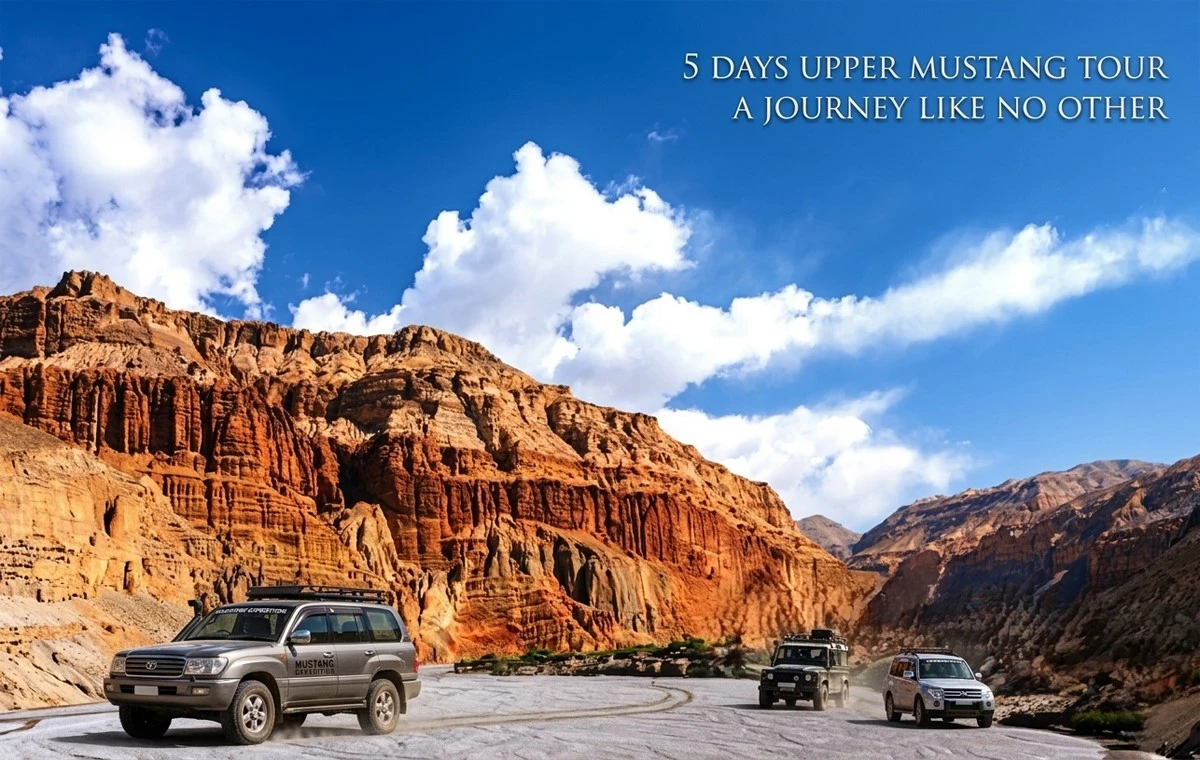
Jeep convoy crossing arid Mustang landscape on guided 5 day Upper Mustang tour from Pokhara
At a Glance
  • Duration5 Days
  • Difficulty Level Easy
  • Max Altitude 4000m
  • Group Size 1 - 50 Person
  • Start City Pokhara
  • End City Pokhara
  • Trip Type Tour
  • Activity Cultural Adventure Tour
  • Best Season March-May and September - November
Trip Highlights
  • Stand inside the medieval walled city of Lo Manthang (3,840 m), the former capital of the Kingdom of Lo
  • Pokhara-to-Pokhara by private 4x4 jeep — no Jomsom flight risk, no trekking days required
  • Drive the full length of the Kali Gandaki gorge, the world's deepest gorge
  • Explore three centuries-old gompas inside the city walls: Jampa, Thubchen, and Chodey
  • Visit the mysterious Chhoser Sky Caves — thousands of human-dug cliff caves, some over 3,000 years old
  • Cross the trans-Himalayan rain-shadow desert with views of Nilgiri (7,061 m), Dhaulagiri (8,167 m), and Annapurna I (8,091 m)
  • Stop in the Thakali apple village of Marpha for lunch on Day 1
  • Pass through the timeless walled villages of Chele, Samar, Ghami, and Tsarang
  • Bathe at the sacred Muktinath Temple (3,710 m) with its 108 water spouts and eternal flame
  • Sleep two nights inside or beside the Lo Manthang walls
  • Experience authentic Loba culture and Tibetan Buddhist traditions with a local Loba-speaking guide
  • Suitable for families, senior travellers, and anyone with limited holiday time
  • Drivable year-round, including monsoon (June–August) — Upper Mustang lies in the Himalayan rain-shadow
  • Maximum altitude only 3,840 m — low altitude-sickness risk with gradual ascent
  • Supplemental oxygen, pulse oximeter, and Diamox are carried on every departure

Most Upper Mustang itineraries you will read online begin with a Pokhara–Jomsom flight. This does not, and that is the point of this package.

The Pokhara to Jomsom flight is short, scenic, and frequently cancelled. In April 2025, we had three back-to-back Mustang departures where the Jomsom flight was grounded for high-altitude wind on the morning of departure; two of those groups lost a full day waiting in Pokhara before we converted the trip to a jeep drive anyway. After the third cancellation, we sat down as a team and built this package the other way around: a 5-day, Pokhara-to-Pokhara jeep journey that never depends on the Jomsom airstrip, never loses a day to weather, and gets you inside the walls of Lo Manthang on Day 2.

This is our shortest Upper Mustang package. It is built for travellers who have five clean days, want to stand inside the walled city of Lo Manthang, want to bathe at Muktinath, and do not want to spend their holiday at Pokhara airport refreshing the weather app.

Who this 5-day jeep tour is for — and who it is not for

We have run enough Mustang departures to know this trip is wrong for some travellers. We would rather tell you that now than have you write a tired review later.

This tour is a good fit if:

  • You have exactly 5 days of real holiday time in Nepal, and Lo Manthang is the priority.
  • You are travelling with parents, with children over 8, or with anyone in the group who does not want to walk 6+ hours a day at altitude.
  • You want to combine Lo Manthang with the sacred Muktinath temple in one journey.
  • You have flown into Nepal during monsoon (June–August), and most other Himalayan regions are washed out, Upper Mustang sits in the rain-shadow and stays drivable.
  • You have already done one Himalayan trek and now want the culture, not the cardiovascular suffering.

This tour is the wrong choice if:

  • You want to walk the old caravan trail on foot, book our 10-day Upper Mustang Trek instead, where you actually earn the Lo Manthang gate.
  • You are prone to motion sickness on rough mountain roads. Days 1, 2, 4 and 5 of this package are long jeep drives on a road that is honest dirt for long stretches above Kagbeni. We are not going to pretend it is a paved highway. It is not.
  • You want to attend the Tiji Festival inside Lo Manthang — Tiji needs at least 2 nights in Lo Manthang and a planned arrival window; ask us about our dedicated Tiji departure (usually late May, dates set by the Tibetan calendar).

Why don't we include the Pokhara–Jomsom flight in this package

The 25-minute Pokhara–Jomsom flight is beautiful and very short. It is also one of the most weather-cancelled scheduled flights in Nepal. The runway sits at the bottom of the Kali Gandaki wind funnel and morning flights are routinely grounded between mid-morning and mid-afternoon during spring and autumn — exactly the seasons most travellers visit.

If we built the trip around the flight and it was cancelled on Day 1, you would lose your Lo Manthang lodge booking and your permit window. We have watched this happen to other operators' groups in Pokhara. We do not want to be that operator.

So this package is intentionally Pokhara-to-Pokhara by road. The drives are long, and we do not pretend otherwise. In exchange, we can promise the trip departs on the date you booked it, regardless of what the wind is doing at Jomsom airstrip.

If you would like to shorten the return journey, we offer the Jomsom–Pokhara flight as an optional Day 5 upgrade (typically USD 130–160 per person, weather-dependent). A Day 5 cancellation is low-stakes — you simply drive back as originally planned.

Why we built a 5-day version specifically

Our standard Upper Mustang Jeep Tour is 7 days. Our trek is 10 days. For three seasons, we did not offer anything shorter because we did not think a meaningful Lo Manthang trip could be done in 5 days. Two things changed our minds.

First, the road north of Kagbeni was steadily improved between 2022 and 2025. The stretch through Chele, Samar, and Ghami that used to be a punishing 7-hour drive is now around 5 to 5.5 hours in a 4x4, with a lunch break at Ghami. That single change made a same-side overnight at Lo Manthang on Day 2 realistic for the first time.

Second, more than half of our enquiries for Upper Mustang in 2024 and 2025 came from travellers with 5 to 7 total days in Nepal, couples on a side-trip from Kathmandu, business travellers, parents bringing teenagers during European summer holidays, and senior travellers who specifically did not want a multi-day trek. The 10-day trek did not fit them. We built this package for that group.

So this is not the trip we would book for ourselves. We would take the 10-day trek. But it is honestly the best Lo Manthang trip we know how to deliver inside 5 days, and we will not pretend a longer one would fit.

The exact route, in plain language

Pokhara → Beni → Tatopani → Marpha → Jomsom → Kagbeni (overnight) → Chele → Samar → Ghami → Tsarang → Lo Manthang (overnight x2) → Ghami → Jomsom → Muktinath (overnight) → Jomsom → Tatopani → Beni → Pokhara.

Total driving: roughly 30 to 35 hours over 5 days, split into 4 driving days and 1 exploration day. The longest single day is Day 1 (Pokhara to Kagbeni, 7 to 8 hours including lunch in Tatopani). The shortest day on the road is Day 4 (Lo Manthang to Muktinath, 5 to 6 hours).

Itinerary

Expand allCollapse all

Our driver picks you up from your Pokhara hotel at 6:00 AM. We leave that early on purpose: the stretch between Beni and Tatopani sees most of its commercial truck traffic between 10:00 and 14:00, and we want to be past Tatopani by then. We stop at the Galeshwor suspension bridge for the first proper Kali Gandaki photograph and at the Thakali village of Marpha around 13:00 for a proper Marpha lunch — usually apple pie and Thakali dal bhat at one of two family-run lodges we have worked with since 2019. Marpha apple brandy is locally produced; we recommend a single small bottle for the evening at Kagbeni and not more, because alcohol at altitude on Day 1 is a bad idea.

By late afternoon we reach Kagbeni, the medieval village that marks the gateway into restricted Upper Mustang. Kagbeni has narrow alleys, a 15th-century fort ruin, and the Kag Chode Monastery. Our recommendation: drop your bag at the guest house, ask your guide to walk you to the old fort wall before sunset, and have an early dinner. The wind in Kagbeni picks up sharply after 14:00; this is the Kali Gandaki wind funnel,  and you will sleep better if you have not been fighting it for an hour.

Overnight: Twin-share guest house in Kagbeni. Attached bathroom rooms are available in two of the three lodges we use; we will confirm which lodge you are in 48 hours before departure based on availability.

  • Max Altitude: 2804m
  • Accommodation: Guest House
  • Time: 7-8 Hours
  • Meals: BLD
  • Transport: Private Jeep

Permit check at the Kagbeni police post is the first stop after breakfast. The check is straightforward, and your guide handles it. But it cannot start before 07:00, so leaving Kagbeni earlier than that is pointless. We leave at 07:15.

The landscape changes within 30 minutes of leaving Kagbeni. The green of the Kali Gandaki riverbed gives way to the multi-coloured eroded cliffs that Upper Mustang is known for. We pass Chele, Samar, and Ghami, three timeless walled villages with mani walls and barley fields, and stop at Ghami for lunch around 11:30. The Ghami mani wall is one of the longest in Nepal at over 300 metres; your guide will explain why it is built where it is.

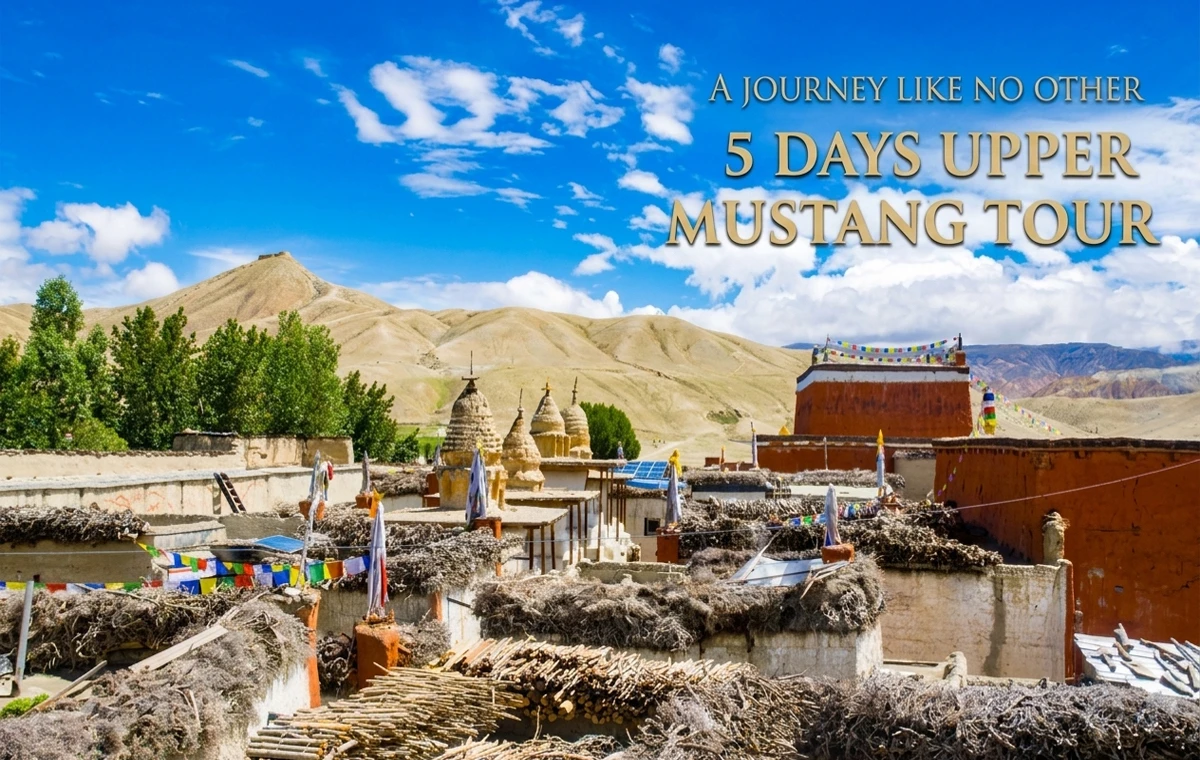
First sight of the Lo Manthang walls comes around a final bend in the afternoon. The ochre city walls rising from the high desert plain is the photograph people remember from this tour. We arrive at our guest house inside or just outside the walled city by 15:00 to 16:00.

Overnight: Twin-share guest house in Lo Manthang. We do not name the lodge publicly because availability inside the walls during peak weeks is genuinely tight; we book 2 to 3 months in advance for our Tiji and October departures.

  • Max Altitude: 3840m
  • Accommodation: Guest House
  • Time: 5-6 Hours
  • Meals: BLD
  • Transport: Private Jeep

This is the day you came for. It is also the day when most generic itineraries are vaguest, so here is what we actually do.

Morning: Inside the walls. Jampa Gompa first (built 1448, recently restored, the murals are the reason to go early before the light shifts). Then Thubchen Gompa, then Chodey Gompa, then the former Royal Palace courtyard from the outside. Our guide is local to Mustang and speaks Loba, a small thing, but it matters when an elderly caretaker at one of the gompas wants to tell you what a particular mural depicts.

Afternoon: Drive 30 minutes north and west to the Chhoser Sky Caves and Jhong Cave complex. These are the human-dug cliff caves the region is famous for; some are over 3,000 years old, and the upper chambers are reached by a vertical wooden ladder that is steeper than it looks in the photos. You do not have to climb the ladder. About a third of our travellers do not, and the lower cave chambers are still excellent. We will not pretend the ladder is easy. It is not.

Return to Lo Manthang by 17:30. Dinner inside the walls.

  • Max Altitude: 4000m
  • Accommodation: Guest House
  • Time: 3-4 Hours
  • Meals: BLD

Last morning inside the walls. We deliberately do not schedule anything before 08:00 so you have time to walk one more loop inside the city or sit with a coffee at the small Loba-run cafe near the north gate.

The drive south retraces our route to Ghami and Kagbeni and then turns east up the side valley to Muktinath at 3,710 metres. Muktinath is sacred to both Hindus and Buddhists. The temple complex has 108 bronze water spouts and a small chapel. Where a natural gas flame burns continuously above water, this is the temple's eternal flame.

Our recommendation: do not visit the temple on the evening of Day 4. Visit on Day 5 in the morning, when the light is better, and the pilgrim crowds are thinner. On Day 4 evening, walk to the village of Jharkot below Muktinath, which has a working 12th-century fortress monastery and a quieter atmosphere than Muktinath village itself.

Overnight: Guest house in Ranipauwa near Muktinath. Hot showers cost an extra 300 to 500 NPR at most lodges here; this is not included in our price because we did not want to inflate the package cost for travellers who do not want one.

  • Max Altitude: 3840m
  • Accommodation: Guest House
  • Time: 5-6 Hours
  • Meals: BLD
  • Transport: Private Jeep

06:30 morning visit to the Muktinath temple. The 108 spouts are cold; devotional pilgrims walk under all of them, which is not expected of you. The eternal flame is in a small chapel to the side of the main temple; ask your guide to point it out.

Back to the lodge for breakfast at 09:00. On the road by 10:00. We retrace the Kali Gandaki valley south through Jomsom, Marpha, and Tatopani, and arrive in Pokhara by 17:30 to 18:30 depending on road conditions. Optional upgrade, booked in advance: take the 25-minute Jomsom–Pokhara morning flight instead of the long drive south. This shortens Day 5 dramatically but is weather-dependent (this is the same flight risk we mentioned at the top; we offer it as an upgrade, not a default).

  • Time: 7-8 Hours
  • Meals: Breakfast & Lunch
  • Transport: Private Jeep

This 5-day Upper Mustang Jeep Tour is a Pokhara-to-Pokhara road journey into the former Kingdom of Lo — no flights, no trekking days. Day 1 drives the Kali Gandaki gorge to Kagbeni (2,800 m). Day 2 enters the restricted area and climbs to the walled city of Lo Manthang (3,840 m). Day 3 explores the medieval gompas inside the walls and the Chhoser Sky Caves. Day 4 descends to sacred Muktinath (3,710 m). Day 5 visits Muktinath temple at dawn and returns to Pokhara. A private 4x4 and licensed Loba guide accompany you throughout. Suitable for families and senior travellers.

Cost Details
What's Included
  • Private 4x4 jeep with driver for the full Pokhara–Pokhara loop (not a shared vehicle).
  • Government-licensed, English-speaking guide who is local to Mustang and speaks Loba.
  • Upper Mustang Restricted Area Permit
  • Annapurna Conservation Area Permit (ACAP).
  • 4 nights twin-share guest house accommodation in Kagbeni, Lo Manthang (x2), and near Muktinath.
  • Full board meals throughout the tour — breakfast, lunch and dinner, ordered from the lodge menu.
  • Three hot beverages per day (tea, coffee, or hot lemon).
  • Seasonal fresh fruit during the tour.
  • First aid kit carried by your guide, including basic altitude medication.
  • 1 Tank of oxygen for an emergency.
  • All government taxes and official service charges.
What's Not Included
  • Pokhara hotel accommodation and meals on the night before Day 1 and after Day 5 — we can book these for you separately at our partner hotels.
  • Travel and rescue insurance with helicopter evacuation cover up to 4,000 metres — this is mandatory and we will ask to see your policy before departure.
  • Optional Jomsom to Pokhara scenic flight on Day 5 — typically USD 130 to 160 per person, weather-dependent.
  • Hot showers at guest houses (300 to 500 NPR per shower, paid locally).
  • Wi-Fi, phone charging beyond standard, bottled drinks, laundry.
  • Entrance fees to monasteries and the Sky Caves where applicable (approximately USD 10 to 20 in total across the trip).
  • Tips for the guide and driver.
  • Any cost arising from itinerary changes due to weather, road blocks, landslides, or government restrictions.

Essential Information

When to go and which month to pick

March to November is the standard answer. Here is what we actually think, season by season, based on running this tour for several years:

Late March to early May: Our preferred window for first-time visitors. Cold mornings (minus 2 to plus 5 at Lo Manthang), warm afternoons, clear skies most days. Tiji Festival usually falls in this window. If you want Tiji, book the dedicated 7-day or 10-day departure, not this 5-day package.

June to August (monsoon): The unique selling point. While the rest of Nepal is washed out, Upper Mustang is in the rain-shadow and stays dry and drivable. Barley fields turn bright green against the red cliffs, visually the most striking time to go. Caveat: the road from Pokhara to Beni is in the wet zone and can have brief landslide closures; we add a 1-day weather buffer to monsoon departures or recommend the 7-day version.

September to mid-November: Crisp visibility, mountains at their sharpest. October is the busiest month for tourism in Nepal — book this package at least 8 weeks ahead for October departures because Lo Manthang lodges fill early.

Late November to February: We do not run this package in deep winter. Locals migrate to lower elevations, many lodges close, and the road through Ghami can hold ice in the mornings. If you ask us, we will tell you to wait for March.

On altitude, what we tell our own family members

Maximum elevation on this tour is 3,840 metres at Lo Manthang. This is below the altitude where acute mountain sickness becomes statistically common, and the ascent profile is gradual (we go from 820 m at Pokhara on Day 1 morning to 3,840 m at Lo Manthang on Day 2 afternoon).

That said, two of our last 40 travellers on this route had a mild headache on the evening of Day 2 at Lo Manthang. Both slept it off. None needed to descend. We do not give Diamox prophylactically; we carry it, your guide will mention it if you ask, and we recommend you consult your own doctor before the trip if you have any heart, lung, or pregnancy considerations.

Drink water steadily through Day 1 and Day 2. Skip the Marpha brandy on Day 1, even if it is tempting. Tell your guide if you are not sleeping well at Lo Manthang. That is the single most reliable early signal of altitude trouble, and we would rather adjust Day 3 than push through.

Our safety protocol on every Upper Mustang departure

Beyond the standard first aid kit, every Breeze Adventure jeep on this route carries one full bottle of supplemental oxygen. That is enough to support one person for 15 to 20 hours of continuous use, or several people for shorter emergency windows. The bottle is sealed at departure and travels with your guide for the full Pokhara–Lo Manthang–Pokhara loop.

We also carry a portable pulse oximeter (your guide will offer a reading on the evening of Day 2 at Lo Manthang if you would like one) and Diamox for altitude management. Mobile signal works throughout the route, including inside Lo Manthang, so your guide can reach our office at any point in the trip.

If a traveller develops symptoms that do not resolve, the protocol is straightforward: descend by jeep to a lower elevation immediately. From Lo Manthang, we can be at Jomsom (2,720 m) in roughly 5 to 6 hours and at Pokhara altitude (820 m) within 24 hours by road. For severe cases, we coordinate helicopter evacuation through your travel insurance provider, which is why we require proof of insurance with helicopter cover up to 4,000 metres before departure.

If 5 days is not the right shape for your trip

We deliberately keep this package short. If you want more, these are the better choices in our own line-up:

  • Upper Mustang Jeep Tour, 7 days — Adds Chhoser cave village in full, a second exploration day inside Lo Manthang, and a more relaxed driving schedule. Best fit for travellers with one extra week.
  • Upper Mustang Trek, 10 days — On foot from Kagbeni to Lo Manthang along the old caravan trail. This is the deepest version of the journey and the one we personally prefer. Not suitable for travellers who do not enjoy walking 5 to 6 hours a day at altitude.
  • Upper Mustang Trek with Luri Gompa, 12 days — For travellers who want the cliff-carved Luri Gompa and Tashi Kabum cave temple, which we cannot reach in shorter packages.
  • Tiji Festival Special Departure — Date fixed, books 6 to 9 months ahead. Built on a 7-day or 10-day basis, not on this 5-day package.
  • Jomsom Muktinath Tour, 3 to 4 days — If your time is even tighter and Lo Manthang is not a must, this stays in Lower Mustang and skips the restricted area permit.

Booking and next steps

We do not run this package on fixed dates only — most departures are private group bookings of 2 to 8 travellers. Send us the dates you are considering and we will tell you within 24 hours whether Lo Manthang lodge availability and permit processing both line up.

If you are choosing between operators, ask each one two specific questions: who is your guide, and is the jeep genuinely private. The answers will tell you more than any brochure.

Equipment Lists

clothCity Clothing and Travel Essentials
  • Comfortable casual clothes (pants, shirts, t-shirts)
  • Lightweight jacket or fleece
  • Travel documents (passport, visa, travel insurance, flight tickets)
  • Copies of important documents (digital and hard copies)
  • Cash (USD and NPR) and/or travel cards
  • Sunglasses (UV-protected)
  • Lightweight duffel or suitcase for city gear storage
  • Sandals or casual shoes
trekkingPorter Carried Trekking Gear
  • Duffel bag (provided by Breeze Adventure)
  • Sleeping bag (Can be rented in Kathmandu)
  • Down jacket (warm and packable)
  • Comfort pants (2 pairs, quick-drying)
  • Base layers (2–3 sets, thermal top and bottom)
  • Fleece or softshell jacket
  • Power bank and charging cables
  • Toiletries and personal hygiene items
  • T-shirts (2–3, moisture-wicking)
  • Warm hat and sun hat
  • Gloves (inner liner + outer insulated/waterproof)
  • Hiking boot
bagDaypack Essentials
  • Water bottles or hydration bladder (2–3L total capacity)
  • Snacks (energy bars, nuts, dried fruit)
  • Sunscreen and lip balm (SPF 30+)
  • Hand sanitizer and wet wipes
  • Trekking map or route notes
  • Camera or phone
  • Lightweight gloves and a hat
  • Buff or neck gaiter
  • Neck rest
  • Personal ID and some cash
medical kitPersonal Medical Kit
  • Prescription medications (with copies of prescriptions)
  • Painkillers (ibuprofen, paracetamol)
  • Antiseptic cream and band-aids
  • Anti-diarrhea medication (e.g., loperamide)
  • Rehydration salts (ORS)
  • Antibiotics (broad-spectrum – consult doctor)
  • Cold and flu tablets
  • Throat lozenges
  • Multivitamins
  • Tweezers and small scissors
listAdditional Recommended
  • Water purification tablets or filter (e.g., SteriPEN)
  • Journal or notebook
  • Book or Kindle
  • Small towel or travel towel
  • Earplugs and eye mask
  • Duct tape or repair kit (for gear fixes)
  • Extra camera batteries and memory cards
  • Lightweight thermos for hot drinks
Similar Trips
You May Also Like