If you’re researching the things nobody tells you about the Annapurna Base Camp trek, then this guide is exactly what you need before you book.
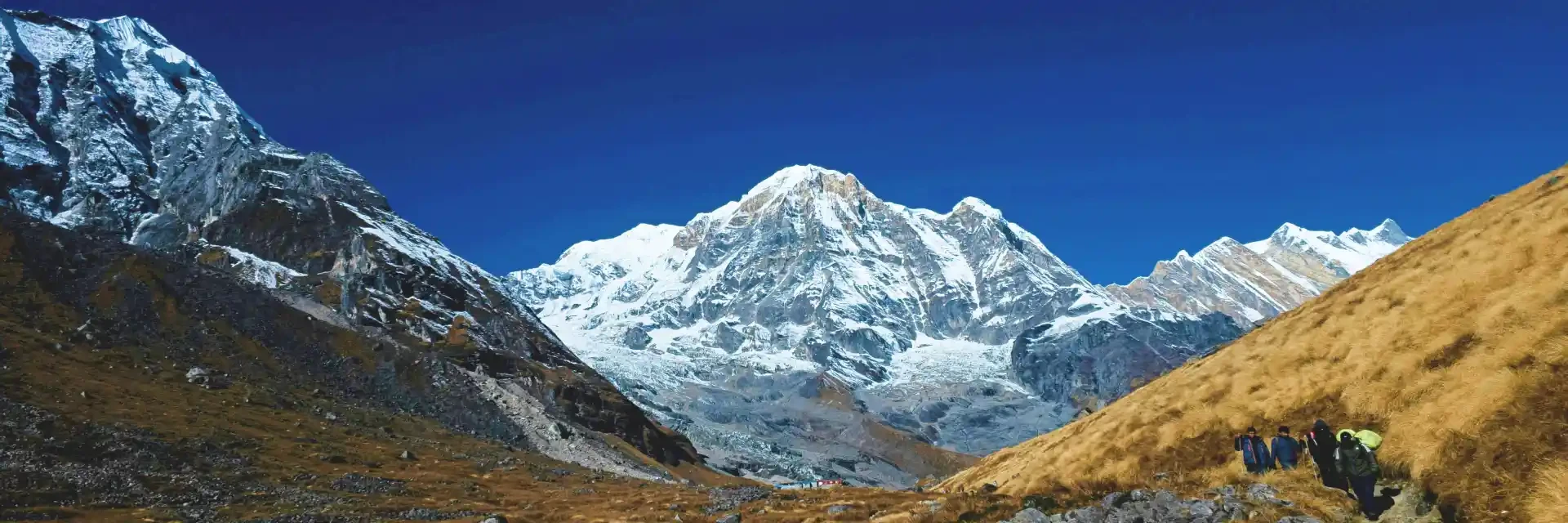
The Annapurna Base Camp trek, also known as the Annapurna Sanctuary trek, is a classic high-altitude journey into a spectacular glacial basin in the north-central Himalayas of Nepal. Surrounded by a ring of peaks exceeding 7000 meters and 8000 meters, including Annapurna I (the world’s tenth highest mountain), the trek offers one of the most immersive mountain amphitheater experiences on earth.
Most travel brochures present the ABC trek as a pristine walk through a mountain sanctuary. The reality involves strict rules and regulations, unpredictable weather corridors, hidden daily costs, and a physical challenge most first-timers underestimate.
This guide covers the 10 essential things nobody tells you about the ABC trek to ensure you are mentally and physically prepared for the sanctuary.
Table of Contents
10 Things Nobody Tells You About the ABC Trek
Altitude is not the main problem
Most trekkers spend months worrying about altitude sickness, but data from the Himalayan Rescue Association suggests that musculoskeletal injuries and gastrointestinal illnesses are far more frequent trip-terminating issues on the ABC route than AMS.
Unlike the more gradual inclines found on parts of the Everest trail, the ABC trek is characterized by relentless, vertical stone staircases.
The Ulleri section alone consists of over 3000 continuous stone steps. The descent from Chhomrong to the riverbed drops thousands of steps, only to climb an equal number straight back up to Sinuwa.
Without specific stair-climbing training and the consistent use of trekking poles, which are non-negotiable for protecting joints on this terrain, many trekkers find their journey ending early because of the “jelly legs” and inflamed patellar tendons.
Going vegetarian above Chhomrong
The Annapurna Sanctuary is a sacred glacial basin believed to be the home of Hindu and Buddhist deities. Local Gurung culture observes a strict “NO-kill” policy from Chhomrong onward. Within this zone, it is strictly forbidden to slaughter animals.
In practice, that means you won't find meat on teahouse menus at higher altitudes. And where meat does turn up, it's a food-safety gamble: it has been carried up by porters in open baskets from lower elevations over several days, without refrigeration. That's why guides almost universally advise sticking to vegetarian food up high because a stomach bug at 3,000 meters dehydrates you fast and can mimic or worsen altitude symptoms.
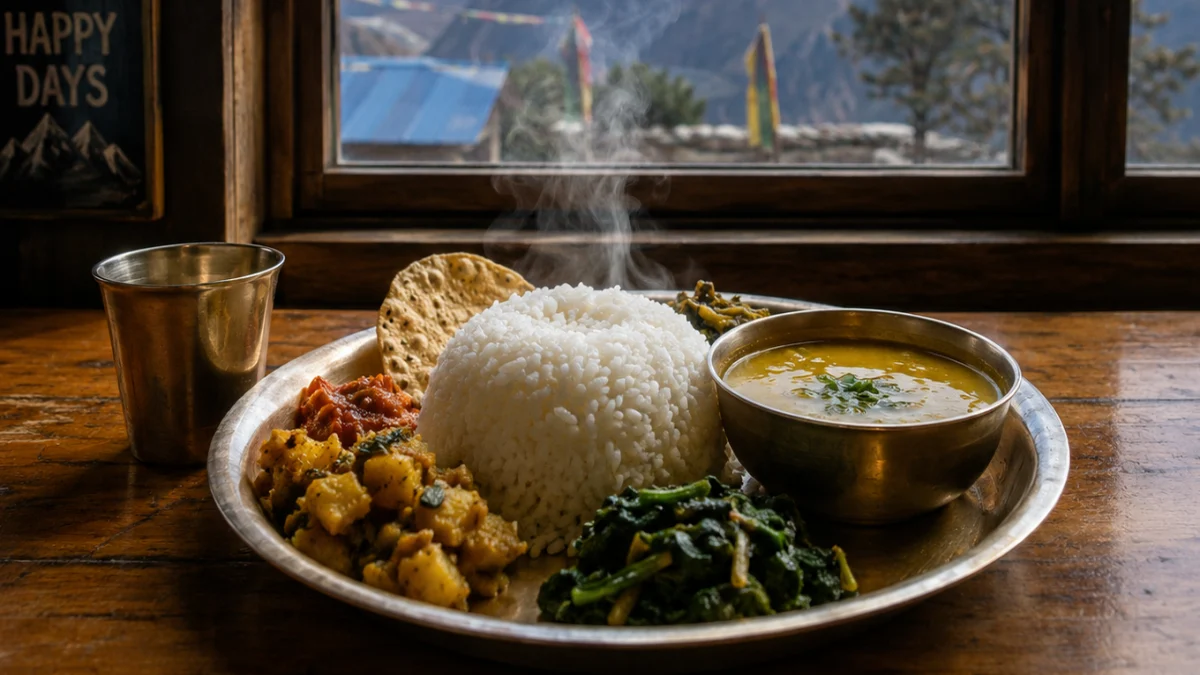
Dal bhat meal served at a teahouse on the ABC trek
What to eat: Dal bhat (lentil soup and rice) is your best friend above Chhomrong. It is filling, nutritious, safe, and many teahouses offer unlimited refills to trekking guests. Eggs remain a safe and reliable protein source throughout the route. Noodle soups, porridge, chapati, and vegetable curries round out a surprisingly satisfying high-altitude menu.
Everything extra costs money
While a basic room at a teahouse in ABC trek costs USD $3-$7 per night at lower altitudes and $10-$20 at higher elevations, teahouses generate their actual profit through cumulative charges for every additional amenity. Warm showers, phone charging, Wi-Fi, and even clean drinking water all come with separate fees that are easy to underestimate.
As you ascend, the cost of supplies rises because everything (fuel, food, gas cylinders) must be transported by mule or porter. There are no reliable ATMs past Nayapul. Carry the NPR equivalent of USD $200–$300 in small Nepalese Rupee (NPR) denominations before you leave Pokhara.
Typical Teahouse Amenity Costs
Typical Teahouse Amenity Costs
Services/Amenity
Typical cost
Operational Reality
Hot shower
USD $3.00 to $5.00 per session
Often uses gas or solar for heating, pipes might freeze in winter and not recommended in MBC and ABC.
Device charging
USD $2.00 to $4.00 per hour or per session
Limited solar/hydro power and available mainly in communal halls.
Wi-Fi access
USD $2.00 to $5.00 per day or per session
Uses satellite links and highly unreliable at high altitudes.
Boiled water
USD $0.75 to $3.00 per liter
Essential for health and price rises significantly with altitude.
Prices are approximate and based on the latest trekking season. Individual teahouses set their own rates
If you aren’t careful, these “hidden” costs can add $10 to $15 to your daily budget.
Your wet clothes will stay wet
Trekkers are often told to pack light and wash clothes on the trail. But the ABC route runs through damp bamboo and rhododendron forest, and between Bamboo and Deurali the humidity and cool air make moisture evaporate slowly.
Laundry hung out in the afternoon rarely dries by morning, and putting on damp garments in the sub-zero temperatures of a Himalayan morning is a major risk factor for hypothermia, not just a discomfort.
To manage this effectively,
Pack three sets of moisture-wicking synthetic or merino wool base layers. Never cotton because cotton retains moisture and loses all insulating capacity when wet.
Use sunny daytime stretches to dry wet items on the outside of your pack while walking.
The communal dining hall of teahouses is often the warmest spot on the property. So, hang damp items there in the evenings.
If you want to know what to pack for your Annapurna Base Camp trek, you can check out our Annapurna Base Camp Packing list for a full gear checklist.
The Deurali-to-MBC Avalanche Corridor
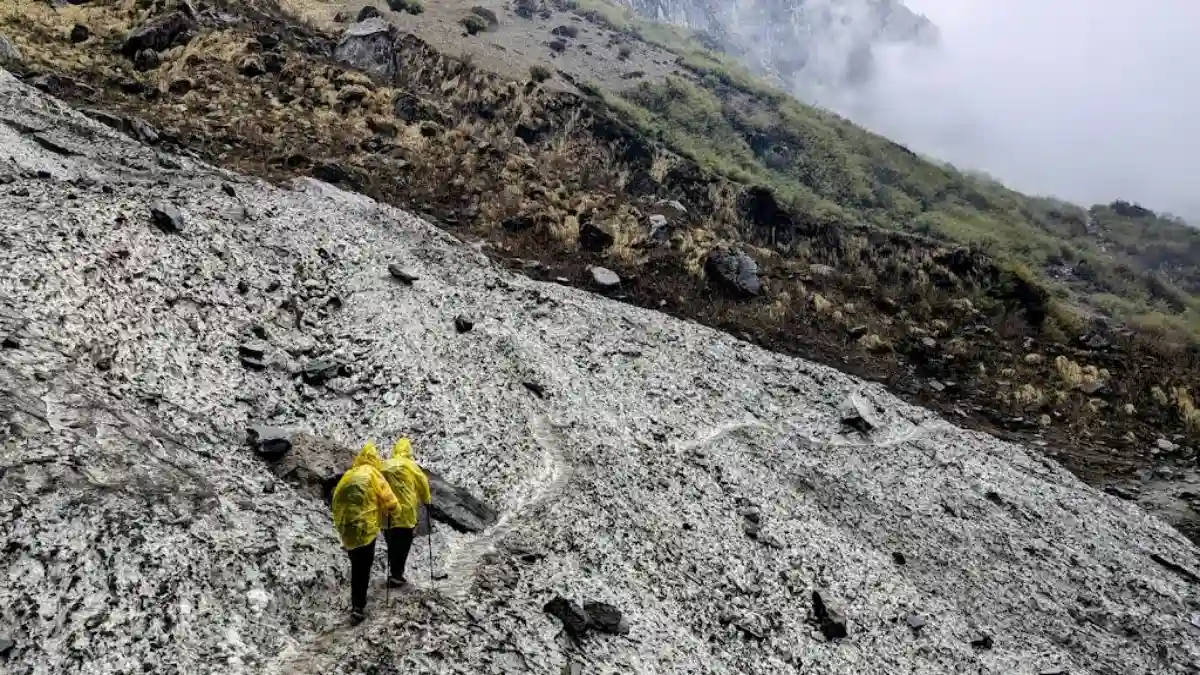
The trail between Deurali (3,230 m) and Machhapuchhre Base Camp (3,700 m) is the most exposed corridor on the trek. It runs through a narrow glacial valley where steep, snow-loaded slopes funnel debris straight across the path.
The risk is seasonal and dynamic. In winter (December–February), cold air pooling in the sheltered bowl slows snow stabilization, producing dry-slab avalanches. In spring (March–May), warming meltwater weakens the snowpack and triggers wet slides, usually in the afternoon. Safe passage means crossing at dawn when the snow is frozen and stable, and following your guide's call on exactly how and when to cross.
ABC trek avalanche corridor
In January 2020, an avalanche hit this section during heavy snowfall, leaving seven people missing, including four South Korean trekkers and three Nepali guides. The trail was closed and remaining trekkers were evacuated downhill; the bodies of missing trekkers were recovered later, after the snow melted with the onset of summer. [source: Khabarhub]
In late March 2025, a Chinese trekker went missing due to an avalanche while returning from Annapurna Base Camp (ABC). The body of the 28-year-old trekker was later discovered in Deurali, Annapurna Rural Municipality-11, near Chhomrong, at a location approximately 20 meters north of the Modi River. [Source: The Kathmandu post]
None of this should put you off. This means you have to plan your trek carefully with the perfect timing for the avalanche-prone area or use alternative trek route. Thousands of trekkers safely cross this section every season with proper timing and local guidance.
Mad Honey: What Trekkers Are Warned About on the Trail
Trekkers may encounter “Mad Honey” being sold or harvested along the trail between 2500m and 3000m. Mad honey is made by Apis laboriosa, the biggest honeybee in the world, which forages on rhododendron blooms full of a neurotoxins called grayanotoxins.Those toxins are what give the honey its potency.
People seek out the mad honey because of its mildly hallucinogenic property and a long history in folk medicine. But it can also be very dangerous if you don’t control the dose. There's no way to eyeball how strong a given batch is, and enough of it slows your heartbeat right down, scrambles the rhythm, and leaves you too dizzy to walk straight. [Source: Grayanotoxin poisoning, National Library of Medicine]
That last part matters more than it sounds. Because you will be days away from a road, a rescue flight depends on clear weather and a lot of money, and "I felt fine after one spoonful" is exactly how people end up taking a second. Most guides just tell you not to.
No trekking alone
Since 2023, Nepal has required foreign trekkers in its national parks and conservation areas, including the Annapurna Conservation Area, where ABC sits, to trek with a licensed guide rather than fully independently. In practice this is checked at entry points such as Birethanti, and most trekkers on ABC now walk with a licensed guide.
A word on the confusion you'll see online. Enforcement of this rule in the Annapurna region has not always been consistent, and you will find reputable-looking sources claiming the area is exempt. Rules and enforcement also shift season to season.
The March 2026 update, for example, eased solo-application rules for restricted areas (Upper Mustang, Manaslu, Tsum Valley) but did not change anything for ABC. Because the picture genuinely changes, treat any single blog (this one included) as a starting point and confirm the current requirement directly with the Nepal Tourism Board or a registered trekking agency before you book.
Trekking without the required guide or permits can mean a fine and being turned back at a checkpoint, so it's not worth the risk even where enforcement is patchy.
Why ABC Teahouses Are So Cold (and What Sleeping Bag You Need)
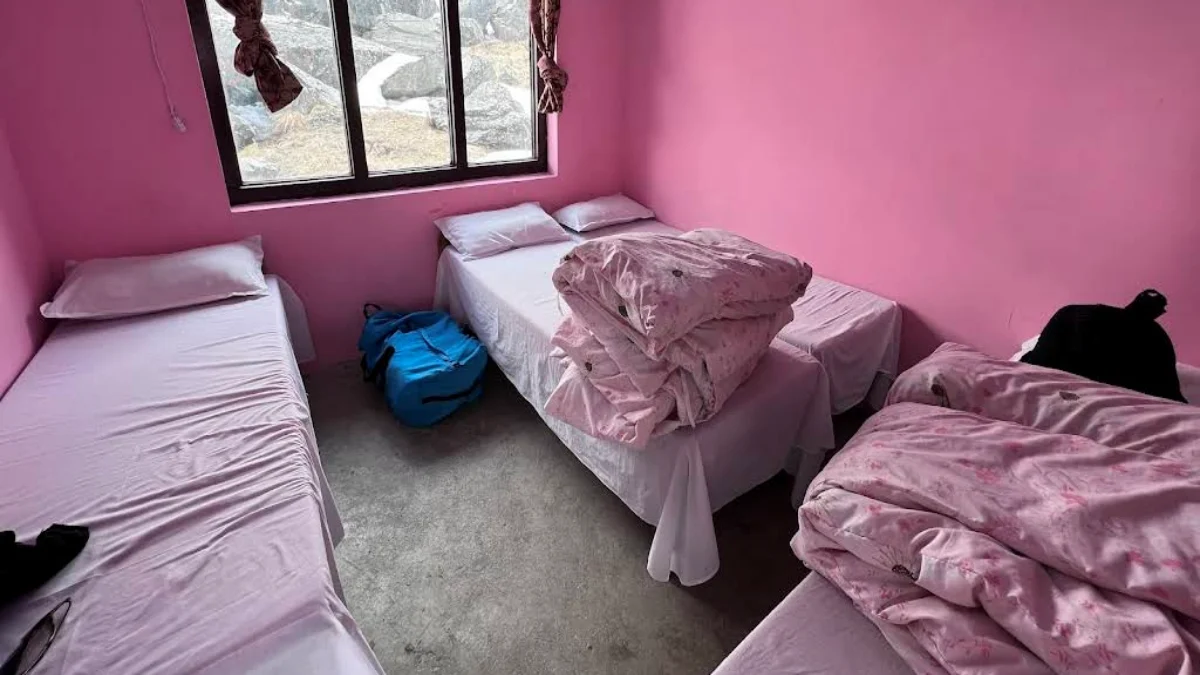
Trekkers often imagine cozy mountain lodges, but teahouses are basic. Rooms are typically small, unheated wooden structures with paper-thin walls that offer no soundproofing. The walls are so thin that the indoor temperatures frequently drop to between -10 °C and -15 °C overnight at base camp. A sleeping bag rated to at least -10 °C is essential for sleeping comfortably.
Basic teahouse room at high altitude on the ABC trek
To combat deforestation in a fragile high-altitude ecosystem, the Annapurna Conservation Area Project (ACAP) has banned wood-burning inside the sanctuary since 1986. And unlike the Everest region, where teahouses use central stoves fueled by dried yak dung, teahouses above Chhomrong have little to no heating in dining halls but in lower trail you can find it. Dress for the cold indoors as well as out.
Walk Like a Turtle: Acclimatization on the ABC Trek
At ABC (4,130m), effective oxygen concentration is approximately 57% of sea-level values. Athletes who push too hard at altitude often fall victim to 'silent hypoxia', ignoring early warning signs because they feel strong, until altitude sickness symptoms become serious. Success on this trail depends on the 'Bistari, Bistari' (slowly, slowly) philosophy.
Recommended ABC acclimatization schedule
Recommended ABC acclimatization schedule
Day
Route
Sleeping elevation
Key acclimatization note
Day 1
Nayapul to Tikhedhunga
1,540 m
Easy warm-up, legs adjust to trail terrain
Day 2
Tikhedhunga to Ghorepani
2,860 m
First big gain, Ulleri staircase hits here
Day 3
Ghorepani to Chhomrong
2,170 m
Descent rests cardiovascular load
Day 4
Chhomrong to Dovan
2,600 m
Stay well within the 500 m/day rule
Day 5
Dovan to Himalaya Hotel
2,920 m
Short day, body adjusts to forest cold and humidity
Day 6
Himalaya Hotel to Deurali
3,230 m
Rest here if any headache is present, do not push on
Day 7
Deurali to MBC
3,700 m
Cross the avalanche corridor at dawn, short afternoon rest
Day 8
MBC to ABC
4,130 m
Sleep at ABC, acclimatization day built in by altitude gain pattern
Day 9
ABC to Bamboo (descent)
2,310 m
Descend fully, most altitude symptoms resolve rapidly on the way down
This schedule is a general guide. Always listen to your body and your guide over any fixed itinerary. If you experience persistent headache, nausea, or loss of coordination at Deurali or MBC, add an extra rest night before ascending further. Never ascend with AMS symptoms.
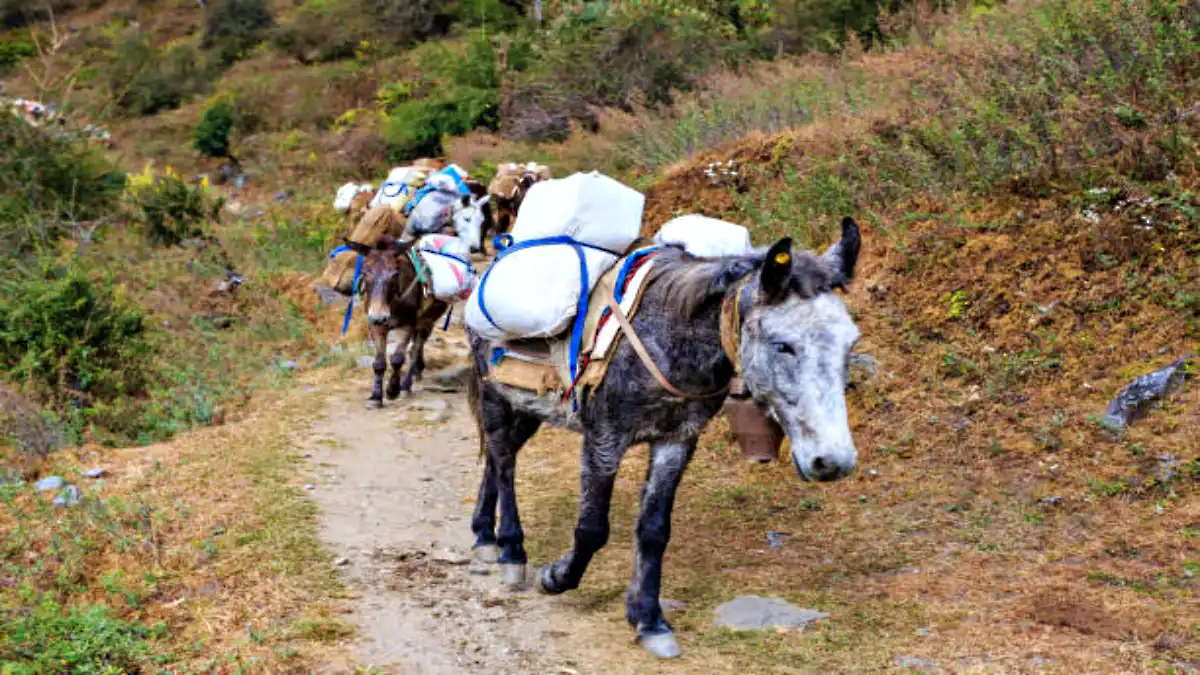
Mule Traffic has the right of way
The trails on the ABC route are not just for trekkers. They are working supply lines, and mule trains are the trucks of the Himalayas. From early morning onward, you'll hear them before you see them, a low jingle of bells echoing off the canyon walls, sometimes a full minute before the lead animal rounds the bend. That bell is a warning, and the rule that follows it is non-negotiable.
Mule train carrying supplies on a narrow ABC trail
When you hear bells, stop walking and move to the uphill side of the trail. Stand still, keep your backpack against the rock face, and wait for the entire train to pass. Never stand on the downhill (cliff) side. A loaded mule carries wide wooden frames packed with gas cylinders, rice sacks, sheets of corrugated tin, or stacks of beer crates that extend well beyond its body. The animals walk a fixed line and will not step around you. Trekkers have been knocked off ledges, pushed into ravines, or had limbs broken by a swinging load simply because they chose the wrong side.
A few practical rules that experienced guides drill into clients:
Yield to the mule train even when you’re going uphill and they’re going down.
Don’t try to take photos mid-pass. A mule spooked by a sudden phone in its face can bolt, and the entire train will follow.
Don’t pet, feed, or touch the animals. They are working stock, not pets, and some will bite.
Watch where they’ve been. Mule trains leave fresh dung across the trail, especially on stone steps where it becomes slick and dangerous after rain.
Final thoughts
The Annapurna Base Camp trek is one of the most beautiful journeys you can do on foot. The version that ends well is the one that was planned honestly, not the one built on brochure promises. This is one of the short treks in Nepal where you can actually reach the base camp in a short time frame.
The stone staircases will test your knees more than the altitude tests your lungs. The cold arrives faster and cuts deeper than most people expect. Costs add up in ways that never appear in the headline price. The trail asks for respect from your first step to the moment you walk back out.
None of that is a reason not to go. It’s a reason to prepare properly. Train for stairs before you leave home. Pack a sleeping bag rated for the temperature you’ll face. Go vegetarian above Chhomrong. Start early on the Deurali to MBC section. Walk slowly, drink constantly, and listen to your guide even when you feel fine.
Trekkers who struggle on ABC are not the ones who are unfit. They're almost always the underprepared ones.
At Breeze Adventure, our all-inclusive packages handle all permits and logistics, so you don’t have to go through the trouble of acquiring permits. And you can contact our team for custom itineraries for your trek.
FAQs
Q. Do I need a guide for the Annapurna Base Camp trek in 2026?
Yes. Since April 2023, all foreign trekkers in the Annapurna Conservation Area are legally required to hire a licensed guide through a registered agency. Checkpoints along the route verify compliance, and trekking without a guide risks a fine and removal from the trail.
Q. How safe is the ABC trek?
It’s one of Nepal's safer, more beginner-friendly routes. The trail is well established, teahouses run the whole way, and you're rarely alone in peak season. Safety improves further if you trek in spring (March–May) or autumn (September–November).
You need two permits to trek ABC: the Annapurna Conservation Area Permit (ACAP) and the Trekkers' Information Management System (TIMS) card. Since the 2023 regulation change, both must be arranged through a registered trekking agency alongside your guide booking.
Q. Which month is best for the ABC trek?
The two best months for the ABC trek are April in spring and October in autumn. These seasons offer stable weather, clear mountain views, and comfortable trekking temperatures.
Q. Is altitude sickness a serious risk on the ABC trek?
The risk is real but manageable with proper acclimatization. ABC sits at 4,130 m, where oxygen is roughly 57% of sea-level concentration. Following the 300–500 m-per-day sleeping-altitude guideline above 3,000 m (see the schedule in point 9) cuts the risk significantly. A persistent headache, nausea, or loss of coordination are signs to stop and descend, not push on.
Kishwor Adhikari is a passionate writer with a deep enthusiasm for trekking and adventure. His extensive travels across Nepal, exploring its diverse landscapes and hidden corners, have shaped his unique perspective on the country's natural beauty. With a wealth of first-hand experience in adventure trekking, Kishwor has become a trusted voice for fellow enthusiasts. Through his writing, he shares invaluable insights, offering practical advice and inspiration for both seasoned trekkers and novices alike. His dedication to sharing his journey and knowledge helps others discover the wonders of Nepal's wilderness, making his work an essential resource for anyone seeking adventure in the region.