I didn't fully understand what people meant when they said Annapurna feels different until I was standing inside the Sanctuary at 4,130 metres. It was completely surrounded by mountains on every side. Then I realised, I wasn't looking at the Himalayas anymore, I was standing inside them. That shift, from spectator to participant, happens nowhere else quite like it does here. The Annapurna Himalayas don't perform for you from a distance. They fold around you, close in gently, and then suddenly you're in the middle of something ancient and enormous and deeply, quietly alive.
The ABC trek, the Himalaya base camp that Nepal's trekking world is genuinely proud of, is not the highest or the longest Himalayan trek in Nepal. But it might be the most complete one. In roughly 6 to 10 days, you walk through rhododendron forests, terraced Gurung villages, river gorges, bamboo groves, and bare glacial moraine. Then you step through a narrow gap between two sacred peaks (Machhapuchre and Annapurna I) into a world that few people on earth have ever seen.
This blog from Breeze Adventure is based on a decade-long experience in Annapurna Himalayan trekking. It is for every Himalayan dreamer planning their first or next time.
Table of Contents
The Mountains, the Sanctuary & the Feeling in ABC Trek
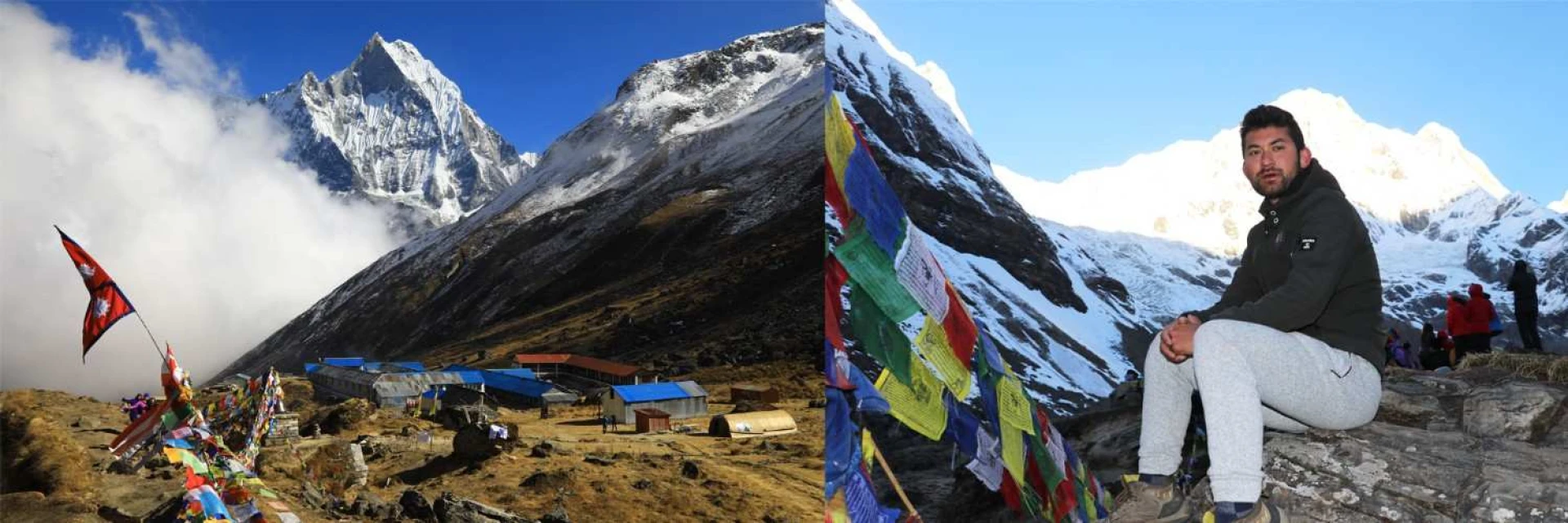
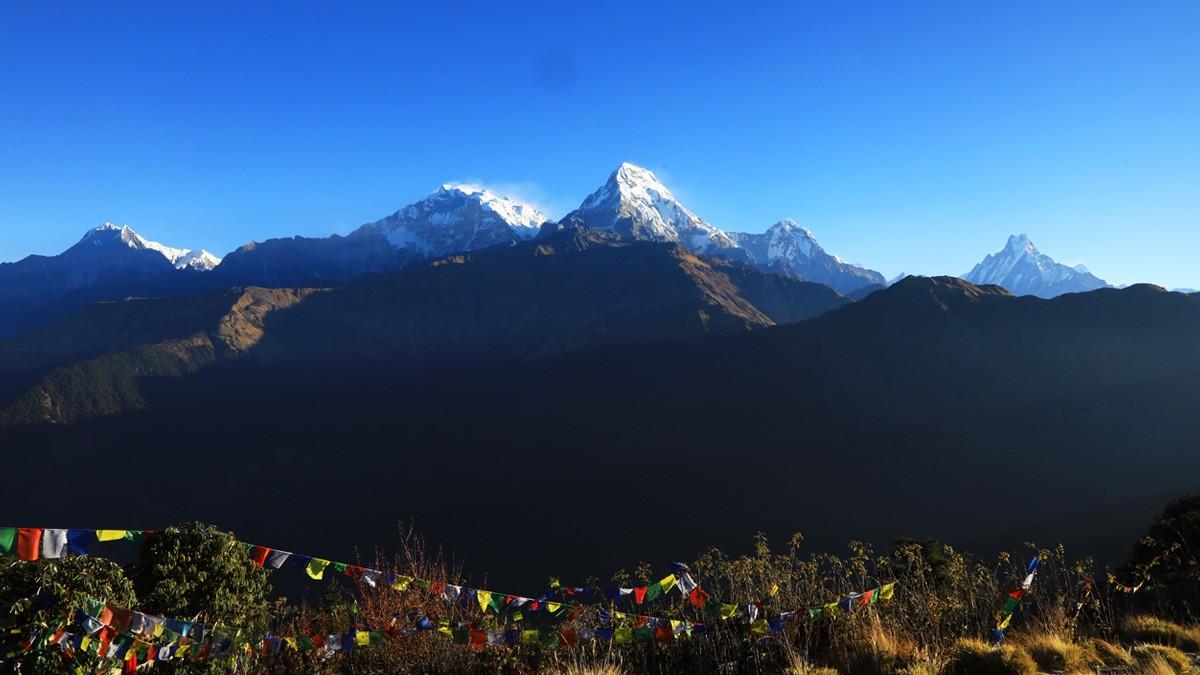
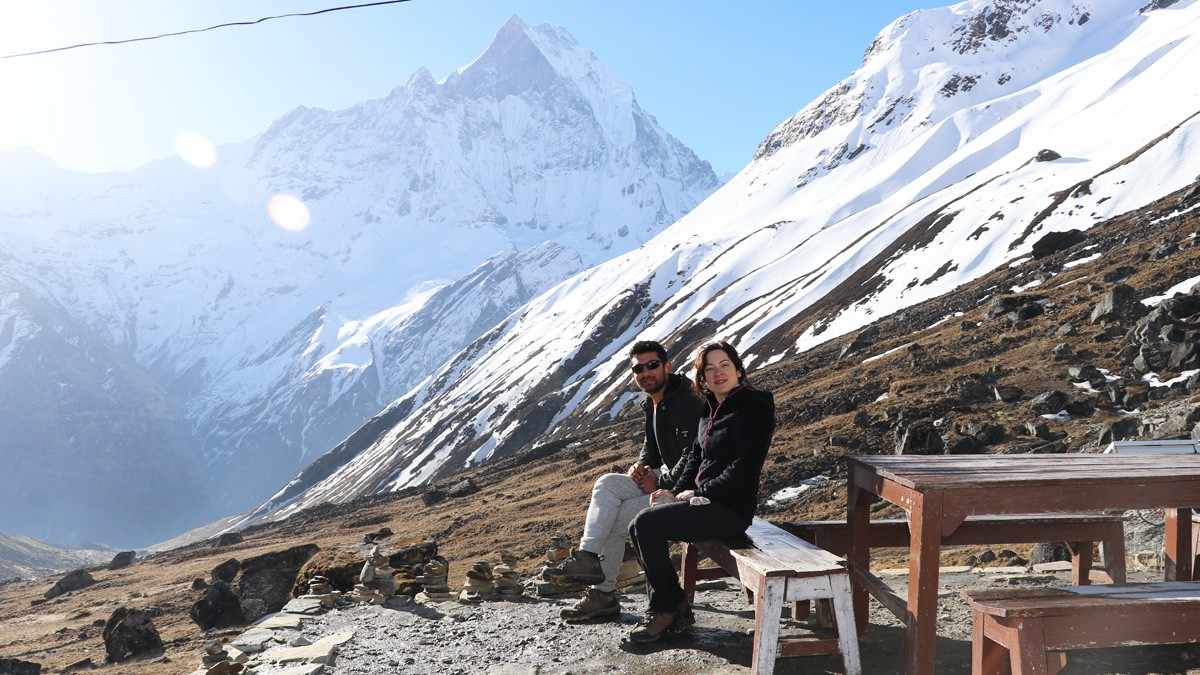
Beautiful Himalaya view captured in ABC Trek Nepal
Himalaya is all about the mountains, the sanctuary, and the mesmerizing feeling, giving a lifetime of the best moments.
Why is Annapurna Base Camp called the heart of the Himalayas?
The name isn't a poetic exaggeration, actually, it's geography. Annapurna Base Camp sits inside a high glacial basin completely enclosed by a ring of peaks above 7,000 metres. There you see Annapurna I (8,091 m) dominating the north.
No other base camp in the Himalaya Annapurna circuit or beyond places you this deep inside a living mountain amphitheatre. You're not at the foot of the mountain, you're inside its embrace. You won't believe what you see in this trail.
What is the Annapurna Sanctuary, and why is it a natural amphitheater?
The Sanctuary is a high glacial basin, roughly circular, roughly 5 km across, entirely rimmed by peaks. The only way in or out is a narrow gorge between Machhapuchhre (6,993 m) and Hiunchuli (6,441 m).
When you enter through that gap, and the walls open up around you, the sensation is genuinely theatrical. It will be like stepping onto a stage ringed by stone giants. Himalayan trekkers who've done both EBC and ABC consistently say the Sanctuary feels more enclosed, more intimate, and more dramatic.
What does it feel like to stand inside a 360° ring of snow peaks?
Photographs don't prepare you for it. You turn slowly, and there will be Annapurna I, Annapurna South, Hiunchuli, Machhapuchhre, Gangapurna, and Annapurna III. Further, there's just no gap, no horizon, no escape route. It's overwhelming in the best possible way, and oddly calming at the same time.
Most people go quiet. Some sit down, and some also cry. The scale collapses your sense of self in a way that's strangely peaceful rather than frightening. The feeling is just undefinable.
Which mountains can you see from Annapurna Base Camp, and how do you identify each one?
From the base camp clearing, you're looking at: Annapurna I (the big one, north, the dark, heavily fluted face). Also, Annapurna South (southwest, perfectly symmetrical pyramid shape), Hiunchuli (southeast, smaller but fierce-looking), Machhapuchhre (east, the iconic fishtail double-summit), Gangapurna (northeast, a broad white shoulder with a hanging glacier), and Annapurna III (further northeast).
The teahouse staff at ABC can usually point each one out on arrival. Kindly take five minutes to learn them. Standing there not knowing anything is a genuine waste. So, have an idea about them before reaching there.
Why is Machhapuchhre (Fishtail) sacred and never climbed?
Machhapuchhre is considered the home of the god Shiva in local Gurung and Hindu belief. It is a living sacred mountain, not a climbing objective. The Nepalese government banned all attempts after a British expedition reached close to the summit in 1957 without summiting, and the prohibition has held ever since.
Locals around Ghandruk and the Sanctuary villages still speak about it with a seriousness that isn't folklore; they mean it. Watching that twin-peaked silhouette at dusk while someone below you in the teahouse kitchen is burning incense makes the reverence feel entirely reasonable. This is a unique sight, you won’t forget for years.
What does sunrise from inside the Sanctuary look like, compared to Poon Hill?
Poon Hill (3,210 m) gives you a panoramic sunrise across the entire Annapurna-Dhaulagiri range from a safe, comfortable distance. It's genuinely beautiful. But sunrise from inside the Sanctuary at ABC is something else. Here, the peaks above you catch the alpenglow first, turning blood-orange against a still-dark sky, and the light slowly drops down the faces towards you.
You're not watching a mountain sunrise. You're standing inside one. If you have to choose, and most trekkers do both on the same trip, ABC wins by a significant margin.
What does it actually feel like to reach Annapurna Base Camp?
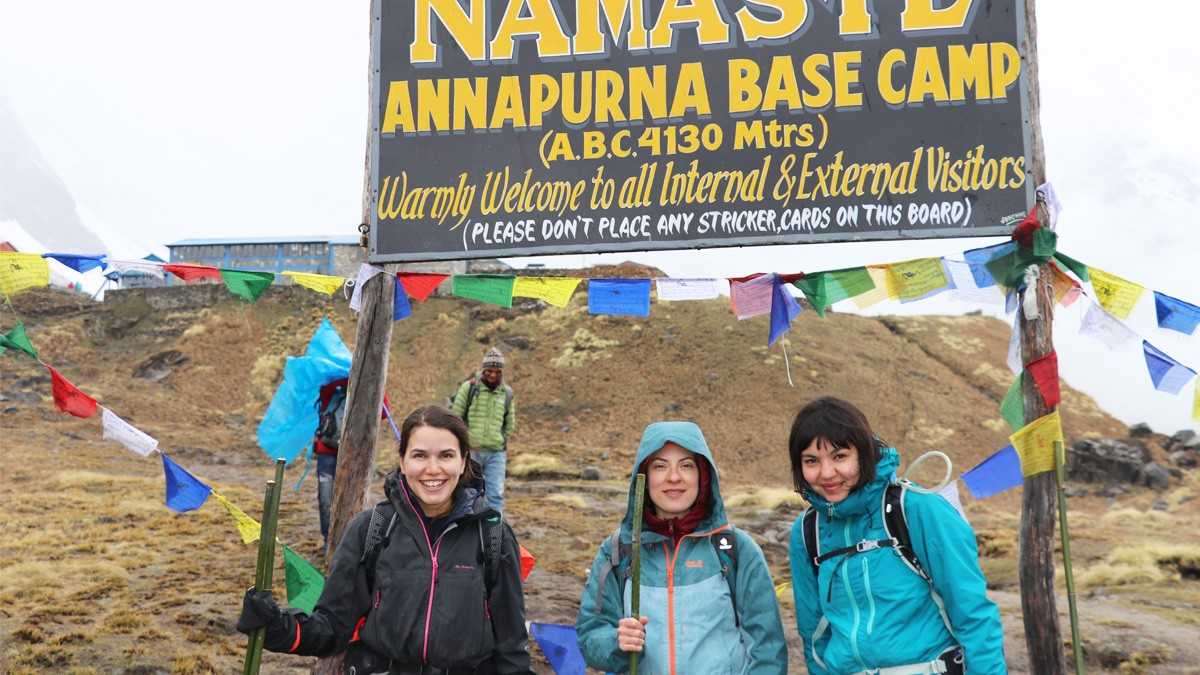
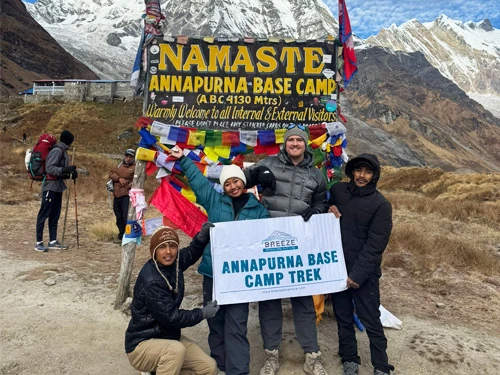
Foreign Trekkers sharing joy of achievement in Annapurna Base Camp at 4130 m
Let me tell you this from my years of experience in the Himalayas. By the time you arrive, you're tired. Your legs have done Machhapuchhre Base Camp to ABC that morning, the altitude is probably pressing on your temples, and the last 90 minutes of the moraine trail are relentlessly grey.
And then the basin opens, the peaks appear in their full ring, and your body's complaints become completely irrelevant for a while. It doesn't feel like a finish line, it feels more like arriving somewhere that's been waiting.
How do the landscapes transform from jungle to glacier along the trail?
The transformation is one of the great pleasures of this trek. This literally unfolds in clear bands over the days. You start in a subtropical forest, climb into dense rhododendron and oak, and then pass through moss-covered trails that feel almost like old England on a wet day.
Then emerge into the bare bamboo and grass terraces above Dovan, and finally, the trees disappear entirely as you enter the glacial moraine below MBC. It's like watching a time-lapse of altitude ecology, compressed, vivid, and impossible to miss.
I can't remember which day exactly, fourth or fifth, but somewhere above Dovan the trees just stopped. For me, it was a magical moment.
ABC vs. EBC- which feels more "inside the mountains"?
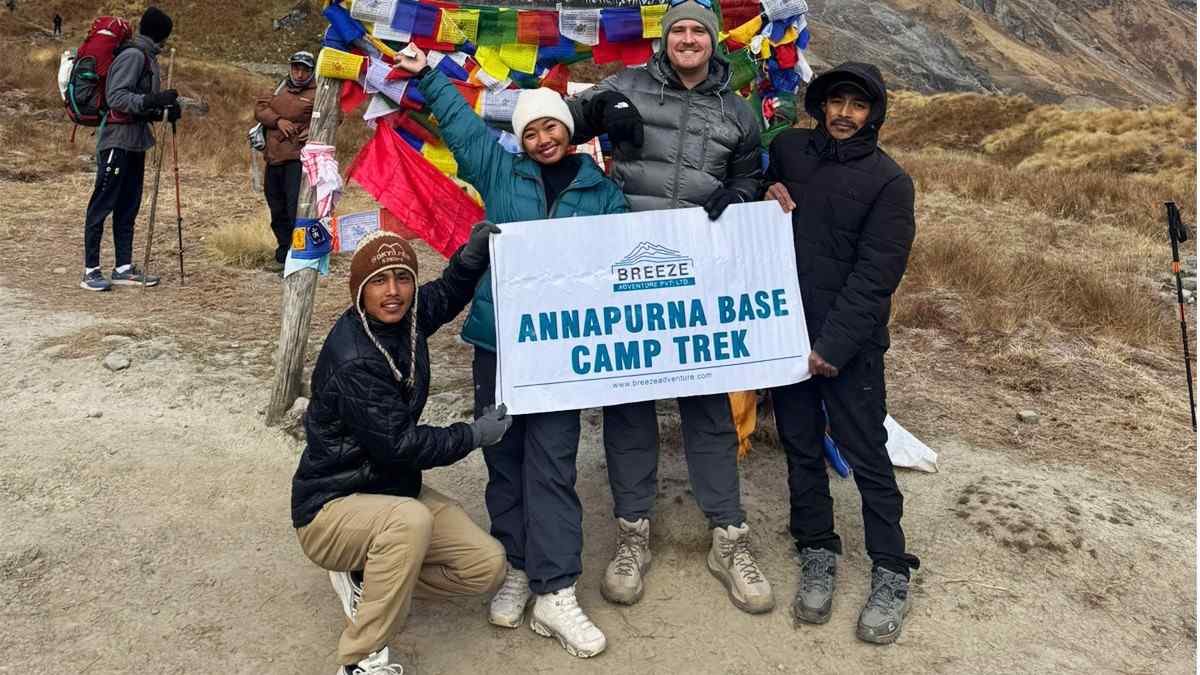
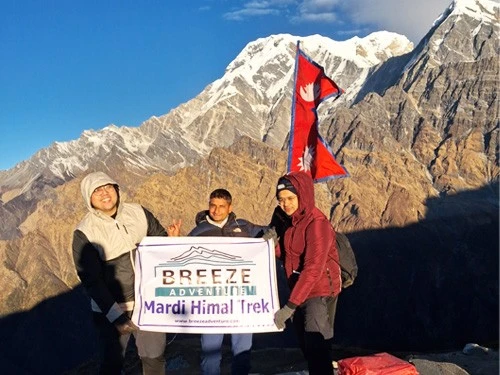
Breeze Adventure Team with happy trekkers holding company banner in Annapurna Base Camp
EBC is longer, rougher, and culturally richer in a different way. There, you see the Sherpa villages and high-altitude monasteries carry a weight that's hard to match. But EBC base camp itself sits at the edge of the Khumbu Icefall; you're not inside a ring of peaks, you're beside a glacier looking up at one.
Meanwhile, ABC puts you inside a closed basin. For the feeling of being completely surrounded by the mountains. You will feel like having been accepted into their interior. So, yes, ABC is the more immersive experience. Most trekkers who've done both say exactly this.
What is the moment of entering the "gates of the Sanctuary" like?
The approach through the gorge between Machhapuchhre and Hiunchuli is narrow, often icy or snow-covered. And this has a genuine sense of passage, like you're crossing into somewhere. Similarly, the walls rise sharply on both sides as the trail squeezes along the moraine.
Then, without announcement, the basin opens. Your first instinct is to stop walking. Almost everyone does. It's one of those moments that divides time into before and after.
Why did locals historically consider the Annapurna Sanctuary sacred, and what was forbidden inside it?
The Gurung people, who have herded yaks and farmed the middle hills below the Sanctuary for centuries, traditionally considered the inner basin the domain of the mountain gods. Menstruating women were historically not permitted to enter. It was believed their presence could anger the gods and trigger avalanches or bad weather. Certain animals could not be slaughtered inside.
These weren't abstract rules; they governed the actual behaviour of shepherd communities who used the high pastures seasonally. The traditions have softened as trekking has transformed the region.
But older Gurung residents in Ghandruk and Chhomrong still speak of the Sanctuary with a deference that feels inherited rather than performed.
What is the Anatoli Boukreev memorial at ABC?
Near the lodges at Annapurna Base Camp stands a simple memorial to Anatoli Boukreev. He was the Russian-Kazakh mountaineer who died in an avalanche on Annapurna on Christmas Day 1997 while attempting a winter traverse.
Boukreev was one of the greatest high-altitude climbers in history, famous for his extraordinary rescue efforts during the 1996 Everest disaster. The memorial is understated, weathered, and easy to miss, but worth finding.
Standing next to it at 4,130 metres, with Annapurna I looming above, gives you a physical sense of what this mountain has asked of people.
How often do you hear avalanches from base camp at night?
You hear this often. Annapurna I has one of the highest avalanche-death rates of any 8,000 m peak in the world. And the enormous faces above ABC regularly shed snow and ice. Especially after temperature shifts at dawn and dusk.
The sound travels across the basin like distant thunder, and if you're awake, you'll often see the dust cloud rising in the moonlight. I watched three of them from my sleeping bag through the window gap. Couldn't sleep after that, not because I was scared. Just... awake. This is one of the most memorable parts of the journey.
What does the night sky look like from 4,130 m?
On a clear night, the Milky Way above the Sanctuary is one of the most absurd things you'll ever see with your own eyes. No city light, no haze, very little humidity at that altitude. There will be just a river of stars so dense it looks structural, like something holding the peaks apart. This stargazing experience in ABC is priceless, not just for scenic beauty but also for calm relaxation to mind and body. You will feel like open air therapy from distant sky.
Jupiter and Venus are often bright enough to cast faint shadows. Make sure you bring a warm sleeping bag liner and lie outside for 20 minutes before you go to bed. You won't regret it.
What is the pre-dawn headlamp walk from MBC to ABC like?
The walk will be cold, dark, and steep in places. This literally feels like one of the best hours of the entire trek. Most trekkers leave Machhapuchhre Base Camp between 4:30 and 5:30 am to catch sunrise at ABC. This means you're picking your way up the moraine trail by headlamp with the peaks above you slowly separating from the sky.
The silence is absolute except for your own breathing and the crunch of frozen mud underfoot. When the first light touches the summit of Annapurna I above you, you're still walking up towards it in the dark. That is the trek distilled into a single image.
Why do some trekkers get emotional on arriving at ABC?
ABC Trek is on the bucket list for millions of people around the world. Yes, most of them have been carrying the idea of the Himalayas for a long time, years, sometimes. The Himalayan dream trek isn't just a holiday for most people who do it; it's something they've worked towards, saved for, and trained for.
They feel like, finally, I am here, I actually did it. With the added altitude, physical exhaustion, and the sheer visual overload of the Sanctuary, the emotional response makes complete sense. There's no shame in it.
Annapurna Base Camp Culture, Seasons & the Living Trail
Snow covered trail in Himalaya ABC Trek Nepal
Well, the Annapurna Base Camp Nepal, through the heart of the Himalayas, means a magical blend of culture, seasons, and the living trail.
What is teahouse life and Gurung village hospitality like along the ABC trail?
The teahouses along the ABC route, particularly in Chhomrong, Sinuwa, Bamboo, and Dovan, are run almost entirely by Gurung families. Further, the hospitality is genuine rather than commercial in feel.
You'll be given a room (shared walls, thin mattresses, thick blankets), a menu printed in five languages, and almost certainly dal bhat for dinner. Locally grown rice, lentil, and green veggies are the ultimate powerhouse. This is because at altitude and after six hours of walking, nothing else comes close.
Families often eat with you, the kitchen fire stays lit late, and conversations with other trekkers around a shared table are one of the underrated pleasures of Nepal's trekking culture. The freshly cooked warm meal is served, and trust me, the local taste has authenticity that is just unmatchable. You can’t help but love it.
Saying that, there are some flaws also, which I must mention to protect you from bigger expectations. The rooms are another story. Yes, shared walls mean you hear everything: the couple arguing in the next room, someone's 3 am bathroom shuffle, and a snorer who somehow sounds louder at altitude. This is the sweetest compromise you pay for the breathtaking mountain beauty. But this is mostly in higher altitudes where lodge options are limited.
When do the rhododendron forests bloom in the ABC Trail, and what do they look like?
March and April are the months for rhododendron bloom. Nepal's national flower, the lali gurans, a deep crimson rhododendron, covers the forests. This is mostly between Ghandruk and Chhomrong in a blaze of red, pink, and occasionally white.
Walking through those forests during peak bloom, with petals on the trail and the upper peaks appearing through the colour above you, is one of the genuinely beautiful experiences on any Himalayan trek in Nepal.
Well, Autumn (October–November) offers clearer skies and sharper mountain views; spring offers the forest. Both seasons are right. It depends on what you want more.
What is the Jhinu Danda hot spring experience like after Annapurna Base Camp?
It's exactly as good as it sounds. Jhinu Danda sits about an hour below New Bridge on the descent. And the natural hot springs are right beside the Modi Khola river. Here, you're soaking in warm sulphurous water with your legs destroyed from the trek, while cold mountain air moves across the gorge above you.
Most trekkers who add the detour down to Jhinu (it's a steep hour each way from the main trail) say it was worth every extra step. Do it on the descent and don't rush it.
How does the Annapurna Sanctuary feel different in spring, autumn, vs. winter?
Spring (March–May) brings rhododendrons below and occasional clouds at altitude. So the Sanctuary can fill with mist in the afternoon, giving it a mystical, sealed-off quality.
Autumn (October–November) is crystal clear, colder at night, and the views are at their sharpest, so most trekkers choose this window.
Winter (December–February) is a completely different undertaking. During this time, the gorge approach can be closed by snow, with temperatures at ABC dropping well below -10°C at night. This led you to often have the entire Sanctuary to yourself. The silence and solitude of a winter morning at base camp are apparently extraordinary, but go only if you're prepared and with a licensed guide.
Hence, the best time for the Annapurna Himalayan Trek matters as per your priority in the trip. Choosing the right time makes your journey enjoyable as well as satisfying.
What is the South Annapurna Glacier, and how is it changing?
The South Annapurna Glacier flows down from the main Annapurna massif into the Sanctuary basin. It's the glacier you're essentially walking on, or beside, during the final approach to base camp.
Guides and older teahouse owners in the area will tell you, without any political framing, that the glacier has retreated noticeably over the past two decades. The moraine fields are wider, the bare rock is more exposed, and the snow line sits higher each year.
It's one of those places where climate change isn't a news story. Rather, it's something you can see in the landscape itself, if you know what you're looking at.
Quick Facts for Trekkers
Best seasons: October–November (clearest views), March–April (rhododendrons)
Typical duration: 6–10 days
Maximum altitude: 4,130 m at Annapurna Base Camp
Permits needed: ACAP (Annapurna Conservation Area Permit) + TIMS card - both available in Pokhara or Kathmandu. The travel agency handles this on your behalf.
Fitness level required: Moderate to good, no technical climbing, but long daily walking days at altitude
Altitude sickness risk: Real above 3,000 m. So, ascend slowly, hydrate well, don't rush MBC to ABC
Gear essentials: Layered clothing, good trekking boots (waterproof), trekking poles, headlamp, and sleeping bag liner.
Kishwor Adhikari is a passionate writer with a deep enthusiasm for trekking and adventure. His extensive travels across Nepal, exploring its diverse landscapes and hidden corners, have shaped his unique perspective on the country's natural beauty. With a wealth of first-hand experience in adventure trekking, Kishwor has become a trusted voice for fellow enthusiasts. Through his writing, he shares invaluable insights, offering practical advice and inspiration for both seasoned trekkers and novices alike. His dedication to sharing his journey and knowledge helps others discover the wonders of Nepal's wilderness, making his work an essential resource for anyone seeking adventure in the region.