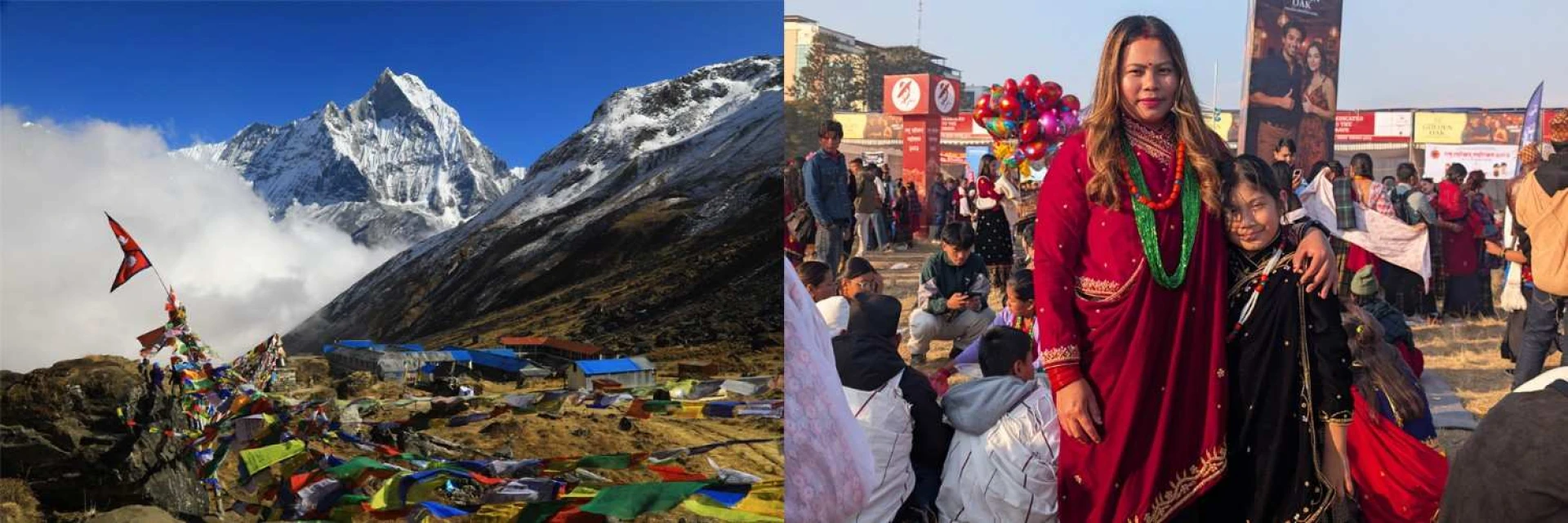
Most trekkers come to the Annapurna Sanctuary for the mountains. They post the same photo of Machapuchare at sunrise, write a caption about "finding themselves," and fly home. What they often miss and what makes this trek genuinely different from Everest Base Camp or the Manaslu Circuit is that the trail walks straight through one of the most culturally distinct living villages in the Himalaya.
The ABC trail isn't a wilderness route. It's a cultural one. For the first three days, you're not hiking through nature; you're hiking through somebody's farmland, somebody's grandmother's courtyard, somebody's centuries-old ridge-top settlement. That somebody, most often, is Gurung or Tamu, as they call themselves.
This guide from Breeze Adventure is for the trekker who wants to understand the place, not just check off the altitude. We'll cover where the Gurungs come from, how they actually live in these mountain villages today, what their dress and jewelry mean, what a Gurung wedding involves, and how to be a thoughtful guest in the teahouses you'll stay at along the way.
Table of Contents
Who are the Gurungs - Ancestry and Origins
Gurung culture in Annapurna Base Camp Region Nepal
The Gurungs are an indigenous ethnic community of central Nepal who refer to themselves as Tamu. In their own language, "Ta" means thunder, and "mu" symbolizes sky. It means people from high-altitude mountains.
The question of where they came from is one of the more contested in Nepali ethnography, and worth understanding because it shapes everything about the culture. Similarly, the language, the religion, the look of the villages, and even the food.
The mainstream scholarly view traces Gurung ancestry to the Tibetan plateau, with a slow southward migration into the Annapurna foothills. Their origins are uncertain, although they are of Mongoloid stock and their ancestors may have migrated to their current location from Tibet around 2,000 years ago. More recent work pushes the origin further north and west. A doctoral thesis at Sichuan University by Tek Bahadur Gurung argues the actual place of origin lies in the triangular zone of Kokonor, the upper Yellow River, and southwest China, supported by DNA analysis showing roughly 26% Mongolian, 15% Tibetan, and 34% Naxi/Yi ancestry components.
Wikipedia and several recent ethnographic summaries link Gurung ancestry specifically to the Qiang people of Qinghai, China, with the migration into Nepal happening through the high passes of Mustang and Manang.
What everyone agrees on:
The Gurungs are of Tibeto-Burman, not Indo-Aryan, origin
Their migration into the Annapurna foothills happened somewhere between 1,500 and 2,000 years ago
They were originally semi-nomadic herders - historically living a semi-nomadic lifestyle, herding sheep and yaks in the Himalayan foothills, before settling into the mid-hill villages that exist today
The Gurung language, Tamu Kyi, belongs to the Sino-Tibetan family. It is rich in stories, proverbs, and folk songs. The language was traditionally oral. With the community's efforts, it has also developed into written forms. If you hear villagers in Ghandruk speaking among themselves and it doesn't sound like Nepali, that's why. It's a different language entirely.
Village Life in the Mountains: How a Gurung Settlement Actually Works
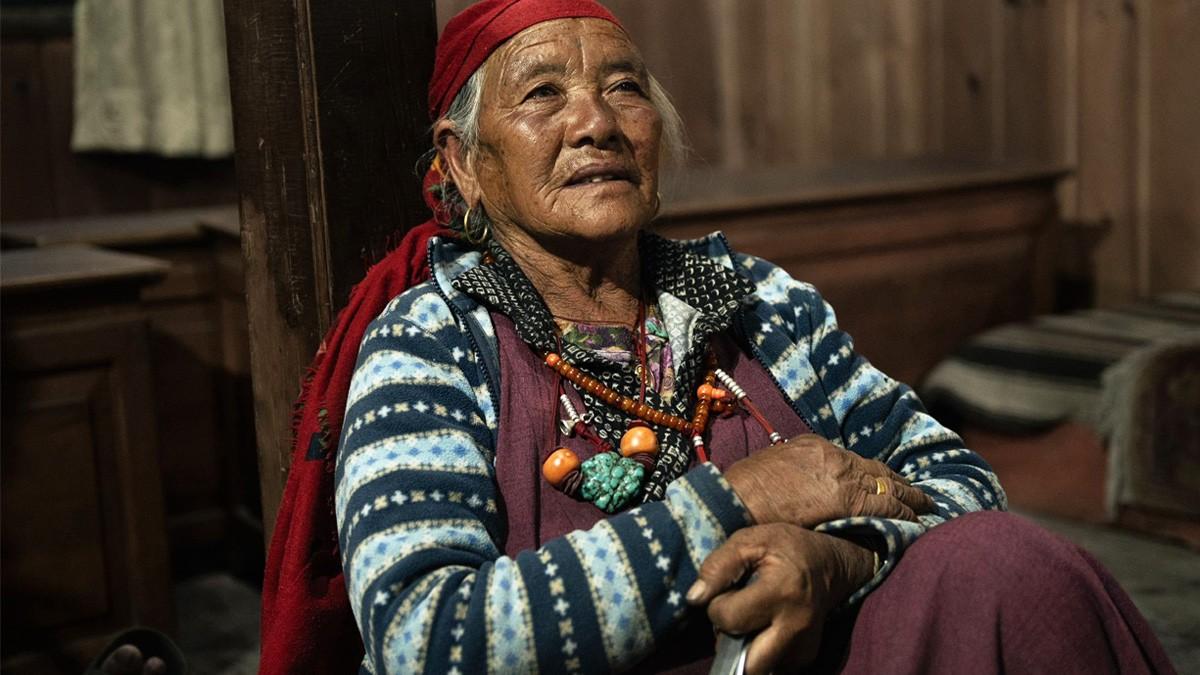
Gurung grandma in traditional attire
The classic image of a Gurung village in the mountains appears unique, having stone houses with slate roofs, terraced fields stepping down a ridge, and prayer flags strung between rooftops. But what looks picturesque to a trekker is, on the ground, a working agricultural economy that has held together for centuries through some very specific arrangements.
Settlements
Their villages on the ABC trail (Ghandruk, Landruk, Chhomrong, Ghorepani's edge) sit between roughly 1,500 and 2,200 meters. That altitude band isn't accidental. It's high enough to be free of monsoon mosquitoes and lowland diseases, low enough to grow millet, maize, potatoes, and rice on terraces. Farming is still a big part of life here. Maize, millet, and potatoes, plus they raise livestock. So, people here are still living very well off the land.
Houses
Look closely at their traditional house, and you'll see three things: stone walls (often whitewashed with lime), slate-tile roofs that survive monsoon hammering, and a raised verandah on the ground floor where most of daily life happens. You will see them cooking, sorting grain, drying chilies, and gossiping.
The upper floor stores grain and sleeps the family. The newer construction in Ghandruk is concrete and tin, but the conservation rules within the Annapurna Conservation Area still encourage traditional materials.
Work
Mornings start before sunrise. Buffalo and goats are milked, fields walked, and water collected. Until the road reached Ghandruk a few years ago, everything moved by foot or mule. Now there's a road, which the villagers appreciate far more than the nostalgic trekkers who lament the loss of "authenticity."
The Gurkha economy
You cannot understand a modern Gurung village without understanding remittances. After the Treaty of Sugauli in 1816, the British started recruiting soldiers into the British Army from the northern villages of Nepal. The majority of these soldiers come from four ethnic tribes, one of which is the Gurung tribe.
Their distinguished service in various military campaigns has earned them numerous prestigious accolades, including highly decorated medals and Victoria Crosses. Walk into almost any Gurung home, and you'll find a portrait of a grandfather or uncle in British, Indian, or Singaporean army uniform. Pensions from these armies have built half the new houses on the ridge.
Rodhi - the institution you must know about
This one deserves its own section, because it's the single best window into traditional Gurung village life that no one explains properly. In the ABC Trek Nepal, this is definitely something you find fascinating, being part of.
Rodhi Ghar - The Original Social Network
Forget about current social networks. The Gurungs had a working courtship and community-formation system five hundred years before the internet.
Rodhi is a traditional cultural practice among the Gurung people of Nepal, characterized by communal gatherings for singing, dancing, and social interaction. These gatherings typically occur in a designated space known as Rodhi Ghar after a day's work, fostering community bonds and cultural expression.
The word itself is revealing. The meaning of the rodhi word indicates a place where skills are being taught to a new generation - "Ro" (skills) and "Dhi" (House).
Here's how it actually worked. After the day's farming was done, unmarried young men and women would gather at the home of a designated rodhi ama (rodhi mother) or rodhi ba (rodhi father). They'd sing, dance, work on handicrafts, share food, and - yes - find partners. A "rodhi" might be male or female. There would be expeditions at night to "rodhi" in other villages. Young men from one village would travel to another to sing courtship songs back and forth with the women there. This way, marriages followed.
It was supervised - the rodhi parent slept in the house and kept order- but it was also genuinely free in a way that few traditional societies allowed young women. Gurung women have historically had more autonomy in choosing partners than women in many neighboring Hindu communities. The Rodhi system is a big part of why.
Modern Rodhi has thinned out. Most young people leave the village for Pokhara, Kathmandu City, the Gulf, or the British Army. But you'll still see Rodhi performances in Ghandruk for cultural programs, and the institution has been adapted - there are now online Rodhi Ghar gatherings connecting expat Gurung communities.
If a homestay offers you a Rodhi evening, take it. It's not a tourist show in the cynical sense; it's a community institution adapting to survive.
What is special about Gurung Dress and Jewelry?
In your Annapurna Base Camp Trek, most Ghandruk teahouses and homestays will offer you the chance to dress in traditional Gurung attire for photos. Several homestays charge extra for guests to wear this traditional attire for photos. A fun optional extra, not a scam. This is worth doing, but worth understanding what you're putting on.
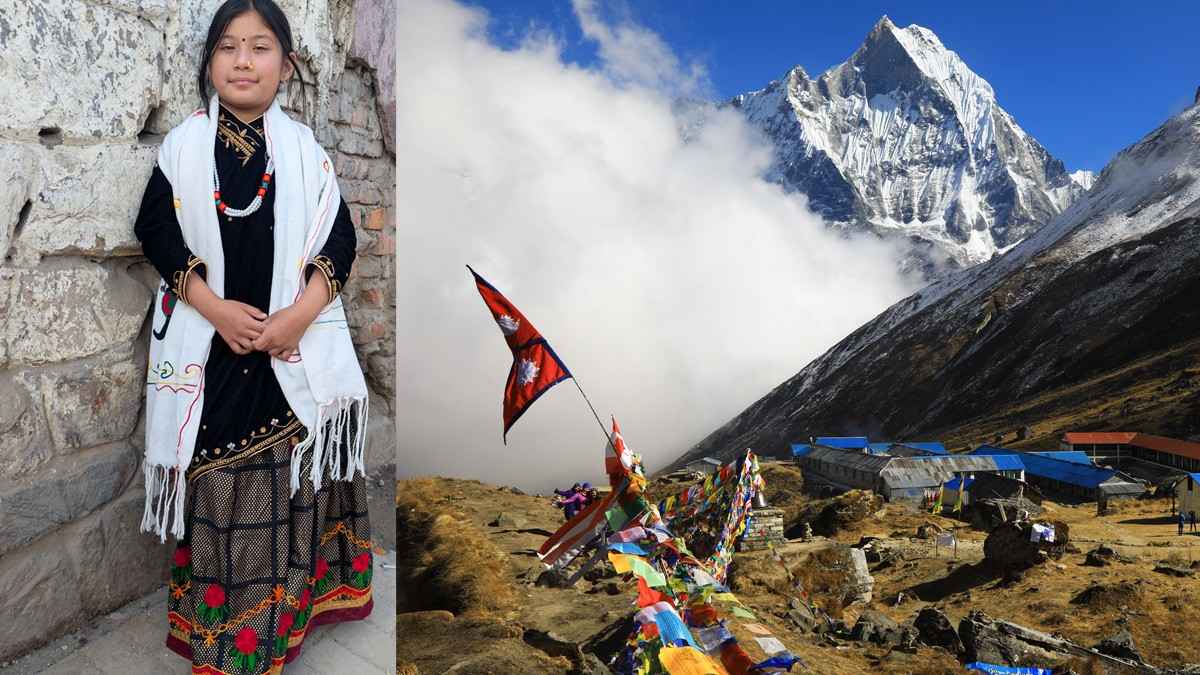
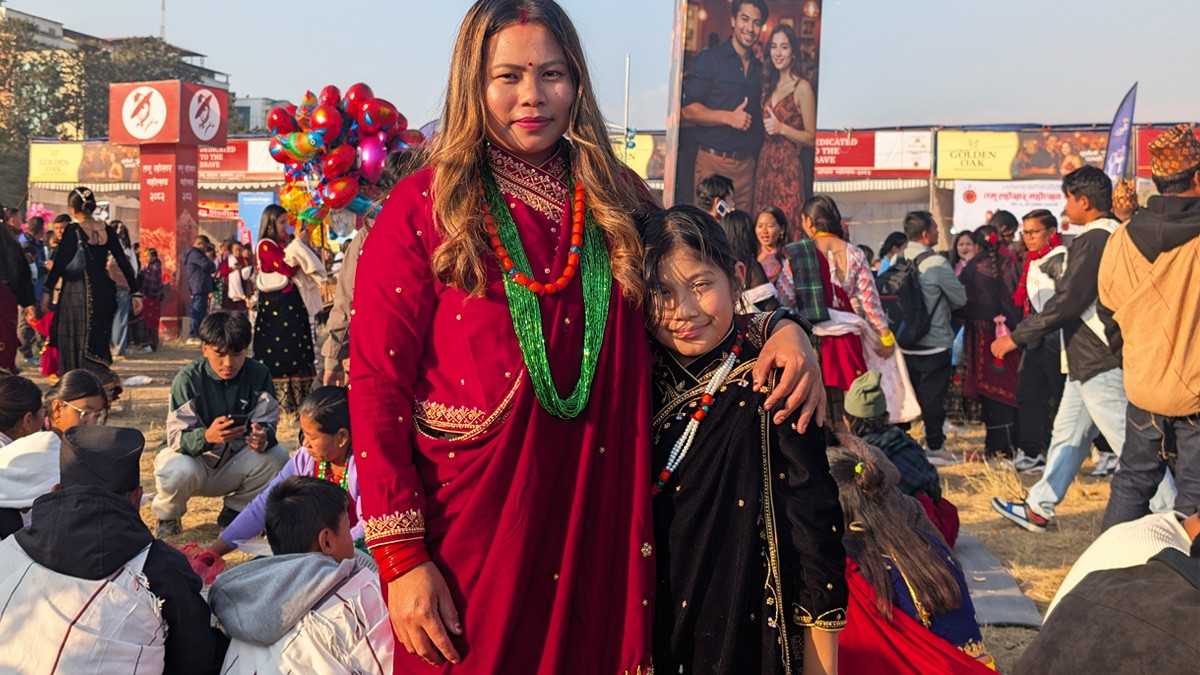
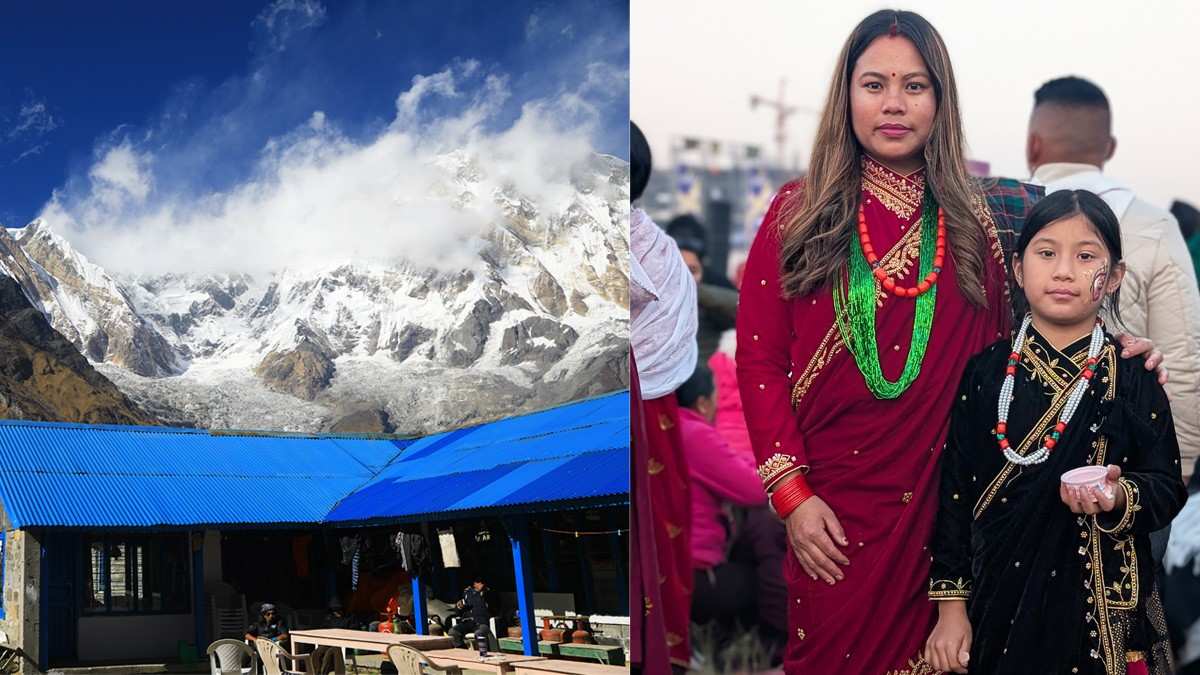
Beautiful ladies representing Gurung Cultural Dress during Gurung Festival
For women
The classic Gurung female outfit is built around four pieces:
Cholo: This is a fitted, long-sleeved blouse in velvet or cotton, traditionally tied at the front, often in deep red or maroon
Phariya or Ghalek: It is a wrap-around skirt or shawl in dark blue or black, often with stripes
Patuka: It’s a long cloth wound around the waist as a belt; this also doubles as a baby-carrier in daily life
Mujetro: This is a shawl draped across the shoulder or head.
The females wear a cotton or velvet pullover called Cholo, which is tied in the front with a dim red shading Phariya with different designs. They bind a scarf over the midriff called Ghalek.
The jewelry - and this is where it gets interesting
The women's jewelry isn't decoration. It's portable wealth, marital status, and family history worn on the body. The necklaces of gold, turquoise, and other semi-precious stones still worn by older women come from Tibet. Other gold pieces, earrings, nose-rings, and bracelets are part of every important ceremony. The key pieces to know by name:
Piece
What it is
Significance
Dhungri
Large ear ornament
Worn from young adulthood; family heirloom
Naugedi
Beaded necklace of nine specific gold, stones/beads
Traditional, often gifted at marriage
Tilhari
Long yellow-bead necklace with a gold cylindrical centrepiece
Worn by married women - equivalent to a wedding ring
Pote
Strings of glass beads, often red or green
Everyday married-woman wear
Sirbandi / Sirfuli
Decorative headpiece
Ceremonial occasions
Phuli / Bulaki
Nose ring/stud
Daily wear; particular styles by region
They wear their ornaments and jewelry like: Dhungri on the ear, Naugedi, Jantar, Potey on the neck, a type of sirbandi decorative on the head, Chhadke Tilhari, and many other ornaments.
The gold is genuine. In a remittance economy, jewelry is how families have historically stored wealth. The grandmother smiling at you from the porch in Ghandruk might be wearing more gold than your annual salary.
For men
Men wear the "bhangra," a white cotton shirt, with a dark vest or jacket and a white cloth tied around the waist. During festivals, they add the "kachhad," a white wrap that looks a bit like loose pants. The traditional cap, called "khadh" is part of ceremonial dress.
The classic male outfit is a bhangra (wraparound cotton shirt), a kachhad (waist wrap, almost like a kilt), a vest (often dark), the Nepali Dhaka topi hat, and the khukuri - the curved knife - tucked into the waistband. The khukuri isn't a costume. It's a working tool that doubles as a ceremonial item. In a wedding, you'll see it carried by the groom's party.
What Happens in the Gurung Wedding?
You may have heard about "vibrant Gurung weddings". This is something that actually makes the Annapurna trek worth visiting for everyone. Here's what an actual wedding involves and what to know if you're ever lucky enough to be invited to one in a village you're trekking through.
A wedding traditionally unfolds across multiple days and several houses. The structure has Buddhist, Bon, and local animist layers depending on the family, and modern weddings often blend Hindu elements too.
The proposal and acceptance. Traditionally, a Gurung marriage proposal goes through intermediaries - typically, the groom's maternal uncle (mama) plays a key role. The groom's family brings a gift of raksi (local distilled spirit) to the bride's family. If accepted, the families set a date.
Pre-wedding. The Rodhi serves as a pre-wedding gathering in many traditional Gurung weddings, drawing on the older Rodhi institution.
The wedding day itself. The groom arrives at the bride's home with a procession - drums, the madal, dancing along the trail. There's a fascinating moment of ritualized resistance. The bride's family and friends symbolically block the procession, and there's playful negotiation (and small payments) before the groom is allowed to enter.
The bride's dress. A traditional bride wears a heavily embellished cholo and ghalek in deep red, layered with all the jewelry she owns or has been gifted - tilhari, naugedi, gold bangles, the sirbandi. The visual effect is striking and intentional. She is, in that moment, both her family's pride and a representation of accumulated household wealth being transferred (in part) to her new family.
The groom's dress. Daura suruwal in modern versions, or traditional bhangra with kachhad, vest, Dhaka topi, and the khukuri at the waist. Grooms often wear a Daura Suruwal, a traditional Nepali outfit, paired with a Dhaka Topi (Nepali cap).
The ceremony. Depending on the family's religious lean - Buddhist, Bon, or Hindu-influenced - the rituals vary. A Buddhist Gurung wedding will involve a lama, prayers, and the giving of katas (white silk scarves). Feasting is enormous - sel roti, meat curries, dal bhat, raksi, and the local millet beer chyang.
Going home. The bride leaves her parents' house, often with significant weeping (this is expected and ritualized - it's a marker of love, not coercion). According to Gurung tradition, upon arriving at the groom's home, the newly married couple seeks permission from the groom's mother to let them come inside.
Modern reality. Most weddings today blend tradition with modern elements - bridal makeup salons in Pokhara, photographers from Kathmandu, and the occasional white dress for a second outfit change. Inter-caste and inter-ethnic marriage, once rare, is now common, especially among Gurungs who've left the village.
Tamu Lhosar: The Festival to Plan Your Trek Around
If you can time your visit, Tamu Lhosar is the most important festival in the Gurung calendar. Observed every year on the 15th of Poush in the Nepali calendar, the festival symbolizes renewal, gratitude, and hope for prosperity in the year ahead. The word "Tamu" refers to the Gurung people, while "Lhosar" means New Year. That works out to roughly December 30 in the Western calendar.
The festival operates on a 12-year cycle similar to but distinct from the Chinese zodiac. This festival marks the transition to a new year, often aligned with a 12-year animal cycle, such as from the Year of the Mouse to the Year of the Cat. 2026 is the Year of the Horse in the Tamu calendar.
In Pokhara and Kathmandu, Tamu Lhosar is celebrated with big public parades - drums, traditional dress, the whole community out. In Ghandruk and other villages, it's quieter but more meaningful: family gatherings, sel roti, the slaughter of goats, lots of chyang, and the elders telling the year ahead.
The trade-off: late December trekking on the ABC route is cold (highs of 5–8°C at Ghandruk, well below zero at base camp), and some teahouses higher up close briefly. But the cultural payoff in the villages is enormous. Also, the peaceful trails make it very soothing and refreshing at this time of year, compared to peak season.
Other Gurung festivals and ceremonies worth knowing:
Tamu Dhee: community-level cultural and political gatherings
Buddha Jayanti: important in Buddhist Gurung households
Dashain and Tihar: celebrated, but with Gurung adaptations layered over the Hindu base
Pae Lava: The Unique Gurung Death Ritual
This won't appear in any trekking company's itinerary, but it's central to who the Gurungs are.
Pae Lava: The most elaborate ceremony is performed several years after someone dies (families need time to save money). Its purpose is guiding the deceased's spirit to the afterlife and releasing them from earthly attachments. The ritual involves creating an effigy of the dead person, animal sacrifices, feasting, and a symbolic dance battle representing the spirit's separation from family ties.
A visitor in Gurung place in the cold weather is very likely to meet a number of people in their best dresses going to other villages for a memorial ritual called the "pae lava." This rite incorporates and symbolizes much of ancient Gurung culture and is the central Gurung institution.
It's officiated by a Pachyu or Ghyabri - pre-Buddhist Gurung shamans whose tradition predates the arrival of Tibetan Buddhism and survives alongside it. If you see, on the trail, what looks like a large multi-day festival in a village that doesn't quite match the festival calendar, it's probably a Pae Lava. Be respectful, photograph minimally, and don't intrude.
The ABC Trail Through the Gurung Country: Where You'll Actually See This Culture
Local tea house and traditional culture in ABC Trail
Here's the cultural geography of the trail in the order you'll walk it.
Pokhara to Nayapul (drive) → Ghandruk (1,940 m)
Pokhara City is the trekking heartland of Gurung Nepal. Ghandruk is a picturesque Gurung village in Kaski District. It is one of the most important villages on the Gurung Heritage Trail, which has preserved the old Gurung culture and traditions. Visit the Gurung Museum - there's a Gurung Museum in the village with old textiles, tools, and war stuff. It's a nice way to understand where this place actually came from. Stay at a homestay rather than a teahouse if you can. Ask about a Rodhi performance in the evening.
Ghandruk → Chhomrong (2,170 m)
The trail dips through Kimrong Khola and climbs. Chhomrong is mixed Gurung-Magar, and the last big village before the trail thins out culturally as it enters the sanctuary proper. The bakery here is famous among trekkers - try the apple pie, which has been part of the trekker economy for forty years.
Chhomrong → Bamboo → Deurali → MBC → ABC
From Chhomrong upward, the trail enters Annapurna Sanctuary proper. The settlements shrink to seasonal teahouse clusters built specifically for the trekking economy. Beyond Chhomrong, all goods - including rice, vegetables, cooking gas, and packaged food - are carried manually by porters or transported by mules. You're now in mountain space, not village space.
Coming down: Jhinu Danda. Hot springs by the river, a welcome reward after the descent. Mixed Gurung-Magar settlement.
Teahouse Reality: Costs, Food, and How to Be a Decent Guest
Here are the practical things with cultural notes for a great experience in Gurung Village Tea house in the ABC Trail Nepal:
Teahouse costs
In the lower villages like Ghandruk, Chhomrong, Bamboo, a teahouse costs you around USD 10 to USD 15 per night for a basic but cozy room. In the higher sections like Deurali, MBC, and Annapurna Base Camp, teahouses cost you around USD 15 to USD 20 per night.
In Ghandruk specifically, around 50 hotels and homestays serve trekkers. Hotels run around $20 USD while homestays average closer to $5. Many teahouses here offer hot showers, WiFi, and electricity for free.
The food and night stay cost is already covered by your trek package. However, you have to pay personally for the WiFi, tips, hot shower, and extra purchases.
Food costs
Budget $20-35 per day for most trekkers. Budget trekkers eating mainly Dal Bhat spend $18-25 daily. Comfortable trekkers ordering Western food, coffee, and treats spend $30-45 daily.
Let me tell you, the prices climb with altitude for a real reason - everything above Chhomrong gets carried uphill by porters or mules. A kilogram of rice that costs NPR 80 in Pokhara might cost NPR 200 at Annapurna Base Camp.
The unwritten rule of teahouses
Teahouses work on a simple idea: rooms are cheap because they expect you to buy food. This is how mountain families earn income and sustain the trekking route. Walking next door to eat cheaper food breaks this system and harms the family hosting you. Don't be that trekker.
Order the dal bhat
Not because it's cheaper (though it is), but because it's freshly cooked, comes with free refills, and is what the family is already making for themselves. The pizza or the lasagna at 3,000 meters is an experiment that rarely ends well.
Being a good guest in a Gurung home or homestay:
Take your shoes off at the threshold
Don't step over food or somebody's legs
Accept the welcome tea even if you don't want it - refusing it is awkward
If you're offered raksi or chyang, sip rather than chug
Ask before photographing people, especially elders
Tip the kitchen staff and porters in cash, separately from your guide's tip
Don't bargain hard on small things - the difference of 50 rupees means little to you and a lot to the family
Standard advice: spring (March-May) for rhododendron blooms and autumn (October-November) for the clearest mountain views. This is correct, and it's also why those months are packed with trekkers and the teahouses fill up by 2 PM.
Winter (December to February) is perfect for a peaceful trail with occasional snowfall.
However, the monsoon (June to August) trekking may require prior experience and strong preparation. This is ok with the right guidance.
Final Thoughts
Annapurna Base Camp Trek with kids and family is the right package for this Gurung Culture and Village life experience. If your only goal is the photo at base camp, do the trek in five days and skip everything else.
Suppose you want to understand a place that almost no one else takes the time to understand, build in two extra nights - one in Ghandruk on the way up, one on the way down. Eat with the local family. Ask about the photographs on the wall. Walk to the Gurung Museum. Find out which animal year you were born in the Tamu calendar. Sit on the verandah at sunset and watch Machapuchare go pink.
The mountains will be there whether you understand the culture or not. The culture - Rodhi nights, Pae Lava rituals, grandmothers in heirloom tilhari - is at a more fragile point in its history. The Gurung community is changing fast. Young people are leaving. The road has arrived. The village is becoming a destination instead of a home.
Walk through it slowly. That's the part of the ABC trek almost nobody tells you about.
Frequently Asked Questions
What's the difference between Gurung and Magar villages on the ABC trail?
Both are Tibeto-Burman communities with overlapping geography, but they're distinct ethnic groups with different languages, festivals, and traditional dress. Ghandruk is predominantly Gurung. Landruk is mixed. Lower villages toward Nayapul lean Magar. Their similarities (Buddhist-animist religion, terraced agriculture, Gurkha military tradition) are real, but ask before assuming.
Do I need a guide to experience Gurung culture on the trek?
Yes, a good guide multiplies the experience by ten. A guide will get you into conversations and homes you'd never find on your own.
Is it appropriate to wear a Gurung dress for photos?
Yes - when it's offered by the host. It's not considered offensive; it's a small income source and a point of pride. Pay the fee, take the photos, and share them with the family.
What's the Gurung religion?
It is a mix. A syncretic religious identity that blends Bon Shamanism, Buddhism, and local animistic traditions. Older generations lean toward Buddhism or Bon; some younger Gurungs are Christian; many practice a blend without naming it.
Can I visit a Gurung village without doing the full ABC trek?
Yes, you can easily do that. Ghandruk is now a 2-3 hour drive from Pokhara, plus a short walk. You can spend two nights there and never trek to base camp. For many travelers, this is the better cultural experience. But trek to base camp for a 360-degree amphitheater of mountains makes your journey worthwhile.
Are the Gurungs the same as Gurkhas?
The Gurkhas (British/Indian/Nepali military) recruit heavily from Gurung, Magar, Rai, and Limbu communities. So most Gurkhas are not Gurung, but a high proportion of Gurungs have served as Gurkhas. The two words are related but not interchangeable.
Kishwor Adhikari is a passionate writer with a deep enthusiasm for trekking and adventure. His extensive travels across Nepal, exploring its diverse landscapes and hidden corners, have shaped his unique perspective on the country's natural beauty. With a wealth of first-hand experience in adventure trekking, Kishwor has become a trusted voice for fellow enthusiasts. Through his writing, he shares invaluable insights, offering practical advice and inspiration for both seasoned trekkers and novices alike. His dedication to sharing his journey and knowledge helps others discover the wonders of Nepal's wilderness, making his work an essential resource for anyone seeking adventure in the region.