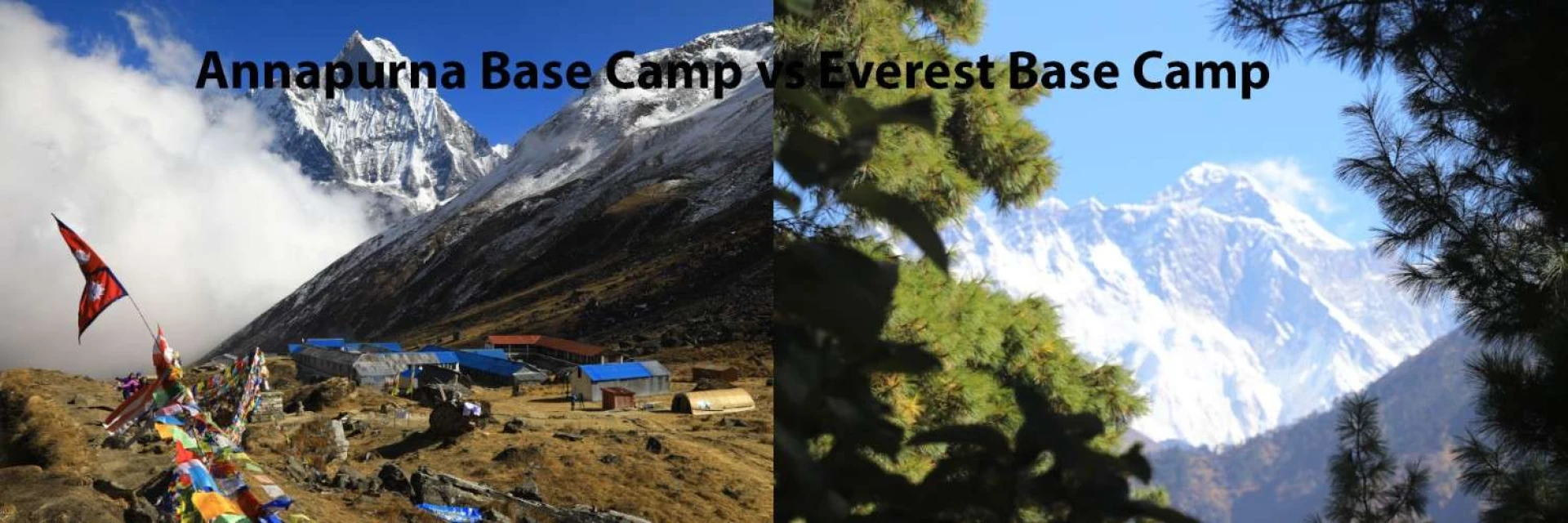
Annapurna Base Camp or Everest Base Camp - which one should you do? People ask this question every week in trekking forums, guesthouses in Thamel, and WhatsApp groups full of strangers who met at some trailhead. Well, both treks sit in Nepal. Both are bucket-list classics. And both will absolutely wreck your legs in the best possible way. But they are very different experiences, and picking the wrong one wastes money, energy, and a precious vacation window.
I am going to give you a real, honest comparison. Not a sponsored one. Not a list of vague pros and cons that tells you nothing. Just the actual differences, the costs, the trail conditions, the crowds, the views, and the things almost no other comparison covers, like which trek has better tea house food, which one gets dangerous in bad weather, and what happens if you need to leave early.
This guide is a clear comparison based on my decade-long experience in Himalayan trekking Nepal. By the end, you will know exactly which one suits you, Annapurna Base Camp or Everest.
Table of Contents
Quick Snapshot: ABC vs EBC at a Glance
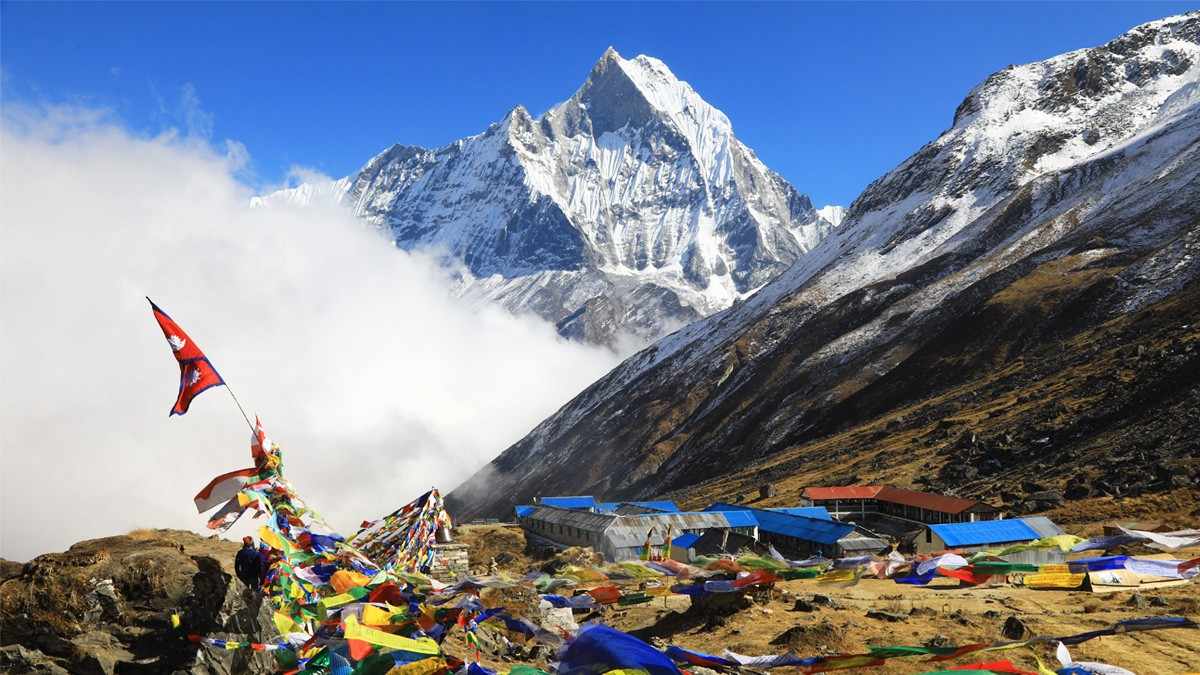
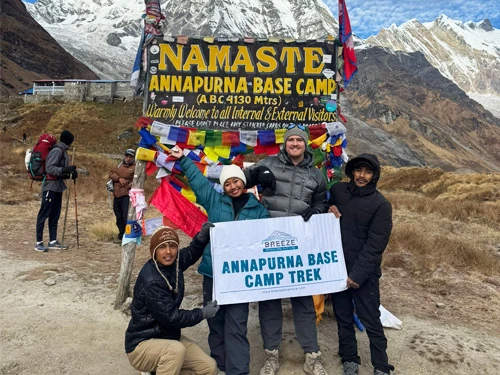
Beautiful image captured in Annapurna Base Camp Nepal
-
Annapurna Base Camp (ABC)
Everest Base Camp (EBC)
Maximum Altitude
4,130 m / 13,550 ft
5,364 m / 17,598 ft
Trek Duration
6-10 days
9-14 days
Total Distance
~110 km round trip
~130 km round trip
Difficulty
Moderate
Moderate to strenuous
AMS Risk
Lower
Higher
Starting Point
Nayapul or Phedi (from Pokhara)
Lukla (via flight from Kathmandu)
Permit Cost
~NPR 3,000 + ACAP fee
~NPR 3,000 + Khumbu entry fee
Best season
March–May, Oct–Nov
March–May, Oct–Nov
Iconic View
Annapurna massif amphitheatre
Khumbu Icefall, Everest South Face
Culture
Gurung and Magar villages
Rich Sherpa culture, monasteries
Teahouse quality
Very good
Good to excellent in main lodges
Crowding Level
Moderate
High on the main route
Flight Required?
No
Yes (Lukla flight) if you want fewer days
Why Altitude Matters in the ABC vs EBC Trek?
This is the single biggest practical difference between the ABC vs EBC trek, and most comparison articles either skip it or mention it briefly without explaining the real implications.
Annapurna Base Camp sits at 4,130 metres. Everest Base Camp sits at 5,364 metres. That is a 1,234-metre gap. It sounds like a number on paper, but your body feels it very differently.
At 4,130 m, most fit trekkers with moderate acclimatisation will be fine. Headaches are common. Shortness of breath on uphill sections is normal. Similarly, Acute Mountain Sickness (AMS) is possible, but not the dominant concern, it becomes at EBC altitudes.
At 5,364 m, your blood oxygen drops noticeably. The Khumbu region above 4,500 m is where most serious AMS cases happen. You must build in proper acclimatisation days at Namche Bazaar (3,440 m) and Dingboche (4,410 m). Pushing through symptoms up there is genuinely dangerous- High Altitude Cerebral Edema (HACE) and High Altitude Pulmonary Edema (HAPE) both become real risks above 5,000 m.
If you have never trekked above 3,500 m before, ABC is a smarter first Himalayan experience. You still get big altitude, dramatic terrain, and mountain immersion - without needing to commit 14 days and manage serious acclimatisation pressure.
Everest Base Camp vs Annapurna- What the Trail Actually Feels Like
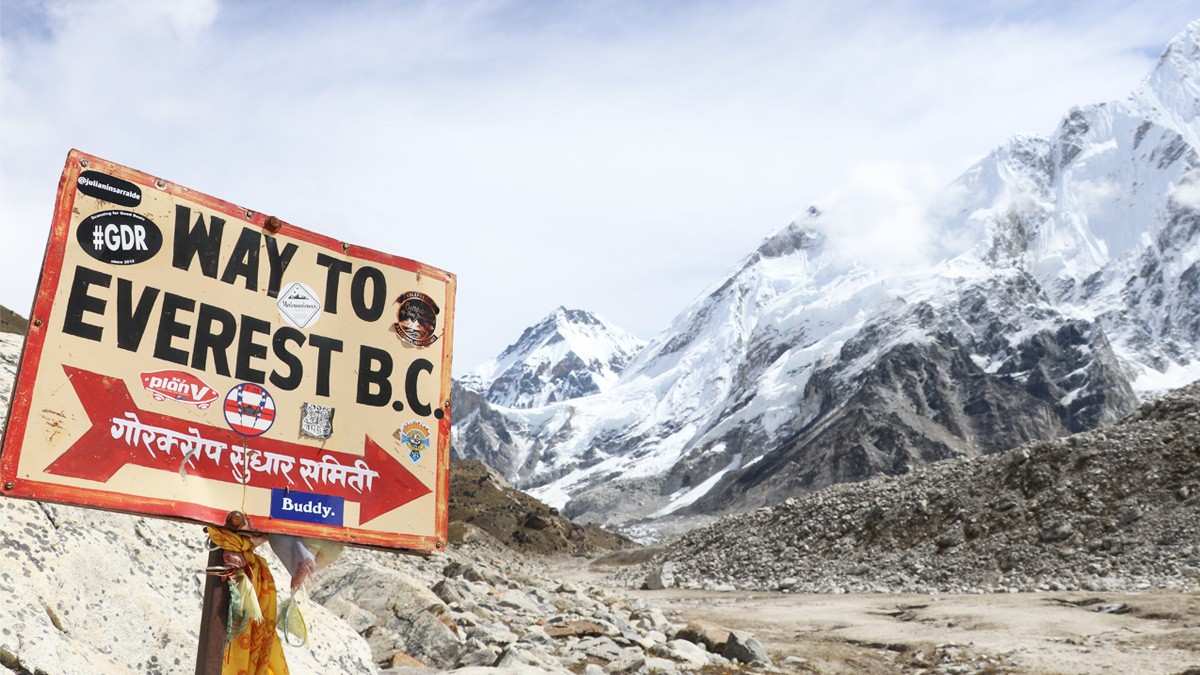
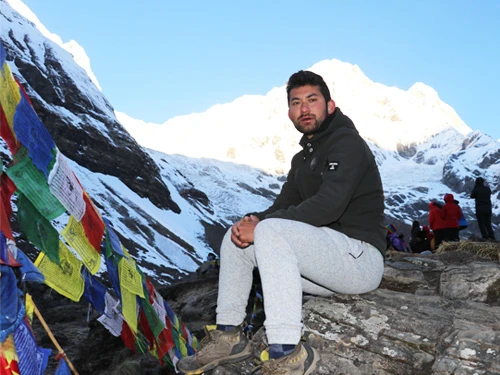
Snow covered way to Everest Base Camp Nepal
Even though both of these are Himalayan trek Nepal, they have huge variations in terms of trail and topography.
Annapurna Base Camp (ABC Trek)
The ABC trek starts from Pokhara, which you reach by a 6–7 hour bus ride or a 25-minute flight from Kathmandu. No Lukla-style drama. No cancelled flights eating your schedule.
From Nayapul, you walk through Gurung and Magar villages. Here, the lower sections feel alive, kids in school uniforms, men hauling timber, women with doko baskets. Likewise, Chhomrong is the last major village before the high terrain. And it has a genuine community feel that most EBC teahouse stops lack.
Above Chhomrong, the trail enters a narrow gorge. The rhododendron forests in this section are extraordinary in March and April- thick, red-flowering, and completely unlike anything on the EBC route. The landscape shifts fast. By the time you reach Deurali, the trees vanish, and the scale opens up.
The final approach to ABC is one of the most dramatic in trekking. The Annapurna sanctuary- the high cirque surrounded by Annapurna I (8,091 m), Annapurna South, Hiunchuli, Machhapuchhre, and Gangapurna. It is not something you ease into gradually. You walk in, and suddenly you are surrounded by peaks on three sides. Yes, the silence up there is thick. It stops people mid-sentence. You can’t help but love it.
Everest Base Camp (EBC Trek)
EBC starts with a Lukla flight. This is worth mentioning specifically because it is one of the most anxiety-inducing parts of the whole trip for many trekkers - the Tenzing-Hillary Airport runway ends on a cliff edge. Flights get cancelled for days when the weather closes in. In peak season, delays cascade. Budget extra days on both ends of your trip.
From Lukla, the trail through the Khumbu is immediately different from the Annapurna. The scale is bigger. The mountains are more recognisable to the general public - you know the shapes before you arrive.
Similarly, Namche Bazaar is a proper mountain town with bakeries, gear shops, and WiFi. It is simultaneously very charming and surprisingly developed.
Tengboche Monastery at 3,867 m is one of the most beautiful Buddhist sites in Nepal. If you are lucky, you catch a morning puja. The monks chant while mist rolls through the valley. That moment alone is worth the trek.
Above Dingboche, the landscape becomes starker. Greener gives way to grey moraine and stone. The Khumbu Glacier is brown and industrial-looking up close, which surprises some people who expected pristine blue ice. By the time you reach Base Camp itself, you are on a rubble field with orange tents and prayer flags. Everest is not visible from EBC - a fact that consistently shocks first-timers. You need to hike 40 minutes above camp to Kala Patthar (5,545 m) for the classic view.
ABC Trek vs EBC Trek Views Comparison
Here is something you rarely read but need to know: ABC delivers a more visually dramatic base camp experience than EBC.
At Annapurna Base Camp Trek, you are standing inside a natural amphitheatre. You are surrounded by peaks. The cirque closes around you. It is intimate and overwhelming at the same time.
At Everest Base Camp, you are on a flat moraine. Everest itself is blocked by Nuptse. The mountain that dominates the skyline is actually Pumori. Most trekkers feel a mix of awe and slight anticlimax.
The payoff at EBC comes from Kala Patthar, not from Base Camp itself. Sunrise from Kala Patthar - with Everest's summit pyramid glowing orange above the clouds -is extraordinary. It is worth every single step.
For pure base camp drama, ABC wins. For the most iconic Himalayan sunrise photograph, EBC via Kala Patthar wins.
ABC or EBC Trek Cost Comparison- What You Actually Spend
This section covers real costs, not best-case-scenario budgeting.
Expense
ABC Trek
EBC Trek
Permits (TIMS + park fee)
~USD 30–40
~USD 40–55
Lukla Flight
Not Required
USD 170–230 (round trip)
Teahouse accommodation
USD 5–15/night
USD 10–25/night (higher near EBC)
Meals on trail
USD 4–10/meal
USD 6–15/meal (pricier above Namche)
Guide
USD 25–35/day
USD 30–45/day
Porter
USD 18–25/day
USD 20–30/day
Total (solo, teahouse)
~USD 700–1,100
~USD 1,400–2,000
With guide + porter
USD 1,200–1,700
~USD 2,200–3,200
Two big cost drivers on EBC: the Lukla flight and higher teahouse prices in the Khumbu above Namche. Food and lodging costs go up sharply the higher you go on the EBC route because everything is carried in by porter or flown in. On the ABC route, the elevation gain is gentler, and supply chains are more accessible, which keeps costs lower.
For budget-conscious trekkers, ABC wins clearly.
Everest Base Camp Trek Companies: What to Know Before Booking
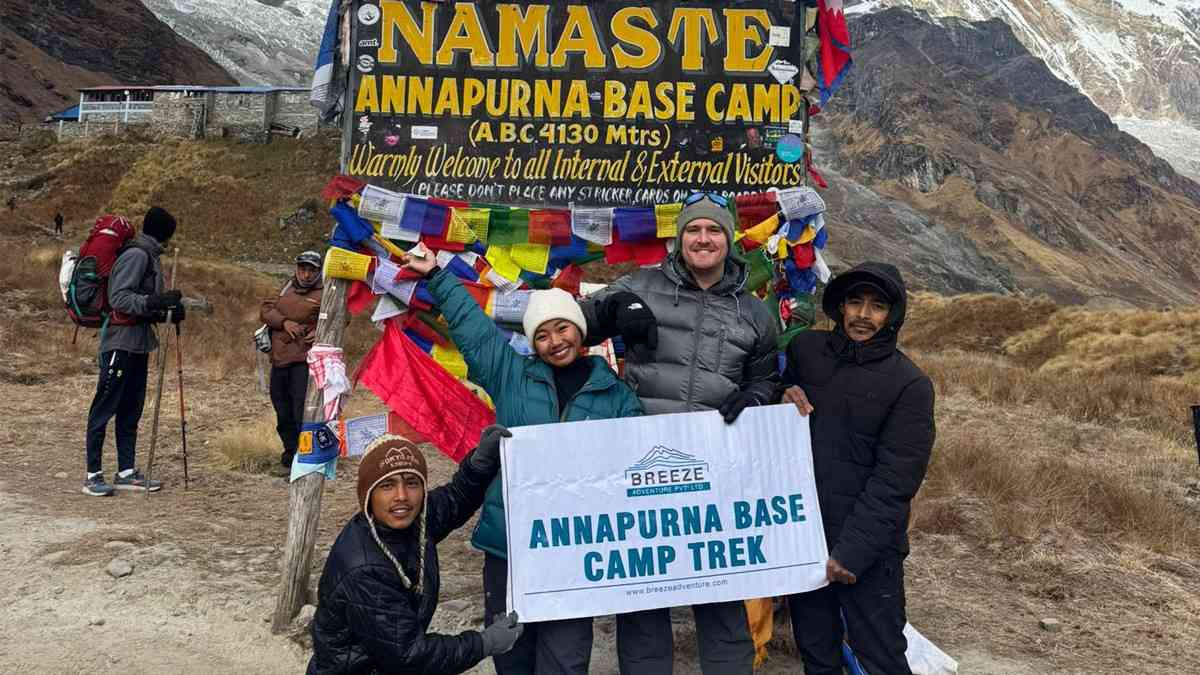
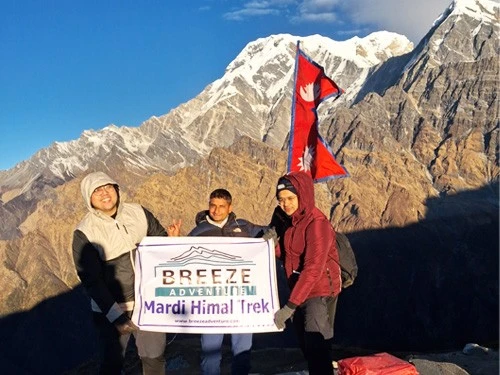
ABC trek with Breeze Adventure
If you are searching for Everest Base Camp trek companies, here is the practical breakdown nobody gives you clearly.
You do not legally need a registered agency for EBC as of current regulations, but booking with a TAAN (Trekking Agencies Association of Nepal) or NTB-registered company is strongly recommended. It protects you if a guide disappears, if there is an emergency, or if you need insurance documentation.
Key things to check when comparing Everest Base Camp trek companies:
Does the price include the Lukla flight? Many advertised prices do not. So, always ask.
What is the acclimatisation schedule? Reputable operators build in at least two full rest days. Companies trying to rush the route in 10 days are cutting safety corners.
Is the guide NMA-certified? Nepal Mountaineering Association guides have formal training in altitude sickness response.
What happens if you get sick and need to evacuate? A good company arranges helicopter rescue insurance as part of the package or explains exactly what you need to buy separately. TIMS and rescue insurance together should cover emergency evacuation, just confirm the amounts.
For ABC, the same applies, though the risks are lower and the logistics less complex. Many agencies like Breeze Adventure Pvt Ltd have been operating ABC treks for decades and are worth looking at. At Breeze, you will get one oxygen tank for a higher altitude trek. Also, the company has the best-trained staff, guides, and porters with a decade-long experience.
Which has more Crowd - ABC or EBC?
Peak seasons - October-November and March-May - get busy on both routes. But the nature of crowds differs.
EBC is more popular globally. The Lukla to Namche stretch in October is genuinely congested. Thousands of trekkers funnel through the same narrow Dudh Koshi valley. Similarly, tea houses fill up. You need to book ahead or start very early each day to secure a good room at your intended stop.
Meanwhile, ABC Trek sees fewer trekkers overall, though Chhomrong and Annapurna Base Camp itself get busy during peak weeks. The approach from Nayapul is quieter than the Lukla-Namche corridor. If you value solitude more than bragging rights, ABC wins again.
That said, both routes have off-peak options. November through early December is quieter on both routes, though cold at higher elevations. February is quiet but involves snow risk above 3,500 m, best with the right preparation and proper guidance.
Weather and What Can Go Wrong
Both the Annapurna Base Camp trek Nepal and the Everest Base Camp trek experience frequently changing weather. Kindly consider the following details for better planning:
Rain and Monsoon
Nepal's monsoon runs from June through September. Both treks are less done during this period, though ABC is technically more doable in the monsoon because it is below 4,200 m and the trail is shorter. Similarly, the rhododendrons and lower forests are lush and beautiful, but leeches aside. EBC in monsoon is a harder sell, with landslides along the approach, cloud cover blocking all views, and the acclimatisation pressure of staying at altitude longer. But many trekkers have successfully done this with the right guidance and training.
Snow
ABC above Deurali can get heavy snow in winter, sometimes making the trail to MBC and ABC impassable from December to February. EBC similarly gets significant snow above Dingboche in winter, with cold temperatures that demand serious sleeping bag ratings (at minimum a -15°C rated bag).
Evacuation
This is one of the most under-discussed topics. On ABC, the escape route is faster - you can descend to a lower altitude within a day from almost any point. On EBC, if you develop serious AMS above 5,000 m and cannot walk down, helicopter evacuation is the only realistic option. These flights cost USD 3,000–7,000 without insurance. Hence, buy evacuation insurance before either trek. For EBC, it is non-negotiable. Nepal travel insurance is a great relief in both cases.
ABC vs EBC Facilities Comparison
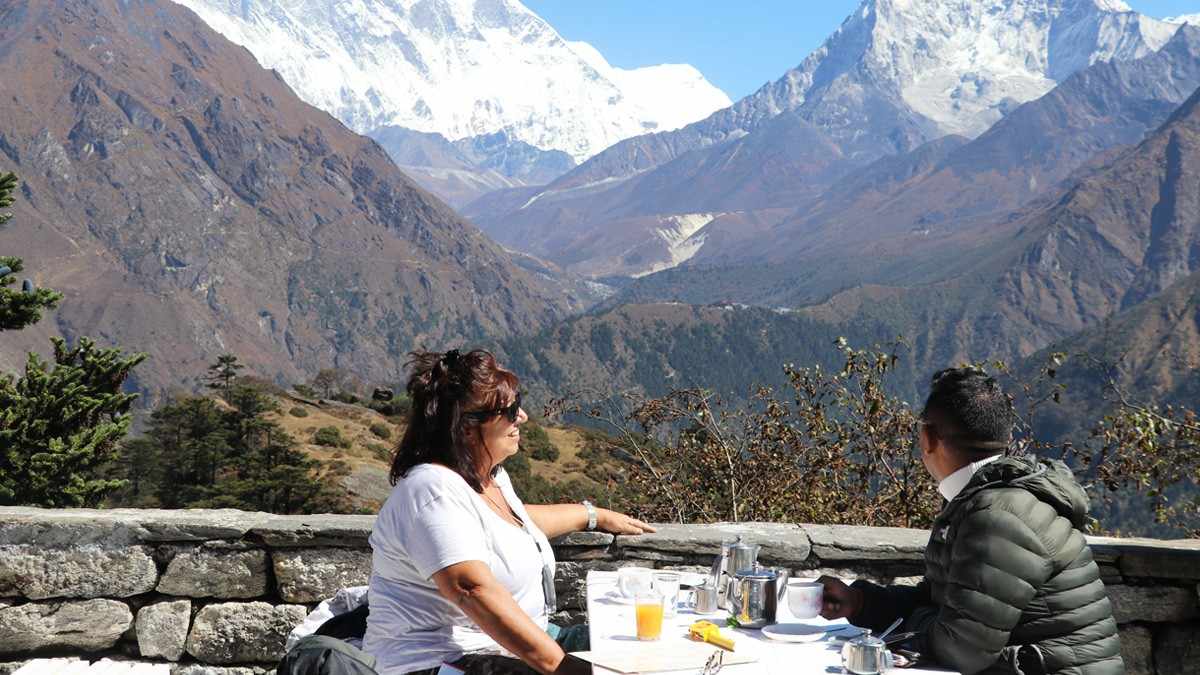
Trekkers enjoying breakfast with Everest views on EBC trek
Even if you plan both treks from the same agency, the facilities still differ due to geographical differences and development.
The Tea House Food Gap Is Real
ABC tea houses in Chhomrong and Sinuwa are run by local Gurung families, and the dal bhat is genuinely excellent. Large portions, refillable, fresh vegetables from lower gardens. Above Deurali, options narrow, but the food stays decent.
On the other hand, EBC tea houses above Namche serve dal bhat, pasta, pizza, and yak steak - but prices spike hard. A plate of pasta at Lobuche costs three times what it costs at Lukla. Portions shrink. Portions shrink more at higher altitudes. This is not a complaint, it is logistics -everything up there is carried in. Know this before you go.
Phone Signal and Internet
Both routes now have mobile coverage through most of the trail. Nepal Telecom NCell cards work on most of the ABC. On EBC, the signal is patchy between Lukla and Namche but generally available in the main villages. WiFi is available at most tea houses on both routes. But usually slow, often paid (USD 2–5 per session), and unreliable above 4,000 m.
Solo Female Trekking
ABC is generally considered safer for solo female trekkers. The trail passes through populated villages, daylight hours are adequate for stage completion, and there is a strong community of solo women who have done it.
EBC is also manageable, but the higher altitude, longer duration, and more desolate high sections make the trek quite demanding.
ABC or EBC- Combining Both Treks
A common question: Can I do both? Yes, but not in one continuous route. They are in different regions - Annapurna and Khumbu are roughly 300 km apart. You would need to return to Kathmandu between them. Some trekkers do EBC first (acclimatisation already built), then fly to Pokhara for ABC. Two to three weeks total. It is ambitious but very doable.
Who Should Choose ABC
Kindly choose the ABC trek, if you are
First-time trekkers to altitude in the Himalayas
Trekkers with 7–10 days available
Anyone on a tighter budget
People who want dramatic base camp scenery without pushing past 5,000 m
Solo female trekkers or those preferring populated trail villages
Trekkers who want to avoid flight risk and Lukla delays
People who care about the forest and the lower valley scenery as much as the summit views
Who Should Choose EBC
Consider the EBC Trek if you are
Trekkers who want to stand near the base of the world's highest mountain - and that matters to them personally
People with 9–12 days and a slightly higher budget
Trekkers who have already done ABC or another 4,000 m+ trek and want to push higher. Even first-timers with good preparation have successfully done this.
Anyone driven by the cultural experience of the Khumbu Sherpa villages and Tengboche Monastery
Those chasing that Kala Patthar sunrise - genuinely one of the best photographs you will ever take
The Honest Verdict: Everest Base Camp vs Annapurna Base Camp
Neither trek is better in an absolute sense. They serve different people at different points in their trekking life.
If you have never trekked at altitude before, do ABC first. It is shorter, cheaper, lower altitude, less logistically complicated, and the base camp view is arguably more spectacular. You will come home completely satisfied and probably planning the next one.
If the pull of Everest is what got you interested in Nepal in the first place, then EBC is your trek. You already know what you want. Just go in prepared - acclimatise properly, buy rescue insurance, add buffer days for Lukla flights, and do not rush the itinerary to save money.
Both will change how you think about mountains. Both will make the city feel flat and loud when you return. Both are worth every blister.
FAQ
Is Annapurna Base Camp harder than Everest Base Camp?
No. EBC is harder primarily because of the altitude - 5,364 m vs 4,130 m - and the longer duration. ABC involves steep climbs on some sections, but the altitude impact is significantly lower.
Can beginners do the Everest Base Camp trek?
Fit beginners can complete EBC, but it is not the best first Himalayan trek. The altitude demand is serious, requiring good guidance and preparation. Doing ABC first builds both fitness and altitude experience that makes EBC safer and more enjoyable.
What is the best season for both treks?
March–May and October–November for both. October is peak season. March offers rhododendrons on ABC. November is clearer and less crowded than October on both routes.
Do I need a guide for ABC or EBC?
Legally required for both. Practically, a guide is strongly needed as a licensed guide helps with logistics, emergency response, and altitude monitoring.
How do I choose between ABC vs EBC if I only have 10 days?
Choose ABC. EBC in 10 days is possible but requires rushing the acclimatisation schedule, which increases AMS risk. ABC fits comfortably in 7–10 days with no safety compromise. Short EBC Trek is also a great option if Everest is on your bucket list.
Which trek has better mountain views?
Both treks offer different views. ABC offers a 360-degree amphitheatre experience at base camp. While EBC's best views come from Kala Patthar, not Base Camp. Both are stunning. Neither disappoints.
Kishwor Adhikari is a passionate writer with a deep enthusiasm for trekking and adventure. His extensive travels across Nepal, exploring its diverse landscapes and hidden corners, have shaped his unique perspective on the country's natural beauty. With a wealth of first-hand experience in adventure trekking, Kishwor has become a trusted voice for fellow enthusiasts. Through his writing, he shares invaluable insights, offering practical advice and inspiration for both seasoned trekkers and novices alike. His dedication to sharing his journey and knowledge helps others discover the wonders of Nepal's wilderness, making his work an essential resource for anyone seeking adventure in the region.