Yes, beginners can absolutely complete the Annapurna Base Camp trek, and it's widely considered Nepal's best high-altitude introduction for first-time trekkers. Every season, thousands of people with no prior Himalayan experience walk into the Annapurna Sanctuary and stand at 4,130 m, surrounded by an unbroken wall of 7,000 and 8,000 m peaks.
The Annapurna Base Camp trek for beginners works because it sits at a sweet spot, high enough to feel like a serious Himalayan journey and low enough to be safer than alternative treks. Its 4,130 m maximum altitude is well below Everest Base Camp (5,364 m), Manaslu Circuit (5,106 m), or Annapurna Circuit (5,416 m), all of which push past the 5,000 m threshold where altitude risks rise sharply.
The trek is physically demanding and moderately difficult, but requires no technical climbing. No ropes, no crampons, no mountaineering experience. But “Beginner-friendly” is not the same as “easy” and understanding that difference is exactly what gets first-timers safely to base camp and back.
Table of Contents
Can Beginners Really Do the ABC Trek?
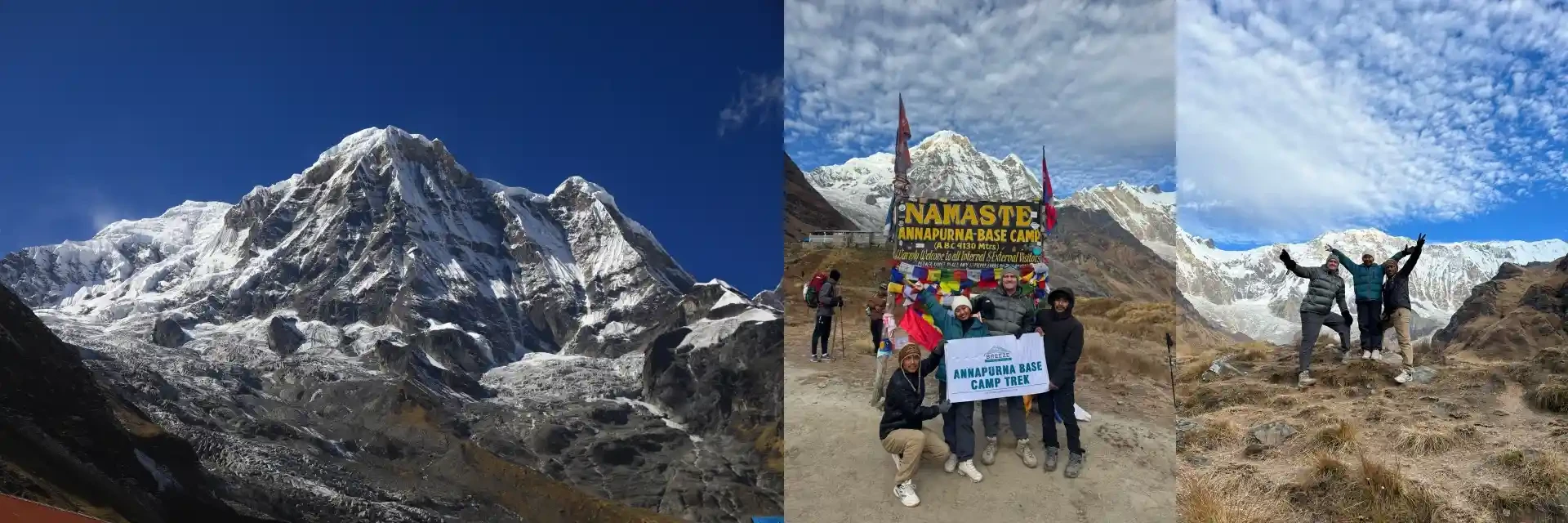
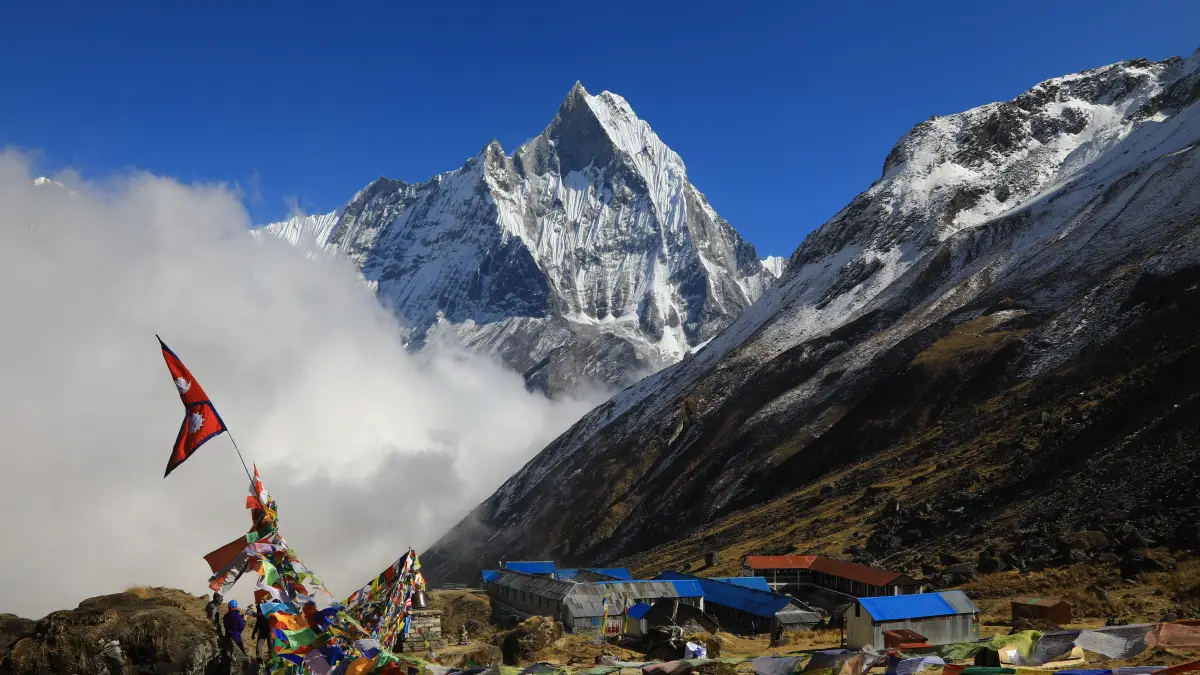
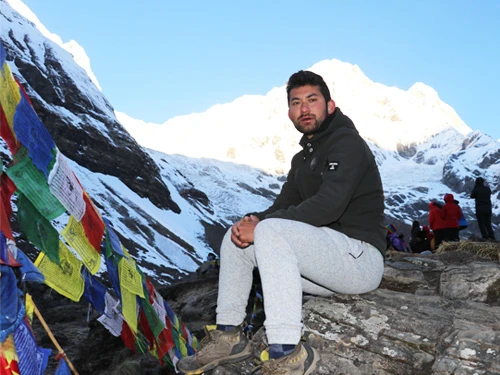
Beautiful Mountain Views from Annapurna Base Camp
Yes, and the data backs it up. According to the Annapurna Conservation Area Project (ACAP), a total of 273,646 foreign tourists visited the Annapurna region from January to November of 2025, with a large share being first-time high-altitude trekkers. Completion rates are high when itineraries are sensible.
Four things make the trail genuinely accessible to first-timers:
Well-marked trails: The route is highly established with clear signage, painted markers, and constant foot traffic. Getting lost is rare even for solo navigators.
Dense teahouse network: Family-run lodges line the entire trail, so you carry no camping gear, no stove, no food beyond snacks.
Gradual elevation gain: Standard ABC trek itineraries spread the climb across enough days that most bodies adapt to thinning air without serious symptoms, which is why the completion rate is high for ABC trek.
Established rescue infrastructure: Helicopter evacuation routes are well-mapped, and operators know the airlift points at MBC, ABC, and Chhomrong.
What Makes ABC Easier Than EBC or Manaslu Circuit?
Compared to Everest Base Camp, ABC is shorter (10-14 days vs 12-16), lower (4,130 m vs 5,364 m), and warmer at base camp.
Compared to the Manaslu Circuit, the ABC Trek has more teahouses, no restricted-area permits, and no high-pass crossing. For a first Himalayan trek, ABC strips out the highest-risk variables while keeping the scenery.
That said, raw fitness helps less than people expect. ABC asks you to walk 5-7 hours per day across rugged terrain for roughly 110-115 km round-trip. What gets people to base camp is preparation, slow pacing, and respect for acclimatization, not athletic background.
How Hard Is the ABC Trek for Beginners?
Under Nepal's standardized trekking classification, ABC is rated as a Grade 2 (moderate) trek. It requires no technical climbing skills, ropes, or mountaineering gear, but it's physically demanding and shouldn't be treated as a casual walk.
ABC trek vs Other popular treks
Trek
Grade
Max Altitude
Days
Distance
Crowds
Beginner-Friendly Rating
Poon Hill
Easy
3,210 m
4-5
32 km
High
5/5
Langtang Valley
Moderate
3,870 m
7-10
65 km
Moderate
4/5
Mardi Himal
Moderate
4,500 m
5-7
40 km
Moderate
4.5/5
Annapurna Base Camp
Moderate
4,130 m
10-14
110-115 km
High
4/5
Everest Base Camp
Moderate-strenuous
5,364 m
12-16
130 km
Very high
2.5/5
Manaslu Circuit
Strenuous
5,106 m
14-18
177 km
Low
1/5
Quick note on Mardi Himal: Mardi Himal Base Camp sits higher than ABC (4,500 m vs 4,130 m), but the climb is shorter and faster, which is exactly what makes it less forgiving on acclimatization than ABC despite the shorter duration.
The Real Dangers Beginners Face on ABC:
Endless stone staircases: Thousands of uneven stone steps in Ulleri and Chhomrong put heavy strain on knees and quads, especially on descents.
Acute Mountain Sickness (AMS): Ascending too quickly above 2,500 m can trigger headaches, nausea or, in rare cases, the life-threatening conditions HAPE (fluid in the lungs) and HACE (brain swelling). Oxygen pressure drops sharply past 2,500 m.
Severe temperature swings: Daytime 15 °C lowlands can fall to -10 °C to -20 °C at base camp overnight. If poorly layered, the risk of hypothermia increases.
Leeches and landslides: Leeches thrive in the damp forest sections during monsoon (June–August), along with the danger of landslides and swollen rivers, which are also at their highest.
Avalanche zones: The Deurali-MBC canyon is avalanche-prone in winter and early spring. This section should be crossed quickly and only under a licensed guide's instruction.
Can You Do the ABC Trek Without Prior Hiking Experience?
Yes, but conditionally. Completing ABC without prior hiking experience is entirely possible if you commit to a structured 8–12-week training phase before departure. If your body has never handled uneven terrain, sustained climbing, or carrying a pack for hours, you can bridge that gap with focused conditioning targeting cardiovascular efficiency and lower-body endurance.
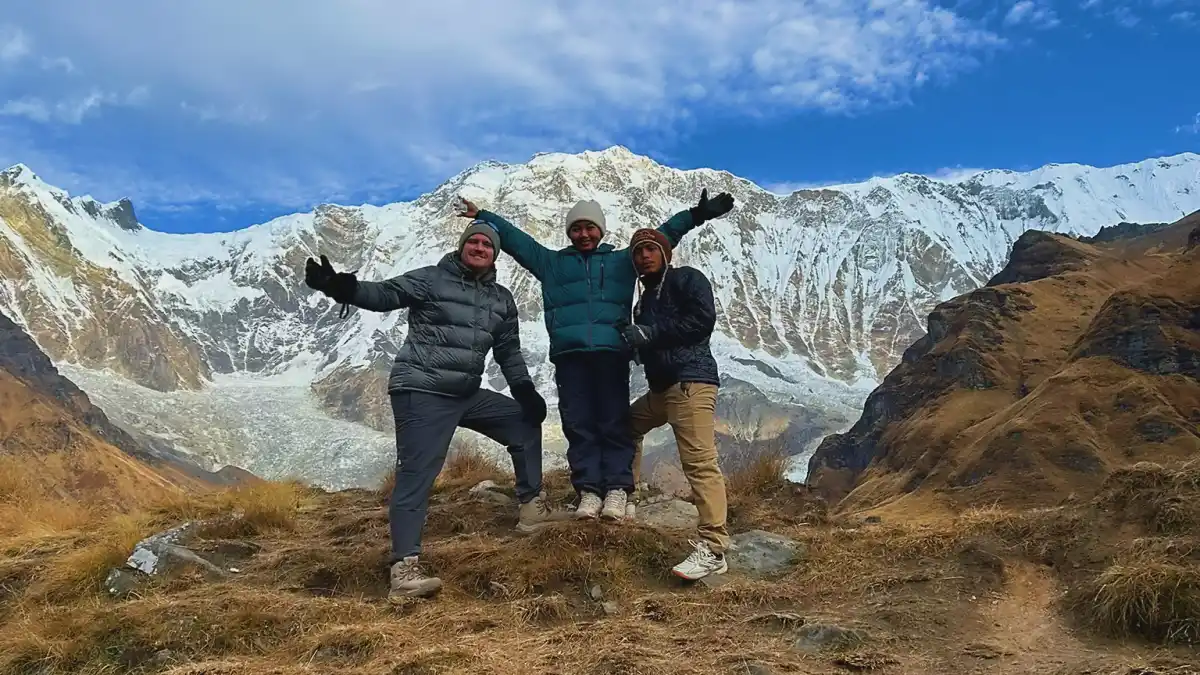
Joy of Reaching Annapurna Base Camp
The Beginner Fitness Self-Test
Before you book your trekking package, see if you can comfortably do all three:
Stair climb: Climb stairs or a steep hill continuously for 30-60 minutes with steady, rhythmic breathing.
Cardio: Run for 20-30 minutes continuously, or cycle 30-50 km on rolling terrain, without complete exhaustion.
Multi-day endurance: Walk 15 km in a day across multiple consecutive days, carrying a 5-7 kg daypack, without severe next-day soreness.
What if you fail the self-test? Most people who fail one or two of these markers can pass them all within 8-12 weeks of consistent work. Begin with shorter walks, add weight gradually, and use the training plan below. Failing the test now is information, not a verdict.
Your trekking boots should also be broken in on local walks before you fly to Nepal because fresh boots on day one is the fastest way to ruin a trek with blisters.
How to Train for the ABC Trek
Your physical preparation should focus on endurance and stamina rather than raw power. Walking 5-7 hours daily over steep, varied terrain demands a structured plan built around strength, cardio, and trail-specific stair work.
Strength Training (2-3 sessions per week)
Bodyweight or dumbbell squats for climbing power.
Walking lunges for unilateral stability on uneven ground.
Slow eccentric calf raises for descent control (most ABC injuries happen going down).
Planks plus bird-dogs to protect your back under a daypack.
Cardio Training (3-4 sessions per week)
45 to 90-minute sessions of running, swimming, cycling, or hill walking to build lung capacity and train your heart to deliver oxygen efficiently in thin air. Beginners should target 3–4 cardio sessions per week, mixing steady-state with one interval session.
Stair and Trail-Specific Training
This is the single most ABC trek-specific exercise you can do. Start unweighted on a stairwell or stadium, then gradually add your daypack, building from 3 kg up to 8 kg over several weeks. If you have access to hills, even better.
What to skip in training
Heavy bench press and powerlifting.
Sprint workouts. ABC is endurance, not power.
Crash diets. You need fuel reserves, not a deficit.
Mental Preparation for High Altitude
Trekking at altitude is as much psychological as physical. The strongest legs in the world fail if the mind quits at day five.
Set realistic expectations: Long days, basic teahouse accommodation, irregular connectivity. Embrace the simplicity rather than fighting it.
Practice mindfulness and breath control: Use deep breathing during training. Conscious breath control is enormously useful when air thins above 3,000 m.
Focus on the process: Don’t fixate on Base Camp. Break each day into smaller goals (reaching the next teahouse, the next ridge, the next lunch stop).
Adopt an acclimatization mindset: Mentally accepting “slow and steady” is your best defense against altitude sickness.
Combine physical and mental training, and the trek shifts from a survival test to a genuinely enjoyable experience.
Sample 8-Week ABC Training Plan
Sample 8-Week ABC Training Plan
Week
Cardio
Strength
Stair/hill work
Long walk
1-2
3x 30 min easy
2x full body
1x 20 min unweighted
5 km, no pack
3-4
3x 45 min steady
2x full body
2x 30 min, 3 kg pack
8 km, 3 kg pack
5-6
4x 60 min mixed
3x full body
2x 40 min, 5 kg pack
12 km, 5 kg pack
7
4x 75 min
3x full body
2x 50 min, 7 kg pack
15 km, 7 kg pack
8
3x 30-45 min
1x full body
1x 30 min, 5 kg pack
One easy 8 km
Best Season for Beginners to Trek to ABC
Beginners should strictly avoid the monsoon season (June-August), which brings mud, landslides, leeches, swollen rivers, and constant cloud that hides the mountains you came to see. The deep winter season (December-February) should also be avoided by beginners because it brings sub-zero cold, ice, and snow on stone steps, avalanche danger, and possible trail closure past MBC.
The best seasons for beginners to trek to ABC are the Spring and Autumn seasons. For beginners choosing the best time to trek is important as it can make your journey enjoyable and will be able to see the best views of the Himalayas.
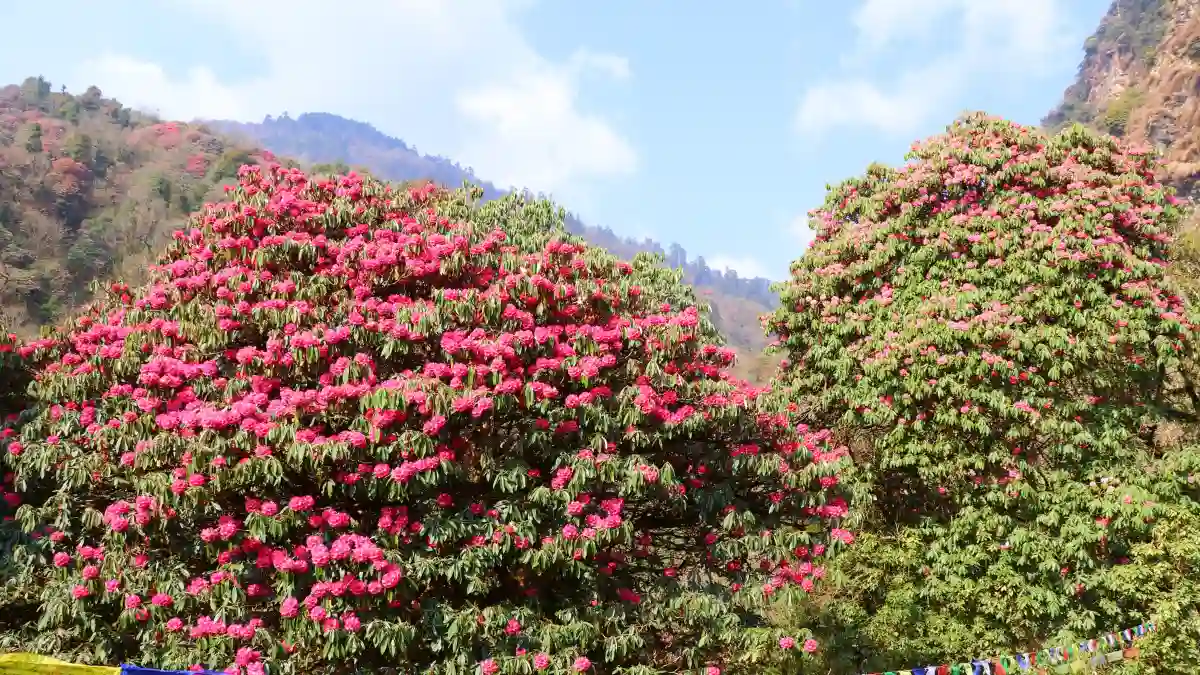
Rhododendron Trees Along the Annapurna Base camp Trail
Stick to the two reliable windows:
Spring (March-May)
Warm days, blooming rhododendron forests in pink and red, and moderate crowds. April offers the most stable mornings and best mountain visibility. May brings afternoon haze and warmer base camp nights.
Autumn (September-November)
Peak trekking season with clean skies, stable weather, and the safest window for first-timers. October has the clearest skies and biggest crowds. November is crisp, quiet, and noticeably colder at altitude.
Month-by-Month Beginner Suitability
Month-by-Month Beginner Suitability
Month
Lowland temperature
Base camp temperature at night
Visibility
Crowds
Beginner suitability
March
12-20 °C
-4 to -8°C
Good
Moderate
Good
April
15-22 °C
0 to -4°C
Excellent
Busy
Very good
May
18–25°C
0 to -2°C
Hazy afternoons
Moderate
Good
June-August
20–28°C
3 to 8°C
Poor
Low
Avoid
September
15–22°C
-2 to 2°C
Good
Moderate
Good
October
12–20°C
-6 to -2°C
Excellent
Peak
Excellent
November
8–15°C
-10 to -5°C
Excellent
Moderate
Good
December-February
0–10°C
-20 to -14°C
Clear but cold
Low
Not recommended
Temperature ranges based on operator records from the Department of Hydrology and Meteorology (Pokhara station) and on-trail observations. Conditions vary year to year; check forecasts before departure.
Accommodation and Food on the ABC Trek
Because the trail is well developed, you don't need camping or cooking gear. You sleep and eat in teahouses which are family-run mountain lodges that form the backbone of trekking in Nepal.
What Teahouses Offer
Teahouses provide twin or dormitory rooms with foam mattresses and warm blankets, a communal stove-heated dining hall (the social center of every evening), and shared bathrooms that get more basic as you climb. Expect:
Rooms: $3-$20 per night, rising with altitude
Wi-Fi: $2-$5 per session, slow and unreliable above Chhomrong
Device charging: $2-$3 per device or per hour at higher elevations
Hot showers: $3-$5, often gas-heated, sometimes solar (don’t expect it past Deurali)
Food on the Trail
Walking 5-7 hours daily demands high-calorie, easily digestible meals. Menus are surprisingly varied at lower altitudes and gradually shrink as you climb.
Breakfast options: include porridge, pancakes, eggs, toast with jam, and Tibetan fried bread.
Lunch and dinner options: include vegetable fried rice, noodles, thukpa, pasta, and simple mountain-style pizzas, alongside traditional Nepali dal bhat, which is the trekker's best value at $5-$10 at lower elevations, rising to $10-$15 above Chhomrong, with free refills throughout.
Above Chhomrong (2,170 m), the Annapurna Sanctuary is strictly vegetarian for religious reasons. No meat is sold, served, or carried past this point. Above 2,500 m, drink garlic soup at least once daily because it aids circulation, eases mild altitude headaches, and warms you in cold dining rooms.
Dietary restrictions: Vegetarian food is universal. Vegan is possible but requires asking (most curries use ghee). Gluten-free is harder, dal bhat is naturally gluten-free, but bread, noodles, and pasta dominate other menu items. Tell your guide on day one if you have allergies.
Typical Daily Food and Lodge Costs
Altitude zone
Room
Meals (3)
Extras
Total per day
Trailhead to Chhomrong
$3-$7
$15-$20
$5-$8
$25-$40
Chhomrong to Deurali (2,200–3,200 m)
$7-$12
$20-$28
$8-$12
$35-$55
MBC and ABC (3,700–4,130 m)
$12-$20
$28-$38
$10-$15
$50-$70
How to Avoid Altitude Sickness as a Beginner
(Medical disclaimer: The information below is general guidance, not medical advice. Altitude illness can be life-threatening. Consult a physician familiar with altitude medicine before your trek, especially if you take any prescription medication or have a cardiovascular, respiratory, or kidney condition.)
Acute Mountain Sickness (AMS) is the single biggest physiological risk above 2,500 m. Preventing it is entirely about discipline, not toughness. Even the fittest person on the trail is not immune to altitude sickness. So, you must know how to handle altitude sickness.
Rules that keep beginners safe
Ascend slowly: Limit elevation gains to 300-500 m per day once above 3,000 m
Build in rest days: Use strategic stops at Chhomrong or Himalaya to let your body catch up.
Climb high, sleep low: At teahouses above 2,500 m, hike an additional 150-300 m above your lodge, rest 30-60 minutes, then return to sleep lower.
Hydrate aggressively: 3-4 liters of treated water daily. Avoid alcohol entirely and limit caffeine because both mask early AMS symptoms.
Eat enough: Loss of appetite is itself a mild AMS symptom. Force calories even when you don’t feel hungry.
Preventative medication: Consult your doctor before leaving for Nepal about carrying Diamox (Acetazolamide). Diamox acts as a mild diuretic that forces your kidneys to excrete bicarbonate, which acidifies your blood and triggers faster, deeper breathing to naturally accelerate acclimatization.
Pulse oximeter readings
A finger pulse oximeter (approx. $15) is a simple safety tool. At altitude, SpO2 naturally drops. Typical ranges on the ABC trail:
Below 3,000 m: 92-96% is normal
3,000 m-4,000 m: 85-92% is normal
At ABC (4,130 m): 80-90% is typical
A reading below 80% combined with headache, confusion, or shortness of breath at rest means stop and consult your guide immediately. Trends matter more than single readings, so measure morning and evening.
AMS Symptom Checklist
Severity
Symptoms
Action
Mild
Headache, fatigue, mild nausea, poor sleep
Stop ascending, hydrate, and rest a day
Moderate
Persistent headache not relieved by painkillers, vomiting, and dizziness
Descend immediately, at least 300-500 m
Severe (HAPE/HACE)
Confusion, loss of coordination, gurgling breath, blue lips, wet cough with frothy/pink sputum, inability to walk straight
Emergency descent plus helicopter evacuation
Skip the Five-Day Itinerary
A rushed 5-day ABC plan forces nearly 1,000 m of gain per day and is suitable only for experienced high-altitude trekkers. For beginners, a 10-14 day itinerary is strongly recommended because it builds in the rest, buffer, and acclimatization days that make the trek both safer and far more enjoyable.
How Much Does the ABC Trek Cost for Beginners?
A well-planned 10-14 day guided ABC trek runs roughly $800-$1,200 USD, excluding international flights and Nepal visa.
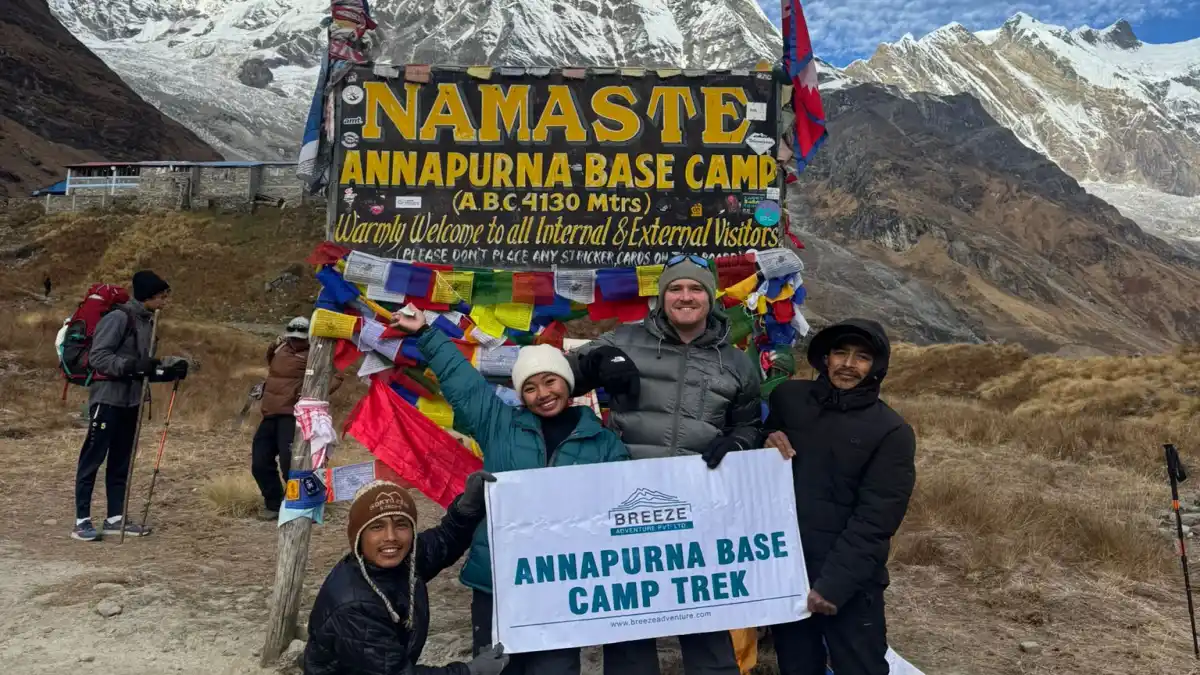
Breeze Adventure Team with Trekkers reaching Annapurna Base Camp
ABC Trek Cost Summary
ABC Trek Cost Summary
Category
Cost (USD)
ACAP permit
$22-$25
TIMS card
approx. $15
Licensed guide
$25-$40/day
Porter
$15-$25/day
Kathmandu-Pokhara tourist bus
$12-$18
Kathmandu-Pokhara AC bus
$20-$30
Kathmandu-Pokhara flight (one-way)
$100-$130
Daily on-trail spend (lower trail)
$25-$40
Daily on-trail spend (base camp area)
$50-$70
Travel insurance (with heli coverage)
$100-$150
Sleeping bag
$2-$3/day
Down jacket
$1-$2/day
Trekking poles
$1/day
Tips (guide + porter, customary)
$80-$150 for 10-14 days trek
Personal gear purchase (if not renting)
$200-$800
What’s Usually Excluded
International flights, Nepal visa ($30-$125 depending on stay length), personal gear purchases, alcohol, and souvenirs are not included in agency package quotes. Always clarify with the agency what’s in and out of their price.
Permits and Guides Rules (Updated for 2026)
Permit and guide rules in Nepal have changed multiple times since 2023, and many older blogs still contain outdated information.
Permits You Definitely Need
ACAP (Annapurna Conservation Area Permit): Required for every foreign trekker entering the Annapurna Conservation Area. Issued by the National Trust for Nature Conservation (NTNC).
Cost: NPR 3,000 (approx. $22-$25 USD) for foreign nationals, NPR 1,000 for SAARC nationals. This rate has been in place since 2023.
Where to get it: Nepal Tourism Board office in Kathmandu (Bhrikuti Mandap) or the NTNC/ACAP counter in Pokhara. Both typically open 9 AM–5 PM on weekdays. Most agencies arrange it for you as part of a package.
Checkpoint reality: Checked at Birethanti, Ghandruk, Chhomrong, and other points along the trail. Carry the printed original copy because digital copies are frequently rejected.
Children under 10: Don't need the permit.
TIMS Card (Trekkers' Information Management System): Officially still required by the Nepal Tourism Board for trekkers in the Annapurna region.
Cost: NPR 2,000 (approx. $15 USD) for foreign nationals, NPR 1,000 for SAARC.
Enforcement reality: Reports from operators in 2026 are mixed. Some report that ABC checkpoints now verify only ACAP and not TIMS; others say TIMS is still checked. Because enforcement varies by checkpoint and date, the safe move is to carry both.
The Guide Rule
This is where outdated information causes real confusion. Here's what's actually in force for ABC:
The rule that applies to ABC: Since 1 April 2023, every foreign trekker in Nepal's national parks and conservation areas must be accompanied by a licensed guide or porter-guide booked through a TAAN (Trekking Agencies Association of Nepal)-registered (government-approved) trekking agency. This includes the Annapurna Conservation Area and, therefore, the ABC trek. This rule was confirmed by the Nepal Tourism Board and has been progressively enforced through 2026.
The rule that does NOT change anything for ABC: On 22 March 2026, Nepal's Department of Immigration removed the two-trekker minimum for Restricted Area Permits, affecting Manaslu, Upper Mustang, Upper Dolpo, Kanchenjunga, Tsum Valley, Nar Phu, and other restricted regions. This was a restricted-area policy change. It did not change anything about the ABC trek, because ABC has never been a restricted area and never required a two-trekker minimum in the first place. If a blog tells you the March 2026 rule "changed the ABC requirement to one trekker plus one guide," that is wrong. The one-trekker-plus-one-guide setup has been the practical reality on ABC since April 2023.
Bottom line for ABC in 2026: You can trek as a single foreign trekker, but you must be accompanied by a licensed guide or porter-guide hired through a TAAN-registered agency. Trekking without one risks a fine and removal from the trail at the next checkpoint. (Fine amounts vary; agencies report figures around NPR 10,000–15,000 in 2026, though this is enforced inconsistently and not published as a fixed sum by the NTB.)
Update note: This information was verified as of March 2026. Rules can change; verify with the Nepal Tourism Board before booking.
What's a Porter-Guide?
A porter-guide is a licensed staff member who both carries part of your load (typically up to 10-12 kg) and provides basic guiding. They cost less than hiring a separate guide and porter, and they're a popular option for solo beginners on a budget.
Always book guides through a government-registered trekking agency in Kathmandu or Pokhara because this guarantees a licensed, first-aid-trained guide. Carry physical permit copies with you. Screenshots are often rejected at checkpoints.
Age Limits for the ABC Trek
There are no legal age limits for ABC. And ABC is safe to trek with children. Suitability depends on individual fitness and altitude tolerance, not the number on a birth certificate.
Children: Experts suggest a minimum age of around 10. Trekking with toddlers is strongly discouraged because they can’t regulate body temperature reliably or communicate early altitude symptoms properly.
Older trekkers: People in their 60s and 70s complete ABC every season, typically with a physician’s clearance, a slower itinerary (12-14 days), and a porter to keep daypack weight low.
Teenagers 12 and older typically handle ABC well with the same fitness preparation as adults. The honest test isn’t age, it’s whether you can pass the fitness self-test above and commit to slow pacing.
Pregnant trekkers should consult their physician; most experts recommend avoiding altitudes above 2,500-3,000 m during pregnancy.
Essential Safety Tips for Beginners
Beyond altitude management, a handful of habits separate smooth treks from miserable ones.
Monitor oxygen with a pulse oximeter twice daily. Pause your ascent if levels drop sharply alongside headaches or confusion.
Keep your daypack under 10 kg and hire a porter for heavier gear. Use trekking poles on descents. Your knees will thank you.
Drink 3-4 liters of treated water daily. Sip every 20-30 minutes, even when you don’t feel thirsty.
Check the forecast each morning and ask teahouse owners about trail conditions because they will have current information about swollen rivers and active landslide zones that no app will give you.
Carry a basic first-aid kit with blister care, painkillers, rehydration salts, and any personal medication.
Safety Notes for Solo Female Trekkers
ABC is one of the safer trails in the region for solo female trekkers, with constant foot traffic, dense teahouse coverage, and a mandatory guide. Most agencies can arrange a female guide if requested, but you must book early in peak season. Stick to well-lit teahouse dining areas in the evening, share itineraries with someone at home, and trust your instincts about lodging choices.
Travel Insurance
Confirm your policy explicitly covers trekking up to 5,000 m and helicopter evacuation. World Nomads, IMG Global, and SafetyWing are commonly used by trekkers, but compare current policies because coverage terms change frequently and exclusions for "high-altitude trekking" vary by underwriter. Travel insurance with high-altitude trekking coverage up to 5,000 m is non-negotiable. Never trek without it. Confirm your policy covers helicopter rescue specifically, not just hospitalization.
Frequently Asked Questions (FAQs)
1. Can a complete first-timer do the Annapurna Base Camp Trek?
Yes. ABC is widely considered Nepal's best high-altitude trek for complete first-timer. Thousands of first-timers complete it every season. The key is 8-12 weeks of training before departure and choosing a 10-14 day itinerary, not a rushed 5-day plan.
2. Is the ABC trek difficult for beginners?
ABC is rated Grade 2 (moderate) under Nepal's trekking classification, which means it is physically demanding but not technically challenging. With proper training and a sensible pace, most beginners handle it well.
3. Can you do ABC without a guide?
No. Since 1 April 2023, every foreign trekker in the Annapurna Conservation Area must be accompanied by a licensed guide or porter-guide hired through a TAAN-registered agency.
4. How fit do I need to be for the ABC trek?
You should be able to run 20 to 30 minutes continuously without exhaustion, walk 15 km in a day carrying a 5-7 kg daypack across multiple consecutive days, and climb stairs or a steep hill for 30 to 60 minutes with steady breathing.
5. Which is the best month for beginners to trek ABC?
April and October are the two best months. March and November are strong second choices because March is quieter than April with slightly cooler nights, and November is crisp and uncrowded but colder at base camp.
6. Which is better for beginners, ABC or EBC?
ABC is significantly better for first-timers on almost every measure. ABC tops out at 4,130 m versus EBC's 5,364 m, meaning lower altitude risk and easier acclimatization. ABC can be completed in 10-14 days, whereas EBC requires 14-18 days for beginners. The ABC trail also has more teahouses than the EBC trail, making accommodation more reliable.
7. What is the cost of the ABC trek?
A well-planned 10-14 day guided ABC trek costs roughly $800–$1,200 USD, excluding international flights and Nepal visa.
8. Did the March 2026 trekking rule change affect ABC?
No. The March 2026 change removed the two-trekker minimum for Restricted Area Permits (Manaslu, Upper Mustang, Upper Dolpo, Kanchenjunga, Tsum Valley, Nar Phu). ABC is in a Conservation Area, not a Restricted Area, and was unaffected. ABC has required a licensed guide since 1 April 2023.
9. How much weight should I carry on the ABC Trek?
Keep your daypack under 10 kg. Hire a porter for the rest. They typically carry up to 20 kg total (often split across two clients). A porter-guide will carry 10–12 kg of your gear and also guide.
10. Is Wi-Fi available at Annapurna Base Camp?
Most teahouses below Chhomrong have reliable Wi-Fi for $2-$5 per session. Above Chhomrong, it slows, and it is often unavailable or extremely slow at MBC and ABC. Buy a local Ncell or NTC SIM in Kathmandu or Pokhara for the most consistent connectivity (still patchy at the highest camps).
11. Can I charge my phone on the ABC trek?
Yes, most teahouses charge devices at $2–$3 per device or per hour, increasing with altitude. Bring a 10,000–20,000 mAh power bank as backup, and a universal adapter for Nepali sockets (Type C, D, M).
12. What’s the difference between a guide and a porter-guide?
A guide focuses on navigation, language, culture, altitude monitoring, and emergencies. They do not carry your bag. A porter-guide is licensed to do both, meaning they carry 10-12 kg of your gear and provide basic guiding. Porter-guides cost less than hiring a separate guide and porter.
Conclusion
The challenges are real with thousands of stone steps, rustic lodges, and cold, high-altitude nights. But with proper preparation and a sensible, slow-paced itinerary, the Nepal Annapurna Base Camp trek is exceptionally rewarding and genuinely achievable for first-timers.
The trail carries you from subtropical rhododendron forest to the ice-carved amphitheater of the Annapurna Sanctuary, where you stand at 4,130 m surrounded by 7,000 and 8,000-m-tall mountains like Annapurna I, Annapurna South, and the sacred Machhapuchhre, delivering one of the most spectacular mountain panoramas on Earth. For a beginner seeking a safe, well-supported, and visually breathtaking introduction to Himalayan trekking, ABC remains unmatched.
Kishwor Adhikari is a passionate writer with a deep enthusiasm for trekking and adventure. His extensive travels across Nepal, exploring its diverse landscapes and hidden corners, have shaped his unique perspective on the country's natural beauty. With a wealth of first-hand experience in adventure trekking, Kishwor has become a trusted voice for fellow enthusiasts. Through his writing, he shares invaluable insights, offering practical advice and inspiration for both seasoned trekkers and novices alike. His dedication to sharing his journey and knowledge helps others discover the wonders of Nepal's wilderness, making his work an essential resource for anyone seeking adventure in the region.