Junbesi: The Valley Where the Moon Comes Down to Rest
Tucked beneath a towering cliff in Nepal's Lower Solukhumbu, at around 2,700 meters above sea level, lies one of the loveliest Sherpa villages in the entire Himalaya. Its stone houses, fluttering prayer flags, spinning prayer wheels, and ancient monasteries sit in a quiet valley that has, for centuries, served as a crossroads between Tibet and the rest of Nepal. This is Junbesi, a place so serene that, according to local legend, even the moon comes down here to rest when it grows tired.
Table of Contents
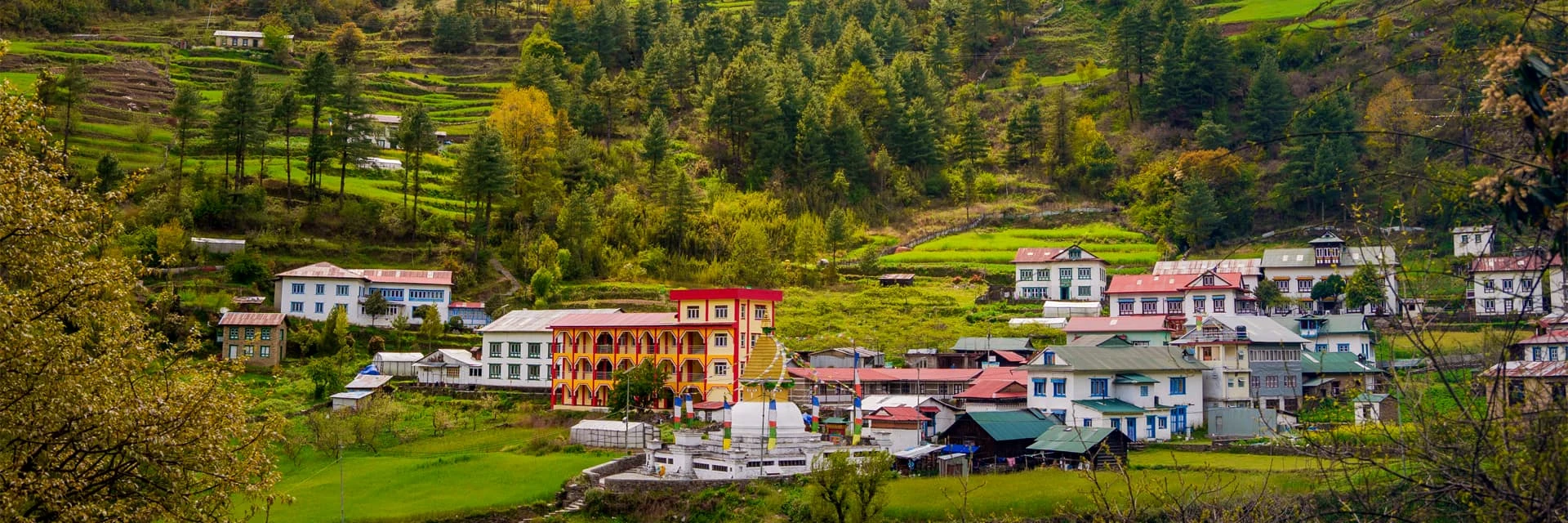
Junbesi village viewed from above, showing the landmark red-and-yellow building, white stupa and prayer flags surrounded by lush green hills.
What Does "Junbesi" Mean?
The name itself tells you something about the spirit of the place. "Junbesi" is the Nepali rendering of the village's name, and it breaks down into two simple, evocative words: Jun, meaning "moon," and Besi, meaning "lower valley." Put together, Junbesi is the "Valley of the Moon."
There is a charming local explanation for the name. Villagers will tell you that Junbesi is the spot where the moon descends to the earth to rest, Jun (moon) coming down Besi (below) to the valley floor. And there is a tangible relic of this lore, too: a large "moonstone" said to sit in the center of the valley, which locals will happily point you toward if you ask.
In the Sherpa language, the settlement clustered around the old Jung Gompa is known as "Jung-yul," while "Junbesi" is the name that travelers and Nepali speakers use. Either way, the moon and the valley are woven into its identity.
Where Is Junbesi?
Junbesi sits in the Solukhumbu District of Koshi Province in eastern Nepal, in the region known as Solu, the gentler, greener, lower-altitude southern half of the famous Solukhumbu (the homeland of the Sherpa people, and the gateway to Mount Everest). The village rests on the banks of the Junbesi Khola (river), framed by terraced fields, rhododendron and fir forests, and sweeping views of the Numbur Himal range.
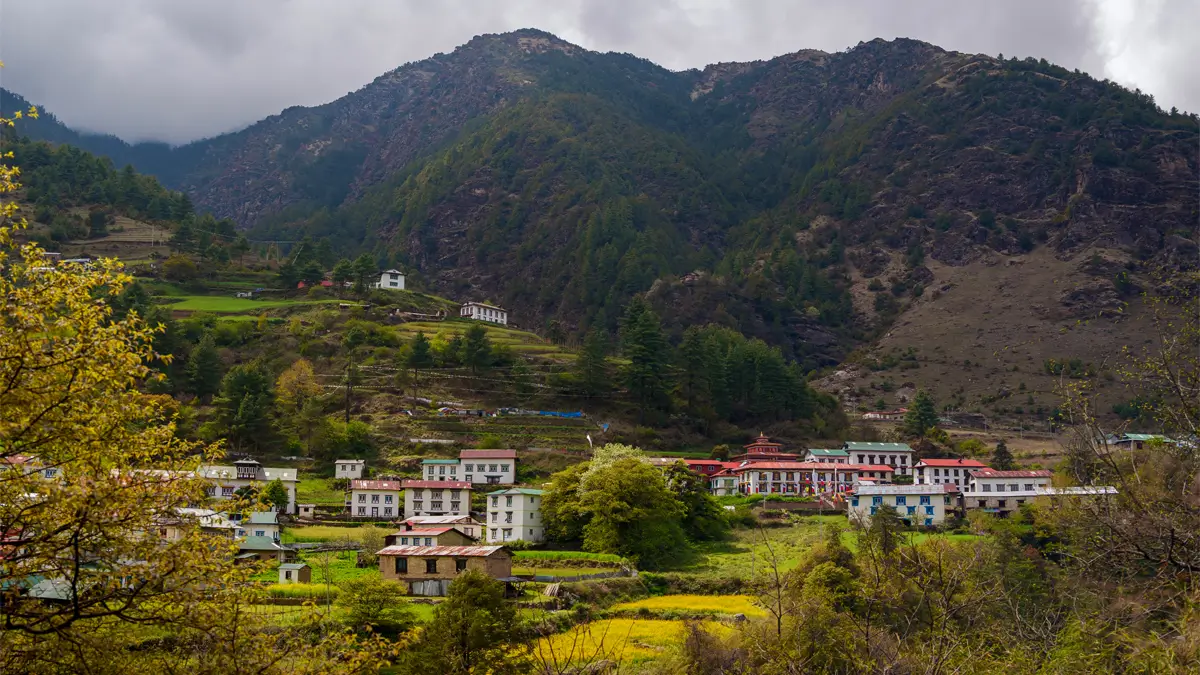
Because the village tucks itself right under a great cliff, first-time visitors often don't see it until they're almost standing in it — and then it appears all at once, quiet and charming, like something out of a storybook. To the north rises the famous Thupten Chholing Monastery on the lap of the Numbur range; to the east, the valley opens toward Phaplu and Beni.
Geographically and historically, the Junbesi area has long been part of a distinct Sherpa cultural world. For roughly fifteen generations, geography separated the Sherpa communities of the Junbesi Khola from those of the Bhote Kosi valley, producing a people united by language, livelihood, and bonds of marriage and trade, yet shaped by the particular landscape of their home valley.
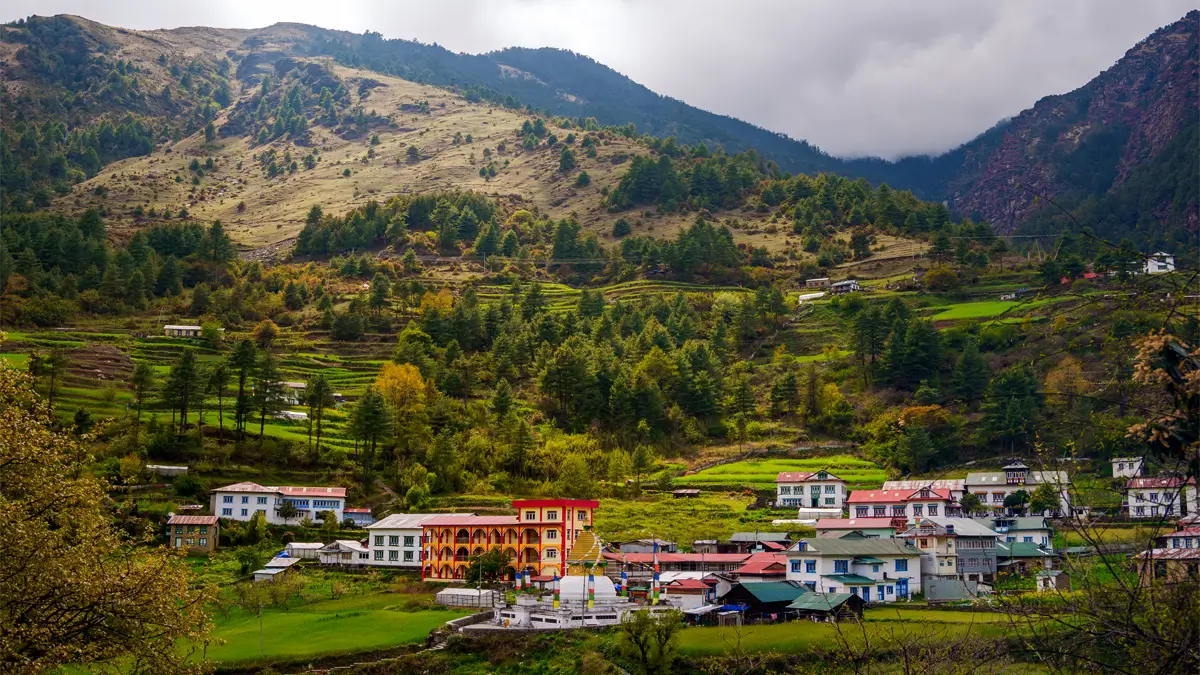
View across Junbesi village, with its monastery and terraced farmland tucked beneath steep, forested Himalayan ridgelines under a cloudy sky.
A Village Steeped in History
Junbesi is no ordinary mountain village! It is, in many ways, the cradle of Sherpa culture in Solu. When the Sherpa people crossed over from Tibet in the early 16th century, Junbesi became their first permanent settlement. It went on to serve as a kind of southern Sherpa capital, centered on the old Zhung (Jung) Gompa. To this day, it is described as one of the loveliest of all Nepal's Sherpa villages, with its scenic layout of stone houses climbing the valley.
The Old Trail to Everest
For decades, before airstrips and helicopters reshaped how people reach the high Himalaya, the only way to Everest was on foot — a long, multi-week walk eastward from the roadhead at Jiri. That classic route, the original Everest Base Camp trail, passed directly through Junbesi. The village became a vital and very busy waystation, a place where porters, traders, pilgrims, and mountaineers all stopped to rest, resupply, and spend the night before pushing on toward the high mountains.
This is the same trail used by the legendary 1953 British expedition. Junbesi lies on the original approach march that the 1953 team — including Tenzing Norgay and Sir Edmund Hillary — followed on their way to making the first-ever summit of Mount Everest on May 29, 1953. Trekkers who walk the Jiri-to-Junbesi route today are quite literally retracing the first leg of that historic journey, and the village remains proud of its place in that story.
Hillary's Lasting Bond with the Region
Sir Edmund Hillary's connection to this corner of Nepal went far beyond simply passing through. After his summit, Hillary devoted much of his life to the Sherpa people, building schools, hospitals, and bridges throughout the Solukhumbu. Junbesi was among the beneficiaries. Its elementary school was endowed by Hillary, a gift that speaks to how deeply the region and its people stayed in his heart.
That bond is echoed nearby at Pikey Peak, the dramatic viewpoint a short trek from Junbesi. Hillary famously declared the view of Everest from Pikey Peak to be his favorite, a panorama that, in clear conditions, sweeps across several of the world's highest peaks. From Dhaulagiri in the west to Kanchenjunga in the east, with Everest, Lhotse, and Makalu standing tall between them.
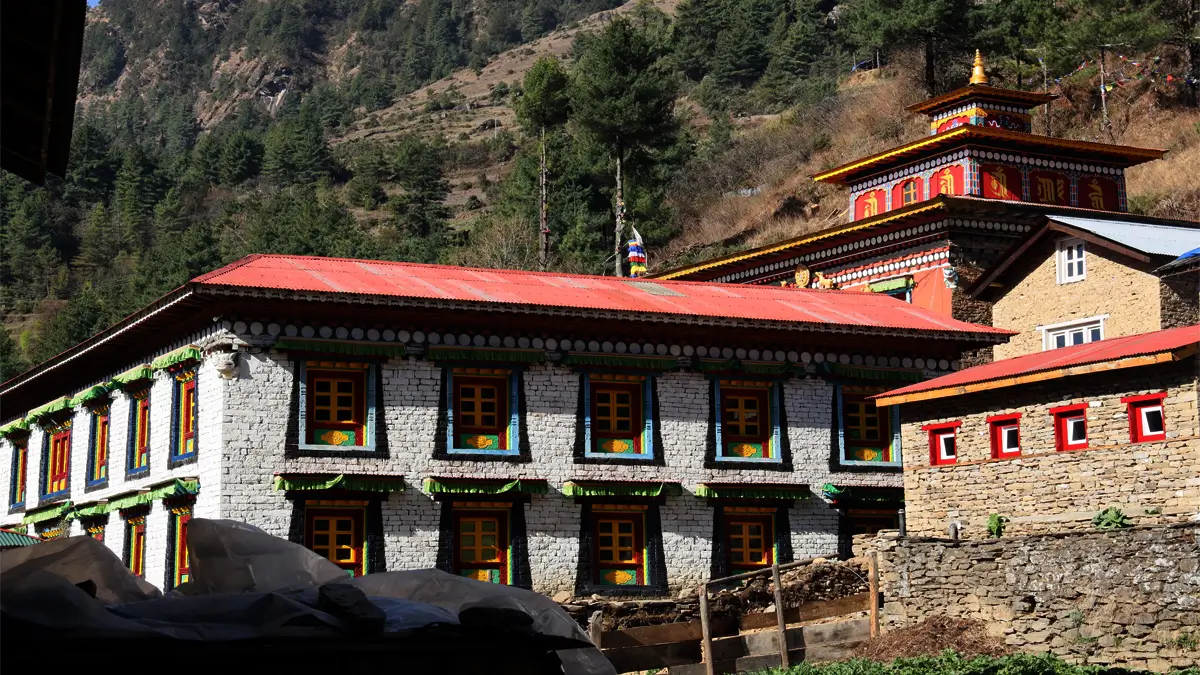
A traditional monastery building near Junbesi with whitewashed stone walls, vividly painted window frames and an ornate golden rooftop shrine behind it.
The Monasteries of Junbesi
If Junbesi is the cradle of Sherpa culture, its monasteries are its beating heart. The village is liberally decorated with prayer flags and prayer wheels, and it is home to four gompas of real historical and spiritual weight, two sitting right in the village, one a short walk above it, and the great Tibetan monastery on the hillside to the north. Together, they make Junbesi one of the richest centers of Tibetan Buddhism in Nepal.
Tashi Thongmon (Junbesi Monastery) — the Oldest of All
At the center of the village stands Tashi Thongmon Gompa — also known simply as Junbesi Monastery, and historically as Zhung (Jung) Gompa or Gonjong Gonpa. It is widely regarded as the oldest Sherpa monastery in the Solukhumbu region, its origins reaching back to the very founding of the village in the 16th century, with sources giving construction dates of around 1635–1636. Over the centuries, it has weathered earthquake damage in the 17th century, a fire in 1914, and several rounds of rebuilding, but it endures. The monastery is celebrated for its ornate woodwork, a level of craftsmanship rarely seen in other shrines of the area.
Inside stand three massive clay statues of Buddha Shakyamuni, Maitreya, and Padmasambhava — replacements made after the 1914 fire. (Local lore holds that the original statues escaped the flames by miraculously flying away to an undisclosed location.) The gompa also houses precious sets of the Kangyur and Tengyur — the great canonical collections of Tibetan Buddhist scripture. It is privately owned by a number of Sherpa families and looked after by Serlo Monastery, with a resident monk deputed to perform the rituals and open the doors for visitors and pilgrims. Each year, the Dumje festival brings the courtyard to life, celebrating the birth of Guru Rinpoche with masked dances.
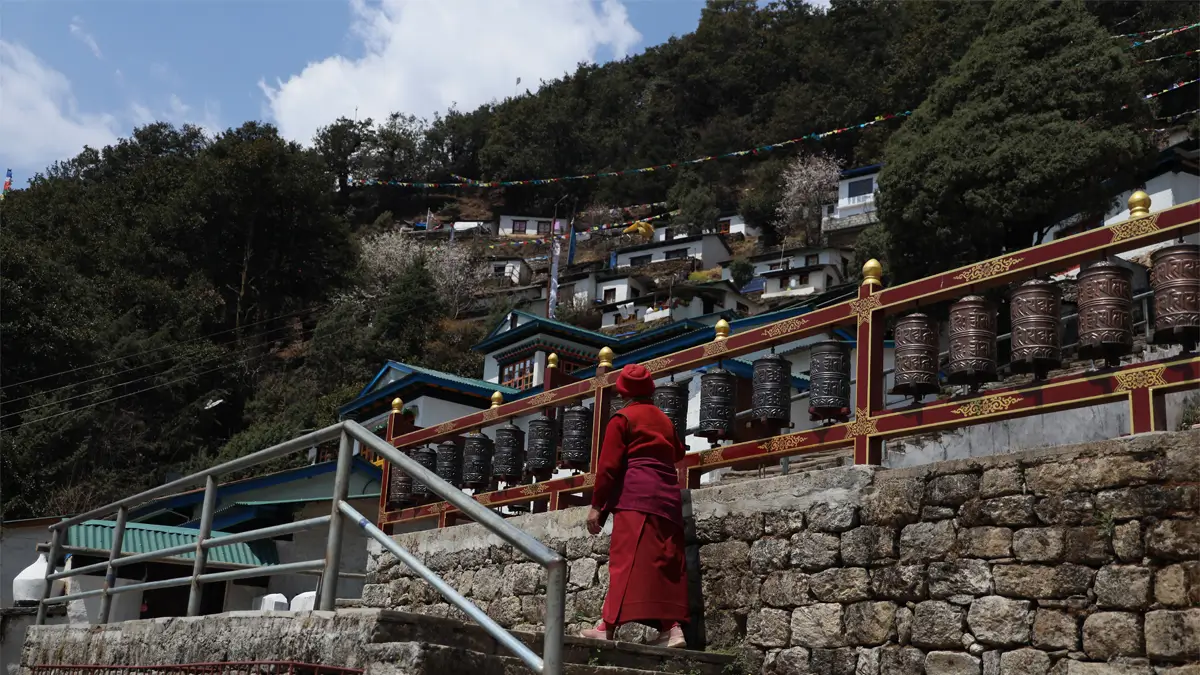
A monk in red robes climbs stone steps alongside a long row of copper prayer wheels, with the village rising up the hillside behind.
Sitting right alongside the old Junbesi Monastery in the village is the Ngagyur Sergon Lungrig Sedrup Zungdelling Monastery — a name that points to its lineage, for "Ngagyur Nyingma" means the "Earlier Translation School," the most ancient of the four great schools of Tibetan Buddhism, centered on the figure of Guru Rinpoche (Padmasambhava). Like the rest of the village, it is wrapped in prayer flags and lined with prayer wheels, and it forms the second of the two monasteries that anchor the heart of Junbesi. For visitors, the two village gompas standing side by side make an easy and rewarding first stop — a chance to spin the prayer wheels, take in the murals, and feel the rhythm of daily devotion before heading up to the larger monasteries on the surrounding hills.
Serlo Gompa (Shedrup Teljuk Chokhorling) — the Monastic School
A short walk of roughly half an hour above the village, to the south, sits Serlo Gompa, whose full name is Shedrup Teljuk Chokhorling. It was built by a remarkable native Sherpa, Lama Sangye Tenzin, who had received his education in eastern Tibet at the great Khampa monastic academy of Shechen — one of the seats of the nineteenth-century Buddhist renaissance. Today, Serlo is above all a place of learning: a Buddhist education center (a shedra) where around a hundred student monks pursue their studies, graduating to become "Acharyas," under the guidance of principal Ang Tshering Sherpa. It is also the institution that looks after the historic Tashi Thongmon Gompa down in the village.
A lovely traditional craft still survives here too: the monastery carves the wooden printing blocks from which religious texts and prayer flags are printed. The walk up rewards you with the soaring sound of the Solu river, waterfalls, surrounding hills, and a fine view of Mt. Numbur shining across the cliffs — and you may well meet the lamas and the curious, smiling student monks. (A friendly "Tashi Delek", hello in the Sherpa tongue, goes a long way.)
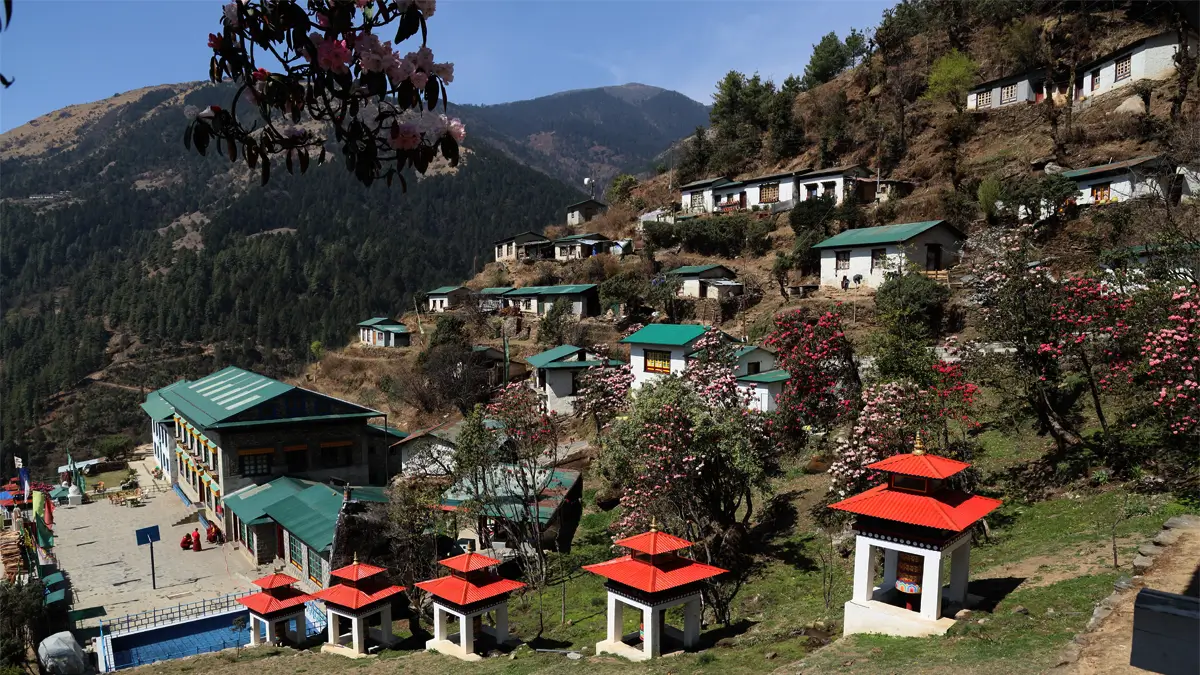
White Monk houses scattered across a green hillside above Junbesi, with red-roofed prayer wheel shrines and pink rhododendron flowers in spring.
Thupten Chholing — One of the Great Living Monasteries of the Himalaya
A few kilometers and a gradual uphill walk above Junbesi (roughly an hour or so through emerald evergreen forest, climbing alongside the stream and crossing a suspension bridge) lies one of the most significant monastic communities in the entire Everest region: Thupten Chholing Monastery, set at around 3,000 meters on the lap of the Numbur range.
Its story is one of faith and exile. During the 1959 Chinese invasion of Tibet, the renowned lama Kyabje Trulshik Rinpoche fled his monastery of Dza Rongphu (Rongbuk) in Tibet, followed by a large community of monks and nuns. He spent several years sheltering in monasteries of the Khumbu, including Thame, all the while hoping to return home. In 1968, on land donated above Junbesi, he built Thupten Chholing. For years he regarded it as a temporary retreat, certain he would one day return to Tibet. So the original buildings were never meant to last. But as Chinese control hardened and Buddhist leaders were barred from returning, Rinpoche accepted that this was now home, and from 2001 the monastery was rebuilt as a permanent, lasting structure.
Today, Thupten Chholing is one of the largest Tibetan Buddhist monastic communities in the mountains of Nepal, at its height home to some 900 monks and nuns, the great majority of them Tibetan refugees. It is renowned in particular as a great center for nuns (anis), with hundreds of women devoted to preserving Tibetan Buddhist tradition, and it is often described as one of the largest nuns' monasteries in the Everest region. The setting is genuinely magical: neat houses for the nuns and refugees climbing a south-facing hillside, brightly painted prayer halls, and the resonant sound of chanting drifting across the slope. Because it has remained an independent and autonomous institution, Thupten Chholing has stayed remarkably authentic and traditional. Visitors are sometimes welcomed into the central prayer hall to witness students reciting from sacred texts — a quiet, profound experience.
The 2015 earthquake hit the community hard, destroying many of the nuns' homes and forcing the temporary evacuation of hundreds of nuns, but reconstruction has steadily restored the settlement.
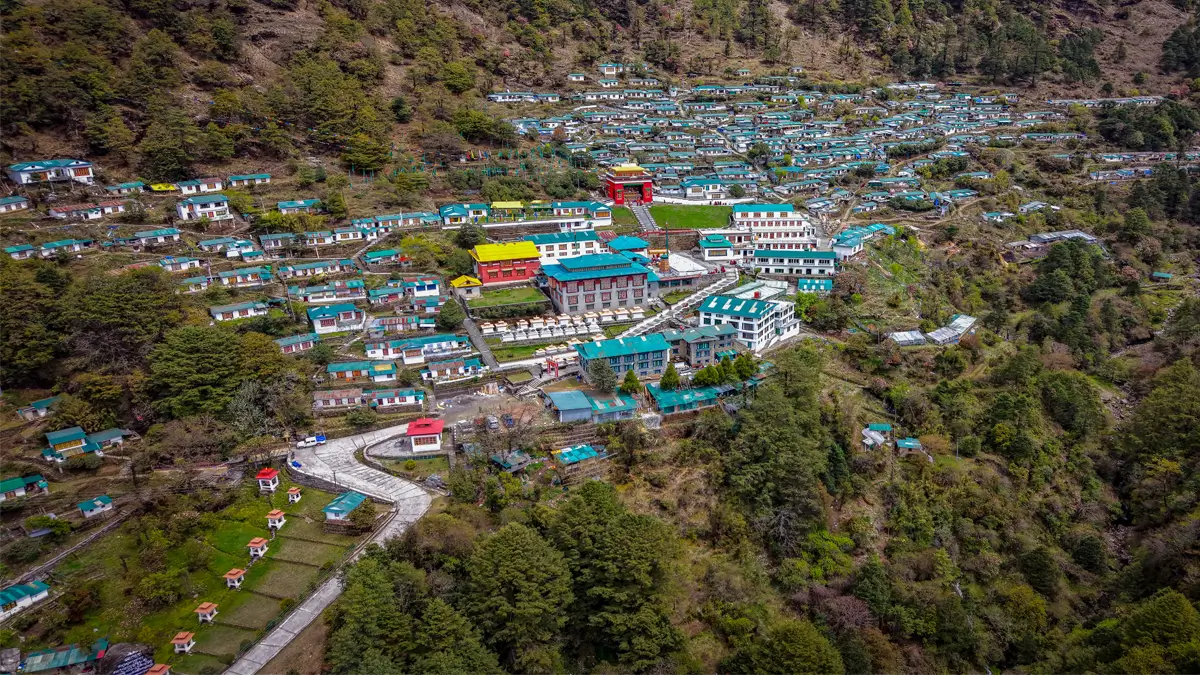
Bird's-eye view of the sprawling Thubten Choling Monastery, its many turquoise-roofed dwellings, prayer hall and gateway built into the forested hillside near Junbesi.
The People and Their Culture
Junbesi is, above all, a Sherpa village — and the Sherpa are among the most respected mountain people in the world, known for their resilience, warmth, and deep spiritual connection to the land. Strip away the tourism, and Junbesi is at heart a small community of yak herders and fruit farmers living much as their ancestors did.
Daily life here is inseparable from Tibetan Buddhism. Religion is woven into the everyday — the prayer wheels turned in passing, the mani walls and chortens that line the trails, the morning chants from the monasteries, the intricate wall paintings inside the gompas. Festivals mark the rhythm of the year: the autumn months around September and October are especially rich with celebrations, and the skies are at their clearest. The nearby Chiwong Monastery is famous for the spectacular Mani Rimdu festival, with its masked dances dramatizing the triumph of good over evil.
There is a striking blend of old and new here, too. The same family that grazes dzo (yak-cattle hybrids) and plows potato fields by hand may also send their daughters to boarding school in Kathmandu, where they return speaking impeccable English. Cell phones, solar lighting, Wi-Fi, and hot showers have arrived in the valley, yet the centuries-old traditions remain very much alive.
One detail captures the remoteness of this world beautifully: there are essentially no wheels in the Solukhumbu beyond the landing gear of aircraft. Everything from eggs to window glass to porcelain toilets — has historically been carried in on the backs of porters, on foot, at high altitude. It is a place where the effort behind every modern comfort is visible.
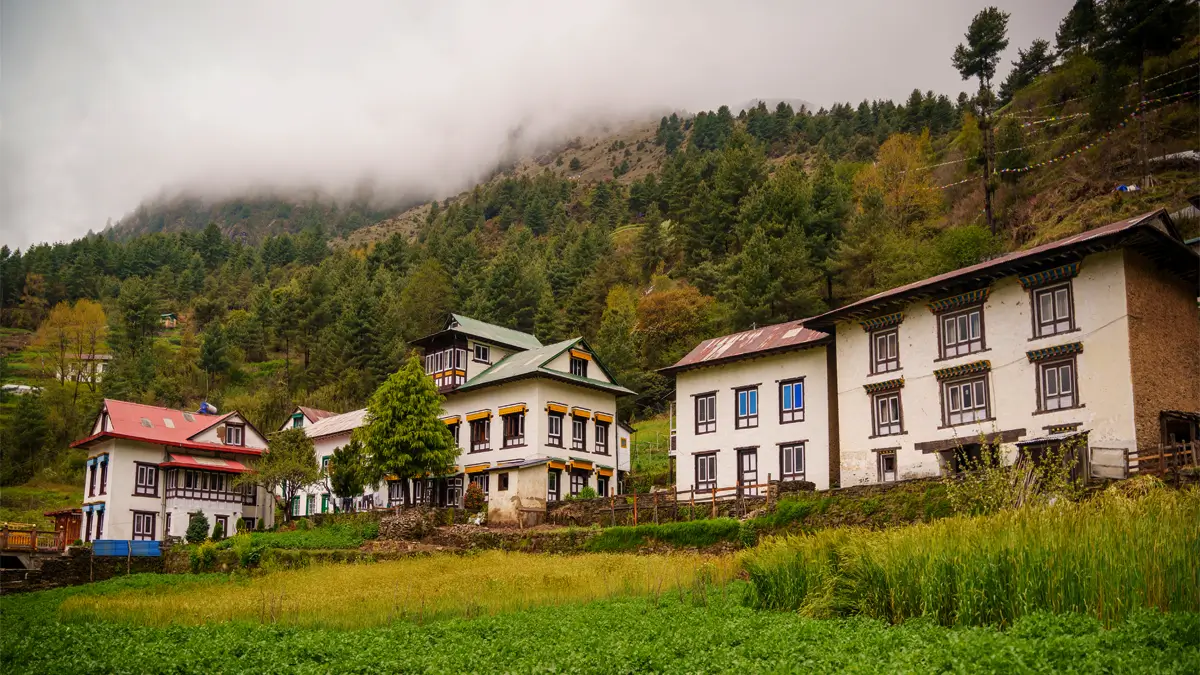
Whitewashed traditional Sherpa homes with carved window frames sit beside green fields, framed by mist drifting over the pine-covered slopes of Junbesi.
The Kiwi and Apple Farms
One of the unexpected delights of Junbesi is its agriculture. This is a village of fruit growers, and the valley has become quietly famous for its organic kiwi farms — a crop that thrives in the temperate, mid-hill climate here. Alongside the kiwis grow orchards of prized apple trees, and the broader area is known for its fruit: the nearby village of Ringmo, a little farther along the trail, is especially celebrated for its apple orchards (and the local apple products that come from them).
Local efforts continue to expand this tradition. In recent years, community members — including a former school principal in Junbesi — have worked with reforestation projects to plant thousands of fruit trees, including walnut, kiwi, apple, peach, pear, and apricot, on land near the river below the village's new post-earthquake school. The economy of Junbesi rests on this trio: agriculture, animal husbandry, and tourism, all underpinned by the famous warm hospitality of its people.
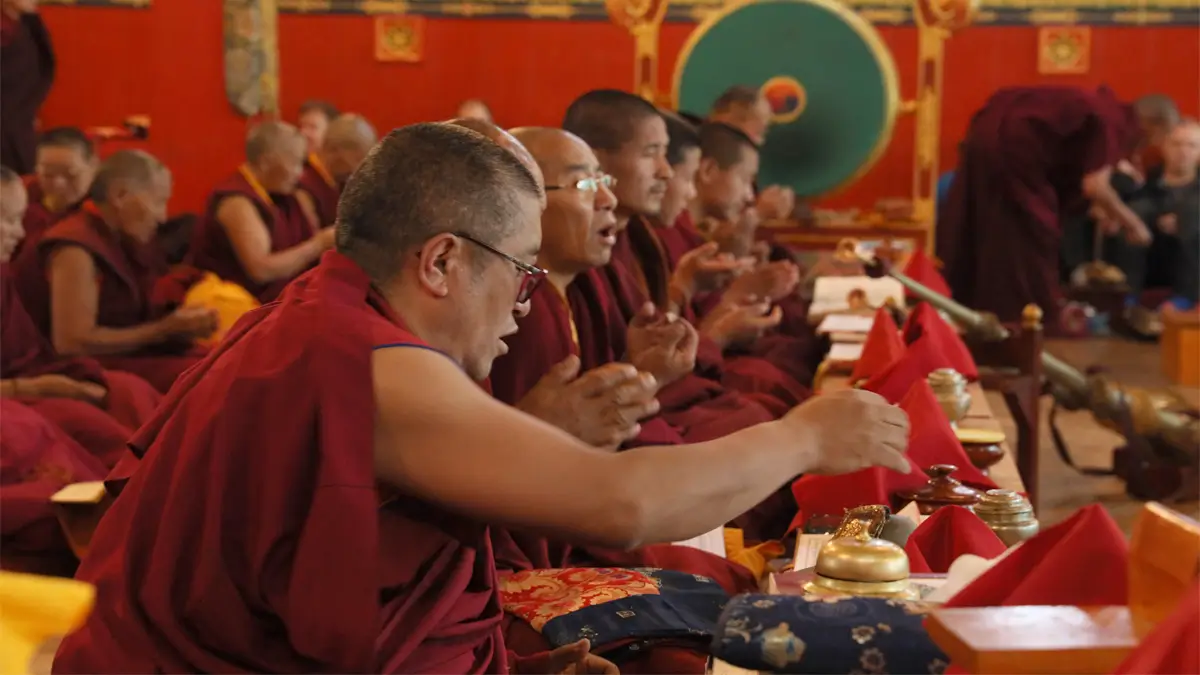
Monks in maroon robes seated in rows during a puja (prayer ceremony), with ritual bells and offerings, inside a richly decorated monastery hall near Junbesi.
The Perfect Place for a Retreat
If there is one village in the Everest region made for slowing down, it is Junbesi. Where the high Khumbu trails are about altitude and ambition, Junbesi is about stillness — and that makes it one of the finest retreat destinations in Nepal.
Everything about the place invites you to exhale. It sits at a gentle 2,700 meters, low enough to be comfortable and green, with no altitude worries and no punishing climbs simply to exist there. It is quiet — tucked beneath its cliff, away from the noise and crowds, with no roar of traffic (remember, this is a land almost without wheels). The days are framed by the soft sounds that calm a restless mind: the turning of prayer wheels, the distant chanting drifting down from the monasteries, the rush of the Solu river, birdsong in the rhododendron and fir forests, and the soft clatter of village life going about its centuries-old rhythm.
It is also, uniquely, a place of deep spiritual gravity. Few villages anywhere are surrounded by four working monasteries, including Thupten Chholing — one of the most authentic Tibetan Buddhist communities in the world, home to hundreds of monks and nuns in quiet practice. To spend a morning sitting in on prayers, watching butter lamps flicker against ancient murals, or simply walking the mani-walled paths between gompas is to absorb a kind of peace that is increasingly hard to find. Visitors describe coming for the views and leaving with something quieter and more lasting — a reset of the nervous system.
A retreat here can be as structured or as unstructured as you wish. Many travelers come for three or four unhurried days, choosing a comfortable Sherpa lodge in the village (the better ones offer warm rooms, hearty home-cooked food, hot showers, and Wi-Fi for when you want it). A typical retreat rhythm might look like this: gentle morning walks up to Serlo Gompa or Thupten Chholing to witness the monks and nuns at prayer; afternoons spent reading, journaling, or wandering the kiwi and apple orchards; long, slow meals of dal bhat and momos; and evenings under some of the clearest, most star-filled skies in the Himalaya. There is space here for meditation, for digital detox, for writing, for grief or healing, or simply for doing nothing at all — and doing it well.
For those who want to combine reflection with gentle movement, Junbesi also works beautifully as a soft, restorative trek rather than a strenuous one. The walks to the surrounding monasteries and viewpoints are short and rewarding, the scenery is constant, and the village always welcomes you back at the end of the day. As the local saying goes, even the moon comes down to Junbesi to rest. It is hard to imagine a better recommendation for a retreat.
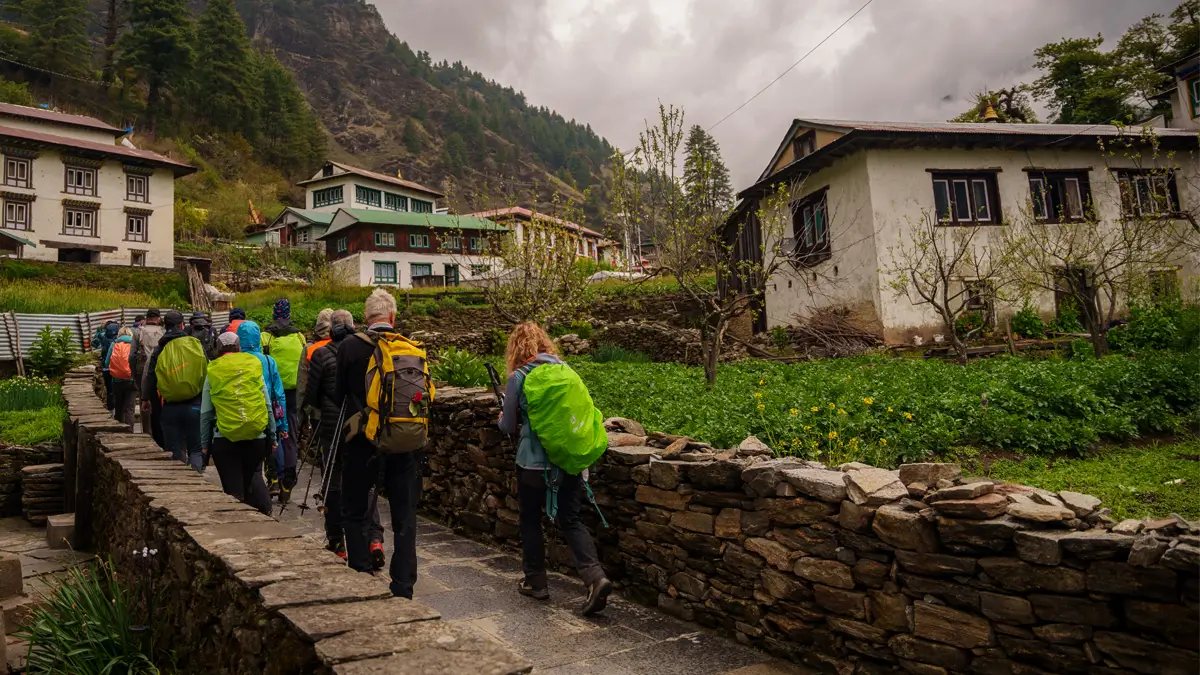
A line of trekkers with bright rain-covered backpacks follows a stone-paved trail through Junbesi, passing fields and traditional Sherpa houses.
Side Trips and Things to Do Around Junbesi
Junbesi makes an ideal base for exploration, and a stay of a day or two rewards you richly. Among the best side trips and activities:
Serlo Gompa: the half-hour walk up to the monastic school above the village, for mountain views and a glimpse of monks at their studies (covered above).
Phugmoche (Phungmoche) Monastery: a smaller but historically important monastery built in 1938, set on a hillside with wonderful views, whose history illustrates the migration and settlement of the original Sherpa families of Solu.
Chiwong Monastery: perched dramatically on a cliffside near Phaplu, famous for the Mani Rimdu festival.
Ratnange (Ratnage) Hill: at around 3,300 meters above Phaplu, a few hours' walk that rewards you with splendid views of Everest and the surrounding peaks.
Ringmo village: a quieter settlement known for its apple orchards, often visited on the onward trail.
The kiwi and apple orchards wander the local farms, sample the fruit, and chat with the growers in the village square.
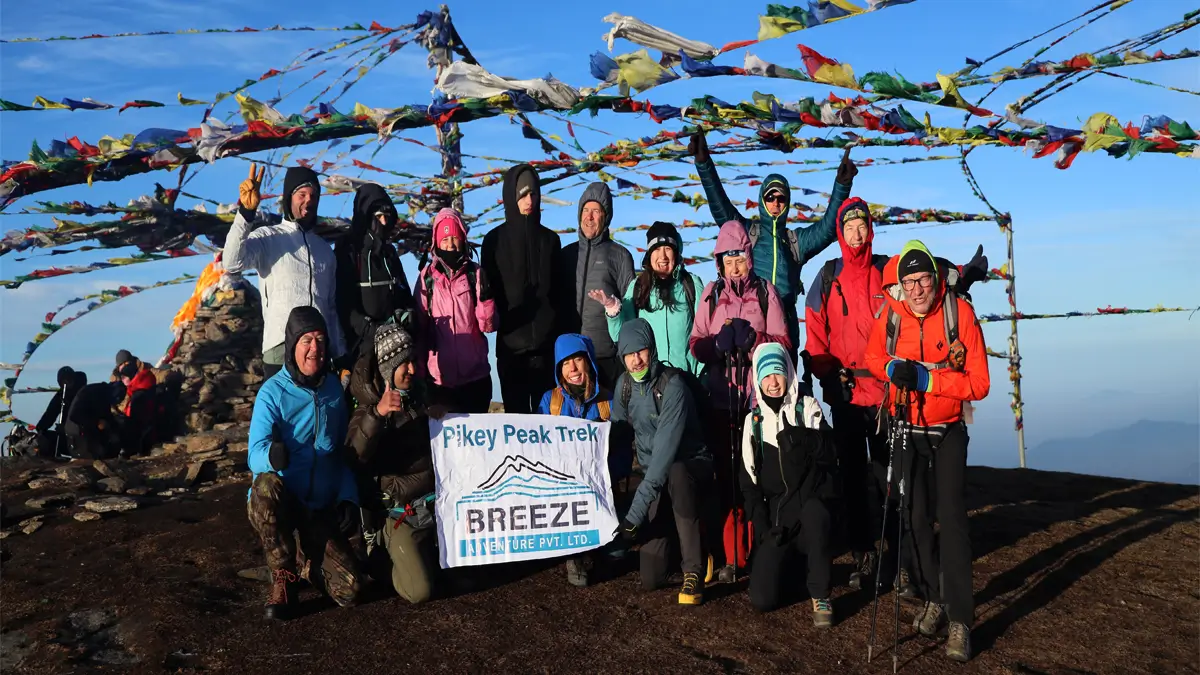
A Breeze Adventure trekking group celebrating at the Pikey Peak summit, surrounded by colourful Tibetan prayer flags at sunrise.
How Pikey Peak Brought Junbesi Back to Life
For years, Junbesi's fortunes ebbed. When trekkers began flying directly into Lukla rather than walking the long Jiri trail, the old route — and the villages along it, Junbesi included — grew quieter. The busy waystation of the expedition era saw far fewer footsteps.
That has changed, and the catalyst has been the rise of the Pikey Peak Trek. This relatively new, low-to-medium-altitude route has rapidly become one of the most beloved short treks in Nepal — and Junbesi sits squarely on it. The appeal is obvious: no nerve-wracking flight to Lukla (you simply drive from Kathmandu to the trailhead), a gentle and beginner-friendly trail, and at its summit (around 4,065 meters) the view that Sir Edmund Hillary himself called his favorite view of Everest — a panoramic arc that can take in several of the world's fourteen 8,000-meter peaks. The name "Pikey" itself comes from a Sherpa clan deity, and the local Sherpa even gather in July/August to celebrate the Pikey Peak Festival in honor of their clan god.
As trekkers have rediscovered this route, they have rediscovered Junbesi. The village now serves as one of the principal overnight stops on the Pikey Peak circuit, with well-established teahouses, hearty food (dal bhat, momos, and more), and its monasteries and orchards once again drawing visitors. After years of quiet, Junbesi feels alive again — its lodges full, its trails busy, its square humming with conversation. The Valley of the Moon, it seems, has entered a bright new chapter.
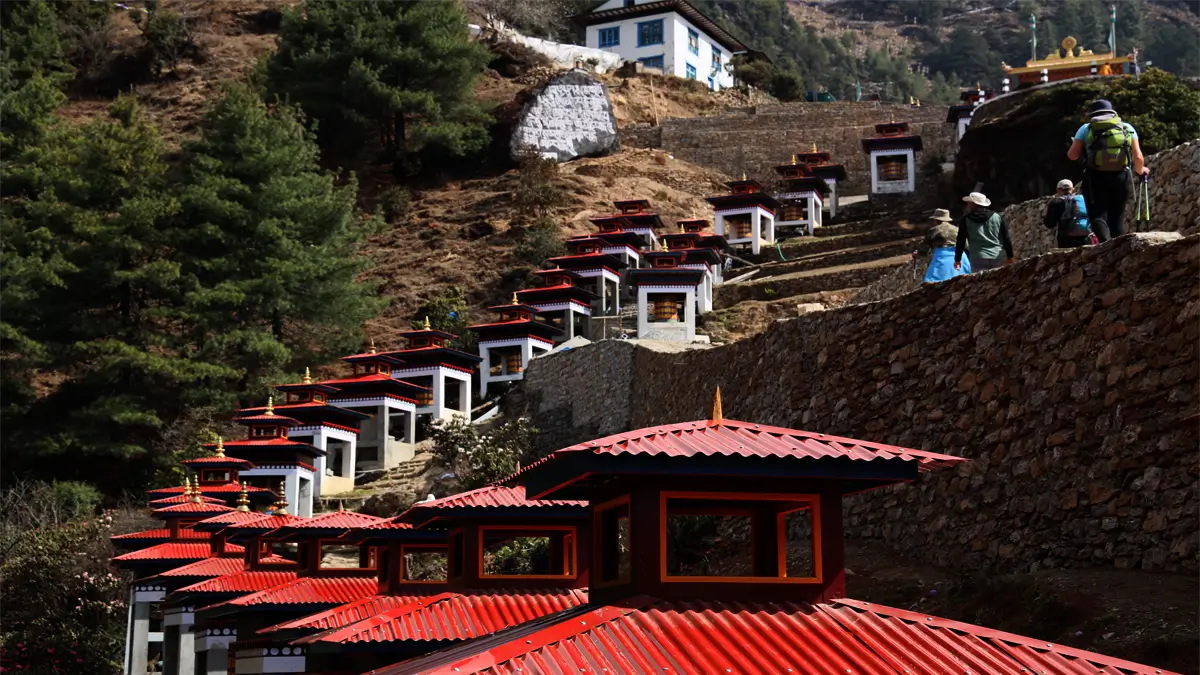
Row of red-roofed prayer wheel shrines climbing a hillside in Junbesi
Visiting Junbesi
The best seasons to visit are spring (April to June), when the rhododendron forests blaze with color, and autumn (September to October), when the festivals are in full swing, and the skies are clearest for mountain views. Most visitors arrive either by flying from Kathmandu to Phaplu (around 45 minutes) and then driving and walking on to Junbesi, or via the longer overland route by bus or jeep, or on foot along the historic trail from Jiri.
However you arrive, Junbesi offers something increasingly rare: an authentic, living Sherpa village, rich in history and faith, set in a valley so beautiful that the moon is said to come down to rest in it. Whether you come for the monasteries, the mountain views, the orchards, or simply the quiet, the Valley of the Moon will not disappoint.
Kishwor Adhikari is a passionate writer with a deep enthusiasm for trekking and adventure. His extensive travels across Nepal, exploring its diverse landscapes and hidden corners, have shaped his unique perspective on the country's natural beauty. With a wealth of first-hand experience in adventure trekking, Kishwor has become a trusted voice for fellow enthusiasts. Through his writing, he shares invaluable insights, offering practical advice and inspiration for both seasoned trekkers and novices alike. His dedication to sharing his journey and knowledge helps others discover the wonders of Nepal's wilderness, making his work an essential resource for anyone seeking adventure in the region.