Badal Danda on the Mardi Himal Trek gave me a lifelong memory that I love to share with a smile and joy. There's this exact moment, somewhere between pulling on your third layer of thermals and convincing yourself the cold is temporary, when you seriously wonder if a sunrise is worth this much suffering. Further, the wind was cutting sideways off the ridge, while my fingers had already given up functioning properly. And guess what, my headlamp was doing that pathetic flicker thing, which suggests the battery is staging a protest.
And then the sky changed. Not slowly. Not gently. But it went from deep navy to the kind of electric orange that doesn't look real. Suddenly, Machhapuchhre, that impossibly sharp fishtail peak, was glowing. Actually, it was glowing, like someone had lit a fire inside 6,997 metres of ancient rock. I forgot about the cold, completely. I stood there with my mouth open like an absolute fool, and I don't regret a single second of it.
This is the story of that morning at Badal Danda on the Mardi Himal Trek. But it's also everything you need to know before you go. In this piece of guide, I will tell you about the altitude, the timing, what to pack, when to leave, and why this particular sunrise, on this particular ridge in Nepal's Annapurna region. It might genuinely be the most underrated mountain experience in the country.
Table of Contents
What Is Badal Danda?
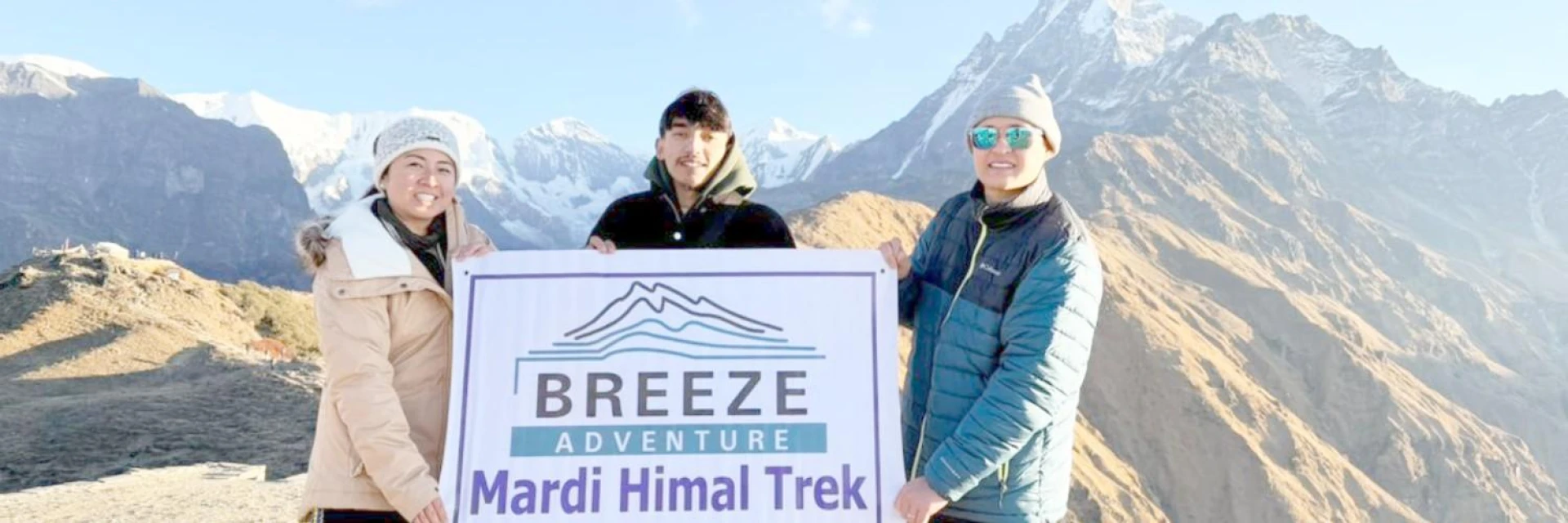
Badal Danda Mardi Himal trek with Breeze Adventure Team
Badal Danda translates from Nepali as "Cloud Hill." And once you're standing on it, the name clicks instantly. You will literally feel like the name makes sense.
Sitting at roughly 3,210 to 3,250 metres (approximately 10,530-10,660 feet) above sea level, Badal Danda appears stunningly beautiful. There, I saw valley clouds that hadn't yet risen to disturb me. But I was high enough to look down on them. On a clear morning, the thick white mass sitting below the ridge looks exactly like a sea.
It's also called Middle Camp along some trekking routes, positioned between Low Camp below and High Camp above. But "Middle Camp" is a boring name for a place this dramatic. Badal Danda, Cloud Hill, is far more honest. You will also feel the same once you are in this location.
Interestingly, this spot is a key waypoint on the Mardi Himal Base Camp Trek. It is a route that officially opened to trekkers in 2012 and has quietly been gaining a reputation as one of Nepal's best short treks ever since. The journey starts from Pokhara, pushes through rhododendron and oak forests, and eventually climbs the exposed spine of a ridge with nothing between you and the Annapurna massif but cold air and altitude.
Badal Danda is where the forest ends. Not just that, there will be the trees thin out, the vegetation surrenders to mosses and lichen, and the world suddenly opens up in every direction. Isn’t this amazing?
Getting to Badal Danda- The Trek Overview
Before I get to the sunrise itself, here is some context on how you actually reach Badal Danda, because the approach matters.
The Mardi Himal Trek Nepal typically takes 4 to 7 days. Mostly depending on the route you choose and how many days you want to acclimatise properly. Most people start from Kande, a small village roughly an hour's drive from Pokhara. From Kande, the trail passes through Australian Camp, Pitam Deurali, and then into the deep Forest Camp zone.
The basic route looks like this:
Pokhara to Kande (drive, about 1 hour)
Kande to Forest Camp (2,500m / Day 1, around 5–6 hours of trekking)
Forest Camp to Low Camp - Badal Danda -High Camp (Day 2, tough day, around 6–7 hours)
High Camp to Mardi Himal Viewpoint / Base Camp - Back to Badal Danda (Day 3, starting pre-sunrise)
Badal Danda to Siding Village - Pokhara (Day 4, descent and drive)
The day you arrive at Badal Danda for lunch, rest a bit, and continue to High Camp- that's the day everything escalates. The forest is gone. The ridge narrows. And the views go from "nice" to "stop walking and just stare" in the space of a few hundred steps.
High Camp, at around 3,580-3,600 metres, is where you sleep before the sunrise mission. But the reason many trekkers return to Badal Danda afterwards, and some even choose to stay there instead, is because of Badal Danda's own sunrise view. Also, its position as a wide, open vantage platform is something special in its own right.
What is the time for the Sunrise at Badal Danda?
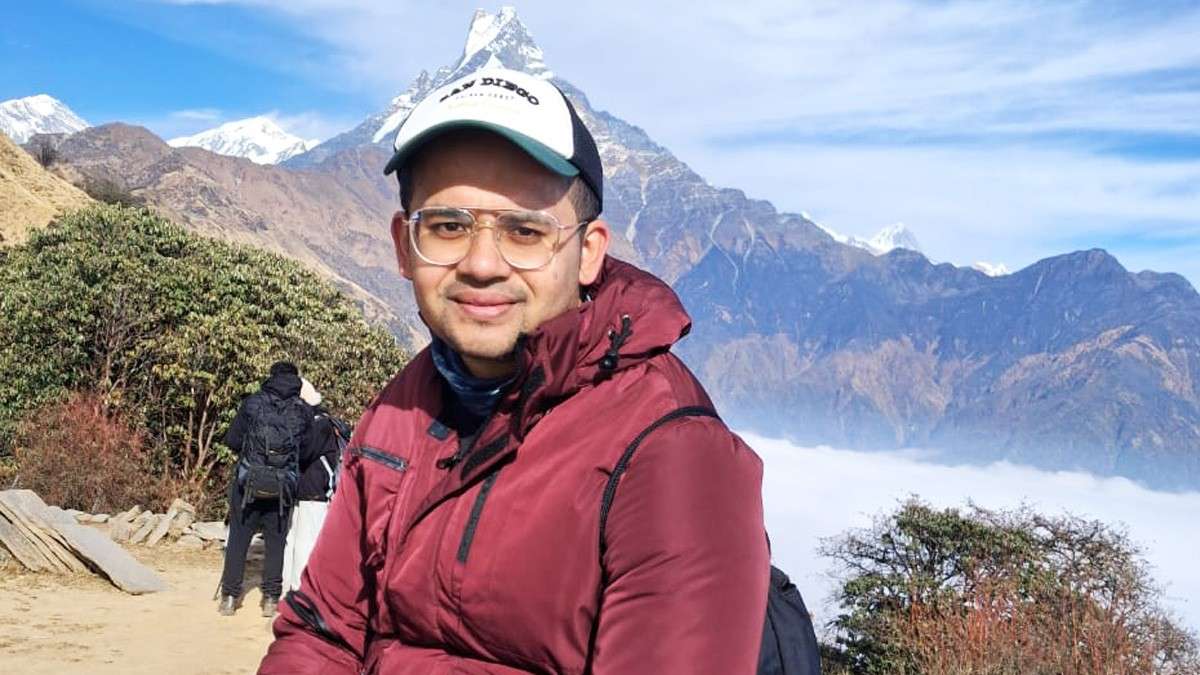
Soothing feeling on Badal Danda Sunrise Trek
This is probably the question that pops up in your mind. Well, I will brief you on this based on my experience.
Sunrise time at Badal Danda varies by season. Located at an altitude of around 3210- 3,250 metres in Nepal's Annapurna Conservation Area at roughly 28°N latitude, here's a practical breakdown:
Season
Approximate Sunrise Time at Badal Danda
Spring (March–May)
5:45 AM – 6:15 AM
Pre-monsoon / Early Summer (June)
5:15 AM – 5:30 AM
Autumn (September–November)
6:00 AM – 6:30 AM
Winter (December–February)
6:45 AM – 7:00 AM
Important: These are approximate times for when first light hits the peaks. The full golden sunrise, that burning orange moment when Machhapuchhre and Annapurna South are fully lit, happens 15 to 30 minutes after the initial glow begins. So, it is better to plan accordingly.
Most experienced guides advise departing High Camp for the Upper Viewpoint (4,200 m) or Mardi Himal Base Camp between 3:30 AM and 4:30 AM. This puts you in a ready position before the light arrives. The walk from High Camp to the viewpoint takes 2 to 3 hours along a dark, rocky, narrow ridge, headlamp is mandatory here.
Further, the best seasons for a clear sunrise view are October–November (crystal skies after monsoon clears) and March–April (rhododendrons in full bloom below, stable morning skies). I went in late October when the sky was absolutely faultless. You can definitely consider the best time for the Mardi Himal Trek Nepal, even for targeting Badal Danda. After all, both are part of the same journey.
What You Actually See from Badal Danda?
Let me be specific, because "amazing Himalayan views" is a phrase that means nothing anymore. Here's what's actually visible from Badal Danda on a clear morning, and why it matters:
Machhapuchhre (Fishtail Mountain) — This peak at 6,997 m is the showstopper. At sunrise, the fishtail shape catches light from the east in a way that seems almost deliberate, one spire lit, one in shadow. Do you know that this mountain is sacred to local Hindus? This is the reason why Machhapuchhre has never been summited. You can just watch it. And at dawn from Badal Danda, it feels like it's watching you.
Annapurna South —The lovely Annapurna South at 7,219 m is broader and more massive than Machhapuchhre. At sunrise, it goes pink before anything else, then burns gold, then settles into blinding white as the sun fully rises. From Badal Danda, you're on the same ridge, at the same height, looking at it almost horizontally. Here, you will get to see the unforgettable beauty of Annapurna, making it further about Annapurna Base Camp vs Mardi Himal Trek in Nepal.
Mardi Himal — This mountain at 5,587m is the trek's namesake peak. Even at such a height, it doesn't feel "small" from Badal Danda, but next to Machhapuchhre, it's the quieter presence. Classified by the Nepalese government as a trekking peak, Mardi Himal rises close and is accessible. And watching dawn break across its snow-covered face from the ridge below is the kind of thing you'd describe as unbelievable
Annapurna I — This massive peak at 8,091m appears as the highest peak in the Annapurna range in the distance. One of the world's 14 eight-thousanders, and this view looks stunning on clear morning days. At that distance, it feels like a rumour more than a mountain. There you will see a white smudge above everything else, enormous even from far away.
Hiunchuli - 6,441m and Gangapurna - 7,454m are additional peaks visible depending on clarity and your exact position on the ridge.
And then there's the cloud sea below.
When morning light hits, and the valley clouds haven't yet lifted, the view looking downward from Badal Danda is almost more striking than looking up. A blanket of white, perfectly flat, stretching in every direction below the ridge, broken only by occasional dark hilltops poking through. You're floating above the weather. Above the noise. Above everything.
The Night Before the Sunrise in Badal Danda
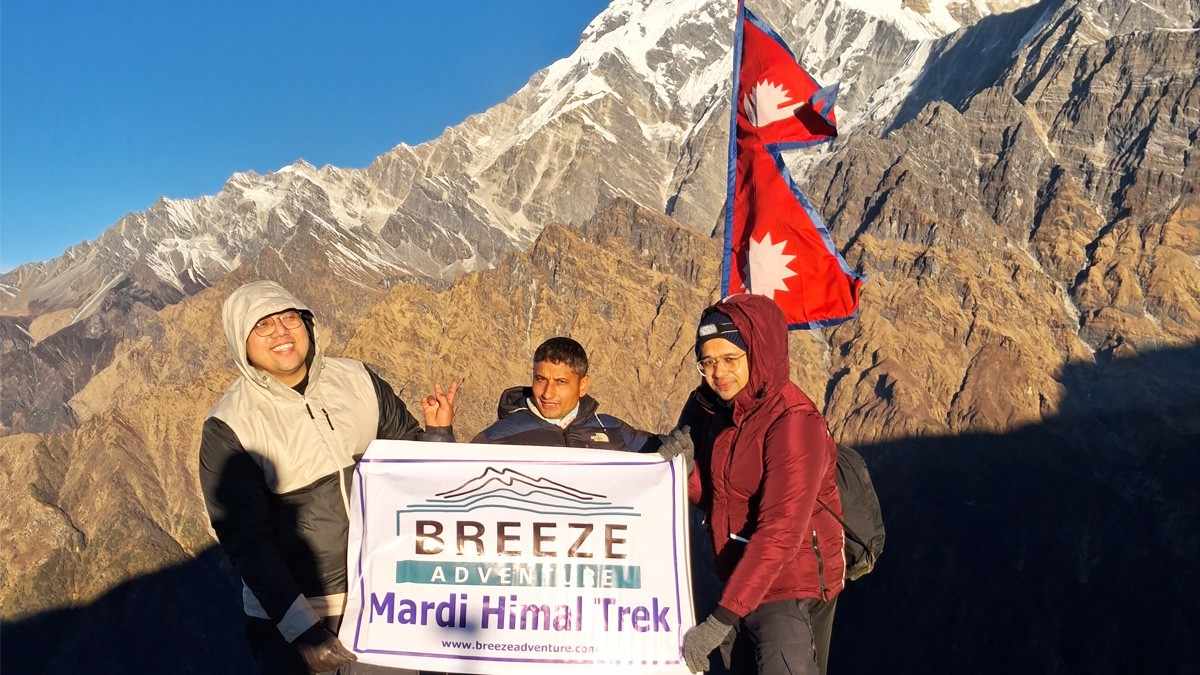
Breeze Adventure Team in Badal Danda Mardi Himal Trek
Here's the part the itinerary descriptions leave out. Nobody warns you about this, so consider this wisely.
You sleep at High Camp the night before. The teahouses there are basic, with thin walls, shared facilities, the smell of yak wool and kerosene. Similarly, the beds are serviceable, but the temperature is not.
At 3,580 metres in October, nighttime temperatures can drop to -5°C or lower. In December or January? Much colder. The wind across that exposed ridge isn't polite about it either. It doesn't gradually cool you down. It finds every gap in your layers and goes straight for your core.
So, it is better to bring a proper sleeping bag rated to at least -10°C. Don't assume the teahouse blankets will be enough. They often aren't. You can rent sleeping bags in Pokhara (around USD 1–1.50 per day), but check the condition carefully.
Your guide will typically brief you the evening before departure. Set two alarms. Put your headlamp where you can reach it in the dark without excavating your bag. Lay out your warmest clothes at the foot of the bed. Don’t forget to charge your camera. Kindly drink extra water to avoid altitude headaches peak overnight, not during daytime exertion.
Then try to sleep while excitement and cold compete for your attention.
The Walk to the Viewpoint- 4 AM in the Dark
I left High Camp at 4:15 AM with my team. It was very, very dark.
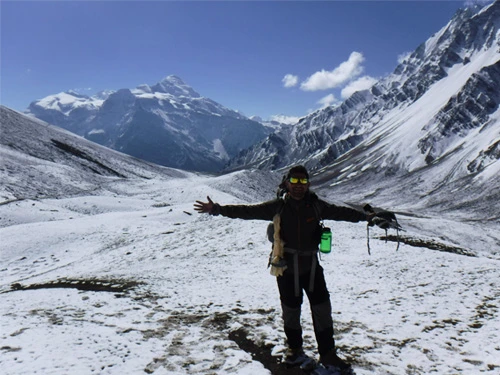
The trail from High Camp to the Upper Viewpoint (4,200m) and Mardi Himal Base Camp (4,500m) follows the ridge's narrow spine. The path is well-marked, but in headlamp light, everything often looks the same: dark rock, frozen ground, prayer flags that whip in the wind like they're trying to warn you off. On one side: the valley, far below, invisible in the dark. On the other: more mountains, more darkness.
Some trekkers moved fast. The rest of us moved less fast. The altitude by this point was doing that thing where you walk at 70% of what feels like a normal pace, and your lungs still have opinions about it. The thin air at 3,600+ metres is noticeable. Not dangerous at this level if you've ascended properly over previous days, but very much there. Still, you need to have an idea about the Mardi Himal Difficulty level for beginners.
We stopped at the Upper Viewpoint just as the sky shifted. Tiny first. A warmth at the horizon that shouldn't have been there. Then the peaks emerged from the darkness, not dramatically, but gradually, like shapes becoming solid from nothing.
The German with the camera started shooting immediately. The Korean couple held hands and went completely silent. I just stood there. And then Machhapuchhre turned gold.
Coming Back Down to Badal Danda
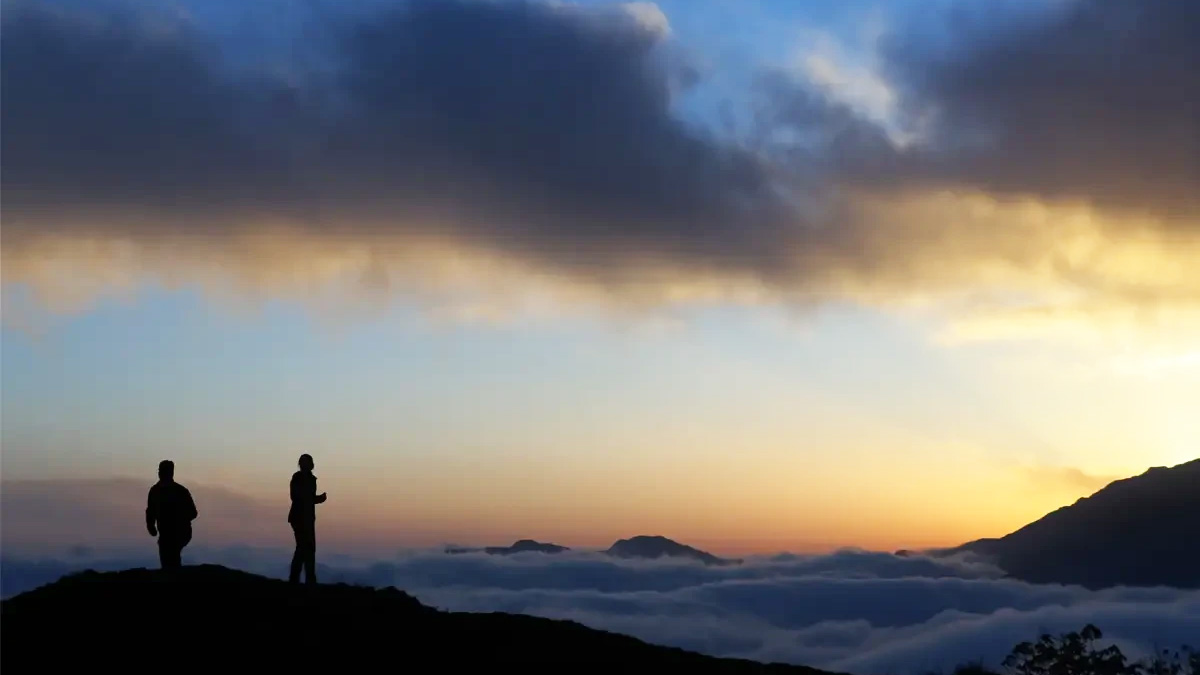
Amazing Sunset view in Badal Danda Mardi Himal Trek Nepal
After the sun was fully up and the mountains had settled from impossible gold back into permanent white, we made our way back. Past High Camp for breakfast, and then the long, knee-testing descent toward Badal Danda.
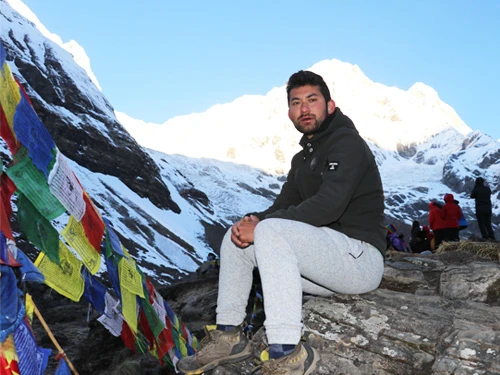
Coming into Badal Danda from above is a different experience from arriving from below. You see the full geometry of the place, the ridge dropping away on both sides, the thin cluster of teahouses that look almost absurd in their setting. Similarly, the prayer flags strung between them, and below, still, that sea of cloud in the valley.
I sat on a stone wall outside the teahouse and had the best cup of instant coffee I have ever tasted in my life. I'm aware that's partly altitude and partly the specific delirium of having been awake since 4 AM, but I stand by it.
Here, Badal Danda on the Mardi Himal Trek Package offers some of the best scenarios that are just incomparable. Moving through such beauty, you get to spend this night in the teahouse. Stargazing is also extraordinary up here. No light pollution. The Milky Way is fully visible on a clear night, not as a faint smudge. It appears as a genuine arch overhead, which you can’t help but love. This is the best chance to experience the Milky Way properly. Badal Danda, after dark, will rearrange your sense of what the sky is capable of.
Why Badal Danda Over Poon Hill?
Fair question, since Poon Hill is Nepal's most famous sunrise viewpoint and gets thousands of visitors.
The answer is simple: Poon Hill is a destination. Badal Danda is an experience.
At Poon Hill Trek, you walk up with a crowd. You watch the sun rise with dozens or hundreds of other people. The views are objectively excellent; nobody disputes that. But it's managed, it's accessible, and it's busy. The infrastructure around it shows.
Whereas, Badal Danda rewards people who've walked for two or three days to reach it. The views are actually closer to Machhapuchhre, closer to Mardi Himal's summit, and closer to the raw mountain terrain. You arrive here tired. You sleep cold and wake in the dark and climb higher still. And when the light comes, it doesn't feel like a tourist experience. It feels like something that happened to you specifically.
What Permits Are Needed For Badal Danda Mardi Trek?
For this trek, you need exactly two permits- the TIMS Card and the ACAP permit. Kindly get both in Pokhara or Kathmandu before heading to the trailhead. Let me remind you that since 2023, Nepal officially requires foreign trekkers to hire a licensed guide in this region.
What are the accommodations on the Badal Danda Trek?
Teahouses at Badal Danda are the major accommodations, which are basic, and that's fine. Small guesthouses line the ridge, and you may get there shared bathrooms. Similarly, thin walls and solar electricity that fades by evening. So, bring a power bank, it earns its weight. The food is simple, mostly dal bhat, noodles, eggs, and tea.
What fitness level is required for this trek?
You don't need to be an athlete, but be honest with yourself. This trek is rated moderate to moderately challenging. No ropes, no crampons, no technical skills needed. What it does ask for is basic fitness and five to six hours of walking per day on steep, uneven ground across several days.
What is the best time for this journey?
October, November, March, and April are your windows. October and November deliver the sharpest skies, with visibility stretching dozens of kilometres on clear mornings. Similarly, Spring -March and April bring warmer days and rhododendron forests turning red and pink below the treeline.
A Few Final Notes from Someone Who's Been There
One thing I wish someone had told me: the cold is not metaphorical. People say "it gets cold up there" in the same casual tone they'd say "it might rain." It won't rain. At 3,600 metres at 4 AM in October, you will be cold in a way that requires genuine preparation. So, prepare genuinely.
Second thing, just give yourself an extra day. Most short itineraries do Mardi Himal in 4 days. Five days lets you move slower, acclimatise better, and not rush past Badal Danda on your way somewhere else. The ridge deserves a morning. Give it one.
Third thing: talk to your guide the night before. Not just about departure time. About the route, the weather, and whether to push to base camp or stop at the Upper Viewpoint. Mardi Himal weather by month varies, and having an idea about this definitely makes your journey smooth.
The Bottom Line
Badal Danda at sunrise on the Mardi Himal Trek Nepal is not the most famous sunrise in Nepal. It's not the most heavily photographed either. You won't find a gift shop at the top selling branded photos of the moment.
What you'll find instead is a narrow ridge at over 3,200 metres, a handful of prayer flags fighting the wind, mountains that fill the entire horizon, and a sky that does something in the minutes before and after dawn that no photograph has ever quite captured correctly.
I've tried. The mountains don't fully translate. You have to go. Enjoy this thrilling sunrise moment, whether you are an adventure lover or a nature lover. You will have the best of it in most of the seasons.
Kishwor Adhikari is a passionate writer with a deep enthusiasm for trekking and adventure. His extensive travels across Nepal, exploring its diverse landscapes and hidden corners, have shaped his unique perspective on the country's natural beauty. With a wealth of first-hand experience in adventure trekking, Kishwor has become a trusted voice for fellow enthusiasts. Through his writing, he shares invaluable insights, offering practical advice and inspiration for both seasoned trekkers and novices alike. His dedication to sharing his journey and knowledge helps others discover the wonders of Nepal's wilderness, making his work an essential resource for anyone seeking adventure in the region.