Ask ten people who've trekked in Nepal which route they'd send a first-timer on, and most of them will say Annapurna Base Camp before you finish the question. It outsells Everest Base Camp in some seasons, fills lodges months in advance during October, and shows up on more "best trek in the world" lists than any other route in the country.
The reasons aren't accidental. ABC sits in a sweet spot that almost no other Himalayan trek manages to hit. And once you break down what trekkers actually want from a Nepal trip, the popularity stops look mysterious. Even with growing altitude and growing difficulties, the Annapurna Sanctuary and stunning local views are worth every step you take forward.
This guide gives a clear picture of why the Annapurna Base Camp trek is the number one trekking adventure in Nepal.
Table of Contents
Why is the Annapurna Base Camp Trek the most preferred choice in Nepal?
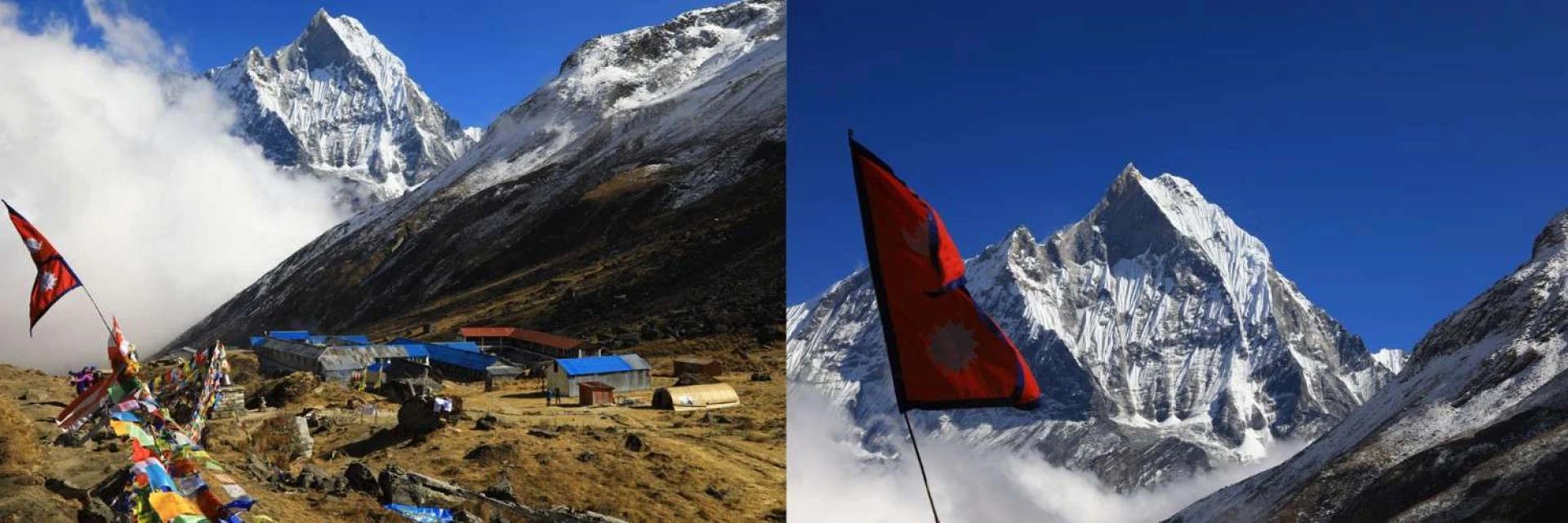
Himalayan beauty captured in Annapurna Base Camp
Annapurna Base Camp Trek in Nepal is not just about adventure and snow-capped mountains, actually, it combines thrill, natural beauty, with local culture and tremendous hospitality. This is an absolute treat for your exhausted mind and soul. Here’s why this trip is the #1 adventure in Nepal:
You reach a real Himalayan amphitheatre in under a week of walking
This is the single biggest reason, and most articles bury it. On day five or six of walking from Nayapul or Jhinu, you stand at 4,130 metres inside a glacial basin ringed by Annapurna I (8,091 m), Annapurna South, Hiunchuli, Gangapurna, Annapurna III, and Machhapuchhre. The peaks form a near-complete 360-degree wall around you.
Everest Base Camp, by comparison, doesn't actually give you a view of Everest from base camp itself, you have to climb Kala Patthar the next morning for that. But ABC delivers the postcard the moment you arrive. For travellers with two weeks of total holiday including flights, that ratio of effort to payoff is unbeaten in Nepal.
The altitude is high enough to feel earned, low enough to be safe
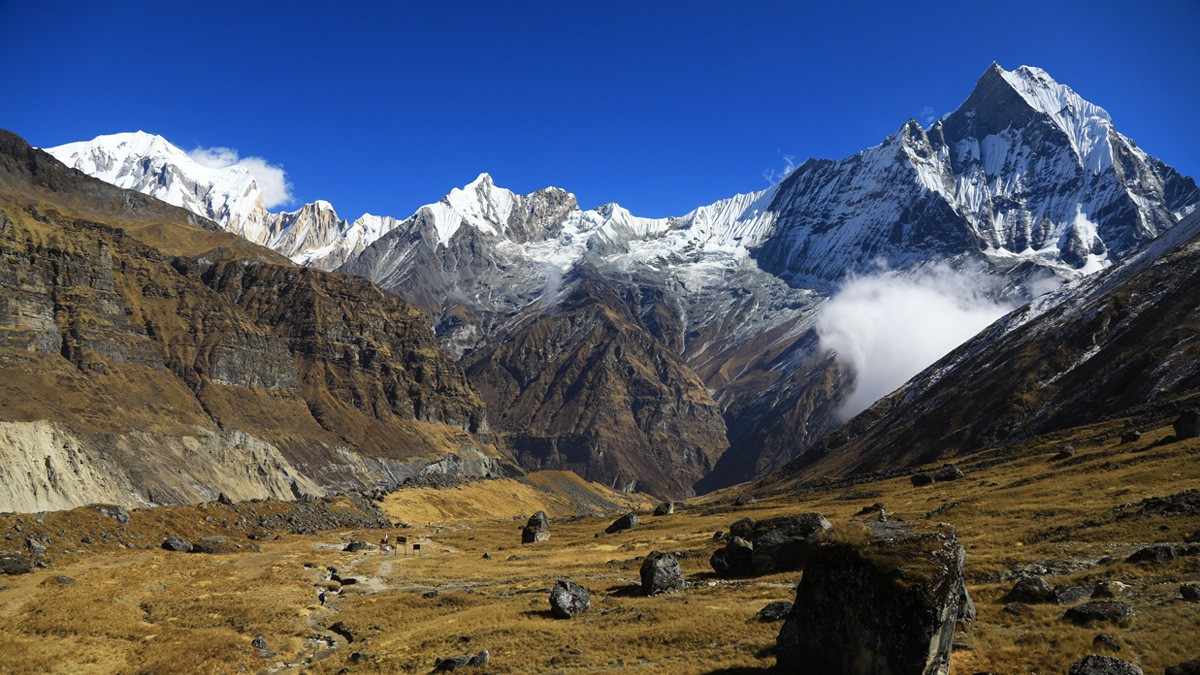
Unique Topography representing ABC Trek altitude and rugged paths
ABC tops out at 4,130 m. Everest Base Camp tops out at 5,364 m, and Kala Patthar at 5,545 m. That difference matters more than it sounds. Above roughly 4,500 m, the risk of acute mountain sickness rises sharply, and a meaningful number of EBC trekkers turn back, get evacuated, or finish the trek miserably.
Meanwhile, ABC sits below that threshold, which means most reasonably fit people without prior altitude experience can complete it without serious AMS. However, the itinerary should include a proper Chhomrong acclimatisation pattern. It's high-altitude bragging rights without the lottery of how your body will react.
ABC Trek works in a tight calendar
Most international trekkers have ten to fourteen days in Nepal, flights included. ABC trekking fits cleanly into that window. The standard itinerary runs 5 to 8 days on the trail, and there are legitimate 4- and 6-day versions starting from Jhinu by jeep for trekkers genuinely short on time.
EBC needs 8 to 12 days minimum once you factor in the Lukla flight and acclimatisation days, and weather buffers. Manaslu Circuit needs 12 to 14 days. Upper Mustang needs special permits and at least 10. So, Annapurna Base Camp is the only major Nepal trek that fits inside a standard two-week vacation with room left for the Kathmandu Valley Tour and Pokhara.
Trek
Trail Days
Max Altitude
Permit Cost (foreigner)
Annapurna Base Camp
5-8
4130 m
ACAP + permit ~NPR 5,000
Everest Base Camp
8-12
5545 m
Sagarmatha + permits ~NPR 5,000
Manaslu Circuit
12-14
5106 m
Restricted area, ~USD 100+
Langtang Valley
6-11
4984 m
LNP + permit ~NPR 5,000
Upper Mustang
10-14
3840 m
Restricted, USD 500/10 days
No domestic flight required
This Annapurna Tour is underrated. Everest Base Camp requires the Lukla flight, which can be cancelled for days at a stretch due to weather. Trekkers routinely lose two or three days of their trip waiting it out, and some miss their international flights home.
Whereas, ABC trekking starts with a road journey from Pokhara to Nayapul, Jhinu, or Siwai. The road is bumpy but reliable. You don't gamble your holiday on a cloud ceiling over a hillside runway.
The ABC Trek scenery actually changes every day
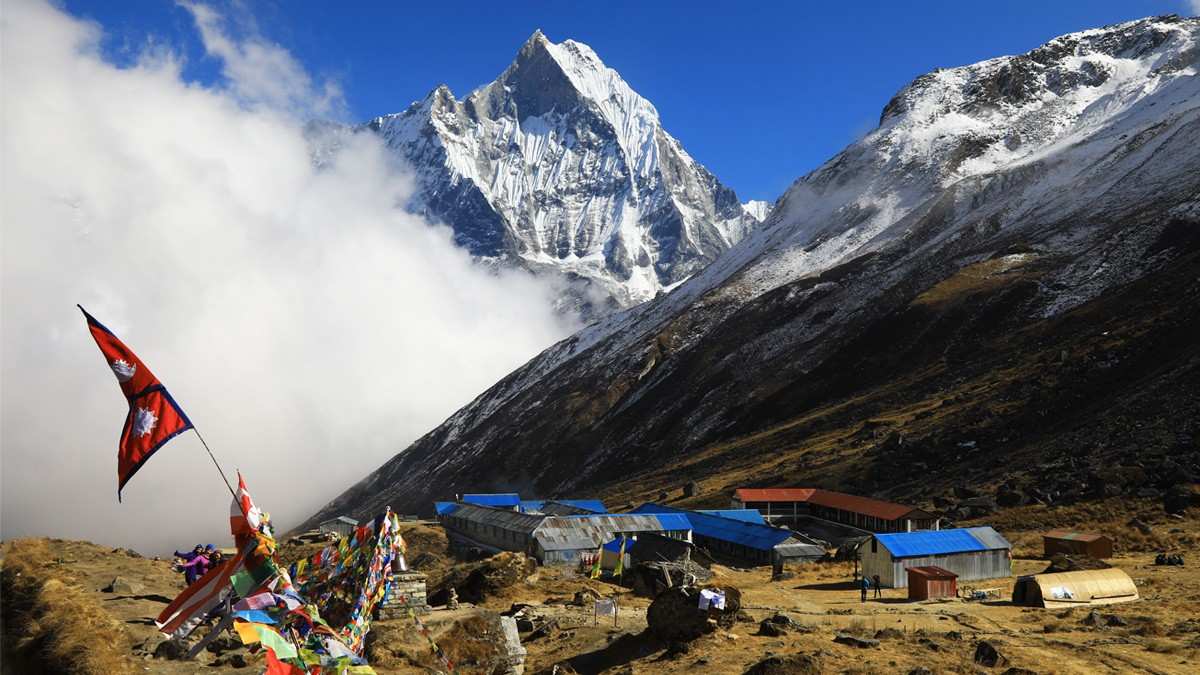
Beautiful scenary in Annapurna Base Camp Nepal
Here are the major highlights of scenery in the Annapurna Base Camp Trekking, which draws thousands of people every year:
In under 1 week, you crash through 5 entirely different worlds, rocketing from 1,020 meters to a dizzying 4,130 meters in just a few days.
You kick off in a subtropical jungle among terraced rice paddies, banana trees, and water buffaloes before ending up surrounded by solid ice.
You plunge into the Modi Khola gorge, a sheer-sided canyon so deep and narrow it acts as its own hyper-isolated, dripping microclimate.
You will march through the world’s largest rhododendron forests, which explode into surreal canopy walls of crimson, pink, and white every spring.
The trail cuts directly through dense, eerie bamboo groves where the endangered Red Panda and elusive Himalayan Black Bear actually roam.
Not just that, you witness an abrupt, dramatic ecotone shift as towering oak and bamboo instantly die out. Literally giving way to raw, wind-swept alpine meadows.
The Annapurna Sanctuary acts as a massive natural amphitheater, locking you inside a seamless, 360-degree wall of ten towering peaks over 6,000 meters high.
Unlike the dusty, monochrome high deserts of Mustang, your eyes are constantly bombarded by contrasting neon-green moss and blinding white glaciers.
You skip the endless, bone-dry scree fields of the Upper Khumbu Route, replacing them with roaring waterfalls and active glacial melt rivers.
You literally feel the atmosphere warp on your bare skin, moving from humid, sweat-drenched tropics to sub-zero Arctic freeze in a matter of hours.
All these things make the Annapurna Base Camp Trek, Nepal’s most popular trek. You will cherish every moment you spent in this trail.
The ABC trail infrastructure is genuinely good
Teahouses on the ABC route have hot showers (mostly gas-heated, paid extra above Chhomrong), reasonably consistent menus, charging points, and Wi-Fi in most lodges up to MBC. Trails are stone-paved or well-graded for most of the route. There are official ACAP checkpoints.
Helicopter evacuation from the sanctuary is straightforward if needed. This isn't wilderness backpacking, it's a developed trekking corridor, which is exactly what most international trekkers want. They want adventure, and they can text their family from.
Pokhara is the pre- and post-trek you didn't know you needed
ABC trek starts and ends in Pokhara, one of the most beautiful cities in Nepal. There you can enjoy a lakeside of cafes, paragliding, lake boats, and mountain views from the breakfast table.
After six days of dal bhat and cold lodges, twelve hours in Pokhara feels like a different country. This bookend matters psychologically more than guidebooks credit it for. It turns the trek into a trip rather than just a hike. This city is one of the factors making ABC the most popular trek in Nepal.
The cost-to-experience ratio is hard to beat
A guided ABC trek typically runs USD 700–1,200 per person, depending on group size and operator, all-in. A budget independent trek (now requiring a licensed guide as of April 2023) can be done for under USD 600, including permits, guide, food, and lodging.
For roughly the cost of a long weekend in most Western cities, you get a week walking through one of the world's great mountain landscapes. So, trekking Annapurna Base Camp is a perfect choice for budget travellers too.
It's genuinely doable for first-timers without lying about it
ABC trek is the right fit for beginners, as it is honestly moderate in difficulty. You walk 5–7 hours a day, much of it on stone steps (the Chhomrong descent and re-ascent is brutal and worth knowing about in advance). You don't need technical skills, ice equipment, or prior altitude experience.
Also, you do need to be able to walk for several consecutive days on uneven terrain with a daypack. Trekkers in their 60s complete it regularly. Children as young as 8 have done it with their families. The trek rewards preparation but doesn't require an expedition CV.
The Gurung villages aren't a sideshow
Ghandruk, Chhomrong, Landruk, and Sinuwa are real working villages, not staged stops. The Gurung community has a long association with the British and Indian Gurkha regiments, and a striking number of households in these villages have a retired Gurkha soldier in them.
The architecture - slate roofs, stone walls, geranium-lined window boxes - is specific to this region. You eat in family kitchens, sleep above someone's living room, and the money you spend stays largely in the village economy through the ACAP system. Not just that, cultural depth on the Annapurna Base Camp trekking is a function of the route, not a brochure phrase.
It scratches the adventure itch without asking you to be a mountaineer
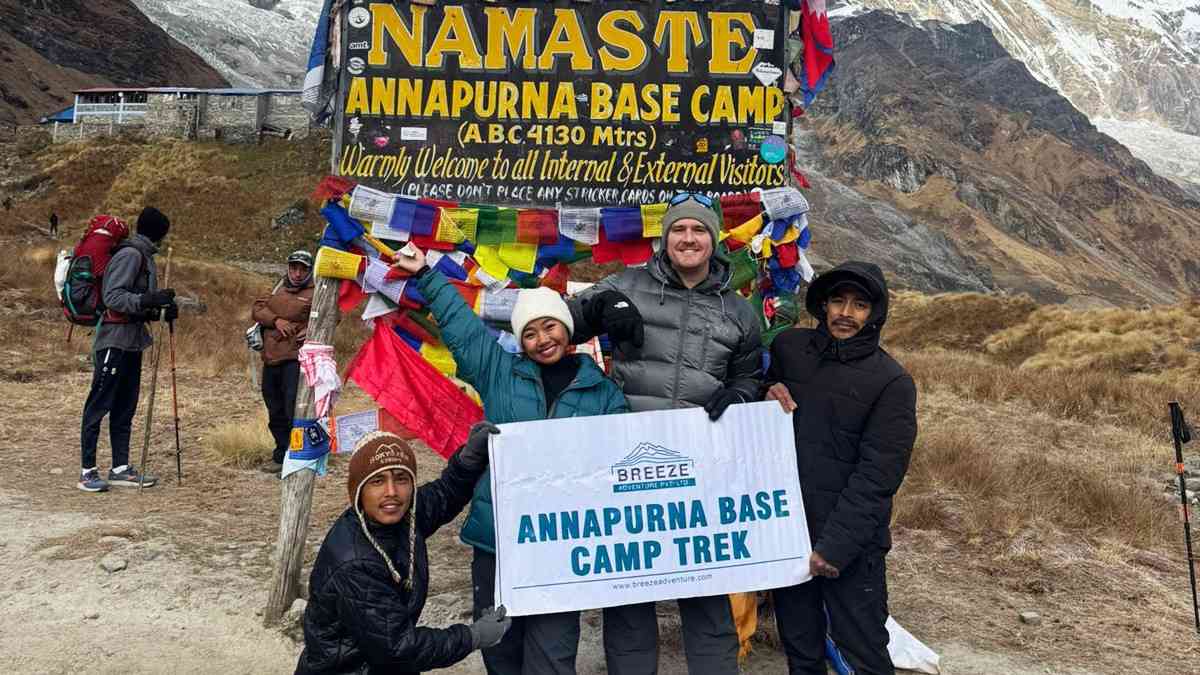
Breeze Adventure Team holding company banner in Annapurna Base Camp
There's a specific kind of adventure most people actually want: the kind they can finish. ABC delivers it. You cross long suspension bridges over the Modi Khola, where the river runs white below you. You climb the Chhomrong stone staircase, which is genuinely punishing and stays in your legs for days.
You walk into a glacial amphitheatre with avalanches occasionally rumbling off the south face of Annapurna I in the distance. Likewise, you wake at 5 am in sub-zero air to watch the first light hit Machhapuchhre. None of this requires ropes, crampons, or technical skill, but none of it feels manufactured either. The trek gives you stories you'll tell at dinner parties for years without ever putting you in a situation you can't handle.
It's one of the few high-altitude treks that genuinely works for families
Family-friendly ABC Trek with kids makes this route the first choice for trekkers. Families with kids between roughly 6 and 14 do ABC every season, and it works because the route is forgiving in ways most Himalayan treks aren't. Daily walking distances are flexible, you can split a stage in two if a child is tired, since teahouses appear every hour or so on most of the lower trail. The altitude stays below the danger zone. Porters can be hired specifically to carry a child's pack, or to carry a tired child if needed.
Food is consistent enough that picky eaters survive on dal bhat, momos, fried potatoes, and pancakes. Lodges have warm dining rooms with wood stoves where kids can do homework or play cards in the evening. And the trek delivers something rare for family travel: a shared physical achievement that the kids will remember for the rest of their lives.
Parents return from this trek talking about it differently than any beach holiday. The family friendliness makes this Annapurna, Nepal’s most popular trek, without a doubt.
Senior trekkers complete it more often than the marketing photos suggest
The trail sees a steady number of trekkers in their 60s and 70s every season, and the trek is built to accommodate them. Yes, the ABC Trek for senior citizens is a popular option. The standard 10-day itinerary can be stretched to 12 or 14 with shorter daily stages and a rest day at Chhomrong or Ghandruk. Porters cost USD 20–25 per day and remove the pack-weight issue entirely. The teahouse infrastructure means no camping, no sleeping pads, no carrying food.
Helicopter evacuation insurance covers the worst case for a fraction of what international travel insurance usually costs. The altitude is the deciding factor for older trekkers, and 4,130 m is meaningfully easier on the cardiovascular system than the 5,000-plus metre Everest, Manaslu, or Three Passes routes. A doctor's clearance and a slow, sensible itinerary opens this trek to people who'd written off Himalayan trekking as something they missed.
ABC is one of the safest Himalayan treks for solo female travellers
This trek attracts a disproportionate number of solo women trekkers, and the reasons are practical. The trail stays busy enough in season that you're rarely alone between groups, the teahouses are family-run with women present in most kitchens, and the mandatory guide rule since 2023 means a solo female trekker walks with a licensed guide by default.
Harassment incidents on this trail are uncommon enough that they don't make the standard safety briefings. And cell signal up to MBC is workable for daily check-ins at home. For women planning a first solo Himalayan trek, this is the route the community keeps pointing to. This is the best option if you are looking for the Safest Female Trekking in Nepal.
The trek works on your head the way a meditation retreat is supposed to
In the Annapurna Base Camp Short Trek, phone signal thins out above Chhomrong and goes quiet above Deurali, which removes the scroll. The day strips down to four decisions, when to wake, what to eat, when to walk, where to stop, and the mental noise you didn't know you were carrying quietly puts itself down by day three or four. Six hours of steady walking with mountains rotating slowly around you produces a meditative state that cushion-meditators spend years chasing.
There will be dinners at six, lodges go silent by eight-thirty, and you sleep ten hours in air clean enough that the sleep itself feels different from city sleep. Most trekkers come down with their priorities quietly rearranged, and the calm lasts weeks after they get home. In this trek, you will literally get Yoga and Spiritual Retreat in Nepal. This will feel longer than a beach holiday, at a fraction of the cost of a retreat.
You leave a slightly different person, and not in a vague way
The personality changes trekkers report from this trek are specific enough to be worth taking seriously. Patience improves, because the trail forces it on you, you can't hurry a 600-metre climb. Risk tolerance recalibrates because you've done something physically uncertain and finished it. Comfort thresholds reset, because you've slept in 4°C rooms and eaten the same meal six nights in a row and discovered you were fine.
Walking 20 kilometres a day for a week teaches the body that it can do more than the desk job had convinced it of, and that lesson is hard to unlearn. Actually, a meaningful percentage of trekkers who finish ABC go on to do harder treks in the following years - Manaslu, EBC, Kanchenjunga - because the trek revealed a capacity they didn't know they had. The trail acts as a kind of audit on what you thought you couldn't do.
It introduces you to a part of the world you'll keep coming back to
This is the quiet reason ABC trekking is popular that nobody puts in a blog post. Most trekkers who complete it return to Nepal. The trek is short enough and approachable enough that it functions as an introduction rather than a culmination. You finish it knowing the rhythm of a Nepali trek, the teahouse system, the basics of Nepali greetings, the geography of the central Himalayas, and the names of half a dozen mountains that were abstract before.
The next trip plans itself -Mardi Himal, Mustang, Manaslu, Langtang, and Everest. Nepal's tourism economy is partially built on the fact that ABC turns first-time trekkers into repeat trekkers, and the country has more routes than any single lifetime can finish. People come back. That's not an accident of marketing; it's a function of the trek itself.
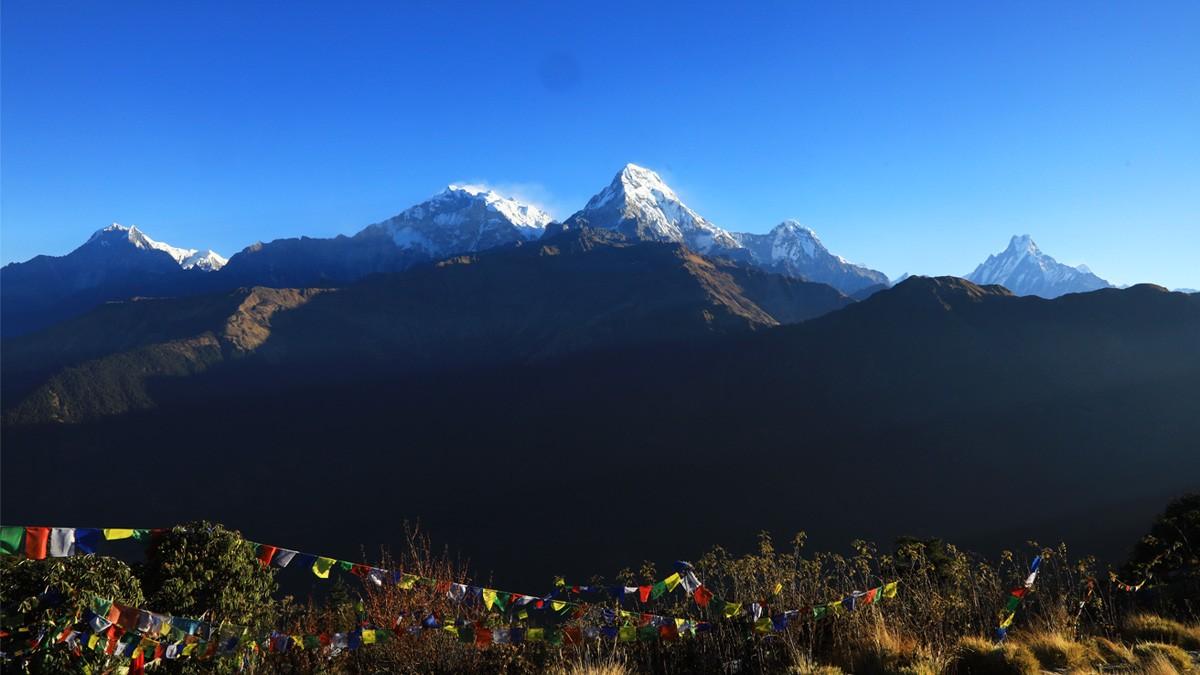
You can see it at sunrise from Poon Hill if you tack on two days
The Ghorepani–Poon Hill Trek extension adds 2–3 days and gives you the single most photographed Himalayan sunrise in Nepal. It’s a 200-kilometre panorama from Dhaulagiri through the Annapurnas to Manaslu.
Many trekkers combine the two, doing ABC via Ghorepani on the way in. It's the highest concentration of "iconic Nepal photos" you can collect in one trip.
What ABC isn't, so you know what you're choosing
It isn't remote. In October and April you'll share the trail with hundreds of other trekkers, and the popular teahouses fill up by 2 pm. It isn't a wilderness experience. It isn't the place to go if you want solitude or unscripted exploration - Manaslu, Kanchenjunga, or Tsum Valley are better for that. It also isn't a technical challenge; experienced mountaineers sometimes find it underwhelming as a physical test.
Let me tell you, ABC hiking is popular precisely because it isn't trying to be those things. It's optimised for the trekker who wants the Himalayas, the culture, and the photographs without a three-week commitment or a high-altitude gamble.
When to do the Annapurna Base Camp Trekking
Talking about the Best Time for the Annapurna Base Camp Trek, October to early December and March to May are the two reliable windows. October has the cleanest mountain views and the heaviest crowds. April brings rhododendrons in bloom - entire hillsides go red and pink.
Due to global warming effects, December and January are not as cold as they used to be a few years back. This can be the best time if you want a snow-covered route and quiet atmosphere, with avalanche risk in the upper sanctuary.
June to September is monsoon with leeches, landslides, and blocked views. This is mostly for experienced trekkers.
FAQ
How difficult is the Annapurna Base Camp trek for beginners?
It’s moderate in difficulty for beginners. No technical skill required, but you need to be comfortable walking 5–7 hours daily on stone steps and uneven trails for a week. The right guidance and proper preparation will be a great help in dealing with difficulties.
Do I need a guide for ABC in 2026?
Yes, you absolutely need a guide for the Annapurna Base Camp Trek. Since April 2023, the Nepal Tourism Board has required all foreign trekkers in national parks and conservation areas to be accompanied by a licensed guide. Solo independent trekking is no longer permitted on ABC, citing safety and illusion.
How much does the ABC outing cost now?
Guided packages range from USD 600 to USD 1,500 depending on duration, group size, and operator. Permits (ACAP and TIMS) come to roughly NPR 5,000 combined. Add personal expenses for charging, Wi-Fi, hot showers, and bottled water - figure another USD 10–20 per day on the trail.
What's the difference between ABC and the Annapurna Circuit?
ABC hiking is a 4–12 day in-and-out trek to a base camp at 4,130 m. The Annapurna Circuit is an 8–12 day loop around the entire massif, crossing Thorong La Pass at 5,416 m. ABC is shorter and lower; while the Circuit is longer, higher, and more varied in terrain.
Can I do ABC without prior trekking experience?
Yes, with honest fitness preparation. Most trekkers on the route are doing their first multi-day trek. Prior hiking experience helps, but it isn't a prerequisite.
Is altitude sickness a risk on ABC?
Mild symptoms (headache, sleep disturbance) are common above 3,000 m. Serious AMS is uncommon if the itinerary includes proper acclimatisation around Chhomrong and Deurali. The 4,130 m maximum is well below the high-risk threshold.
Where does the ABC trek start and end?
Most itineraries start from Pokhara with a road transfer to Nayapul, Jhinu Danda, or Siwai, and end back in Pokhara via Jhinu or Ghandruk. No domestic flight is required.
What's the best month for ABC Trekking Nepal?
October for clearest views, April for rhododendrons in bloom, late November and March for fewer crowds with still-reliable weather.
Kishwor Adhikari is a passionate writer with a deep enthusiasm for trekking and adventure. His extensive travels across Nepal, exploring its diverse landscapes and hidden corners, have shaped his unique perspective on the country's natural beauty. With a wealth of first-hand experience in adventure trekking, Kishwor has become a trusted voice for fellow enthusiasts. Through his writing, he shares invaluable insights, offering practical advice and inspiration for both seasoned trekkers and novices alike. His dedication to sharing his journey and knowledge helps others discover the wonders of Nepal's wilderness, making his work an essential resource for anyone seeking adventure in the region.